
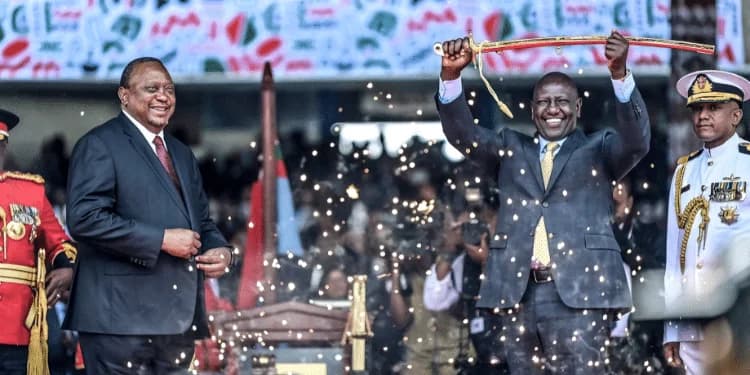
When the Independent Electoral and Boundaries Commission (IEBC) warns that it may be unable to conduct the 2027 General Election because the country has become a “toxic environment,” every Kenyan should stop and ask one simple question: Who made it toxic? That question is not political. It is constitutional.
Violence does not appear by accident. Political intimidation does not emerge spontaneously. Democratic space does not shrink on its own.
If political rallies are disrupted by organized gangs, if citizens are assaulted for attending opposition meetings, if police officers appear to enforce the law selectively, and if fear increasingly replaces political freedom, then the country deserves to know who is responsible.
Without answering that question, any discussion about postponing or frustrating elections risks punishing the victims instead of those creating the problem.
Kenya’s Constitution does not make elections optional. It does not state that elections will be held only when the political environment is comfortable or when those in power feel secure.
The Constitution fixes the electoral calendar because sovereignty belongs to the people, not to the government of the day.
Article 1 declares that all sovereign power belongs to the people of Kenya. Article 38 guarantees every citizen the right to participate in free, fair and regular elections.
Those provisions are not ceremonial declarations. They are the foundation upon which Kenya’s constitutional democracy rests.
Elections Give Kenyans the Opportunity to Exercise Their Democratic Right
August 10, 2027, is therefore not merely another election date. It is the day when millions of Kenyans exercise the sovereign authority that no President, no political party, and no state institution possesses the constitutional power to take away.
The IEBC exists to facilitate that constitutional moment, not to cast doubt upon it. This is why the Commission’s recent warning should concern every Kenyan, regardless of political affiliation. If the electoral environment has indeed deteriorated, then constitutional institutions must ask why.
Who is sponsoring violence? Who is financing organised disruption? Who benefits when political rallies cannot proceed peacefully? Who benefits when fear replaces democratic competition?
Until those questions are honestly answered, the phrase “toxic environment” risks becoming an excuse instead of a diagnosis. A constitutional democracy cannot allow that.
Imagine the dangerous precedent that would be created. If political actors can generate instability and then use that instability to question whether elections should proceed, violence itself becomes a political strategy.
Every future government facing electoral uncertainty would possess an incentive to tolerate, or even encourage, chaos before claiming that conditions are unsuitable for democratic competition. That would reward lawlessness instead of punishing it.
The constitutional response should be the exact opposite. Where there is violence, enforce the law. Where there is intimidation, protect citizens.
Where there are criminal gangs, investigate, arrest and prosecute those responsible. Where political rights are threatened, defend them.
The answer cannot be to weaken democracy because democracy has come under attack. The answer must be to defend it more vigorously. This is where the National Police Service bears an enormous constitutional responsibility.
The police are not established to protect governments. They are established to protect the Constitution. Every Kenyan, whether supporting the government, the opposition or no political party at all, is entitled to campaign, assemble, associate and express political opinions without fear. The Constitution demands nothing less.
IEBC Responsibility
The IEBC also carries a heavy constitutional obligation. Its responsibility is not simply to announce election dates or print ballot papers.
Its responsibility is to inspire public confidence that every eligible Kenyan will vote freely, every vote will count equally and every candidate will compete on a level constitutional playing field.
Confidence is built by demonstrating independence. Confidence is built by defending constitutional principles. Confidence is not built by appearing to accept the consequences of political violence as inevitable.
Kenya’s democratic history teaches an important lesson. Whenever elections become uncertain, public anxiety grows.
Markets become nervous.
Investors hesitate. Communities become fearful. The economy slows because uncertainty spreads beyond politics into everyday life.
That is precisely why the Constitution deliberately established fixed electoral timelines. It sought to remove uncertainty from presidential succession and place constitutional order above political calculations.
Those gains should never be surrendered lightly. The real danger facing Kenya is not the election itself. The real danger is allowing anyone to believe that elections can be frustrated simply because the political climate has become uncomfortable.
Democracy is not tested during periods of calm. It is tested precisely when political competition becomes intense. If constitutional institutions retreat during those moments, they cease performing the functions for which they were created.
Ultimately, this debate is not about the fortunes of one President, one political party or one coalition. It is about whether the Constitution remains supreme.
If President William Ruto believes the Kenyan people continue to support his leadership, the ballot box offers the strongest possible validation. If he believes otherwise, the Constitution provides the same answer it has always provided. Allow the people to decide. That is the essence of democracy. The election belongs to the people.
The Constitution belongs to the people. The Republic belongs to the people. No institution should allow fear, intimidation or manufactured instability to become the reason Kenyans are denied the opportunity to exercise the sovereign power that the Constitution declares is already theirs.
The proper response to a toxic political environment is not to suspend democracy. It is to defend it with even greater determination.
Follow our WhatsApp Channel and X Account for real-time news updates.



Comments
No comments yet. Be the first to share your thoughts.