
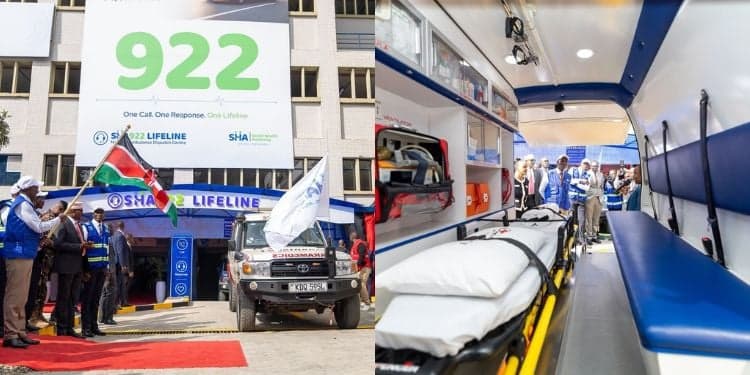
President William Ruto has launched a free emergency medical line that the government says Kenyans can use to request an ambulance and other emergency medical response services.
Speaking on August 6, the government announced that calls to 922 for medical emergencies will now be free across all mobile networks, allowing Kenyans to seek emergency assistance without requiring airtime.
Ruto said the initiative is intended to ensure that the first response during a medical emergency is to save lives rather than determine a patient’s ability to pay.
According to the President, the emergency line will be accessible to all Kenyans regardless of their mobile service provider, improving access to emergency medical services nationwide.
“Calls to 922 will be free across every network and accessible even without airtime.”
How the New Digital Platform Works
In a statement, the Ministry of Health said the new technology-enabled emergency platform will support emergency call management and clinical triage, helping responders assess patients more quickly and dispatch the appropriate care.
The system also includes a point-of-care application that allows ambulance crews to securely transmit patient information to hospitals while en route, enabling healthcare workers to prepare before the patient arrives.
In addition, the platform features a real-time incident management system linked to the National Health Information Exchange, allowing emergency services and receiving health facilities to coordinate patient care more efficiently.
“The technology-enabled platform features emergency call management and clinical triage, a point-of-care application through which ambulance crews can securely transmit patient information while in transit, and a real-time incident management system connected to the National Health Information Exchange. This enables receiving facilities to prepare for patients before they arrive,” the Ministry’s statement read in part.
SHA Contracts 1,243 Ambulance Providers to Expand Response
According to Ruto’s statement, the Social Health Authority (SHA) has contracted 1,243 ambulance and emergency service providers to support the rollout of a coordinated national emergency medical service.
Under the program, ambulance evacuation and the first 24 hours of emergency treatment will be funded through the Emergency, Chronic and Critical Illness Fund at approved tariffs.
This emergency cover will be available to all patients, regardless of whether they are registered with SHA or have made SHA contributions, ensuring access to emergency medical care when needed.
“This protection applies whether a patient is registered with SHA or not, and whether or not they have paid for SHA,” he stated.
200+ Ambulances Join National Emergency Response Network
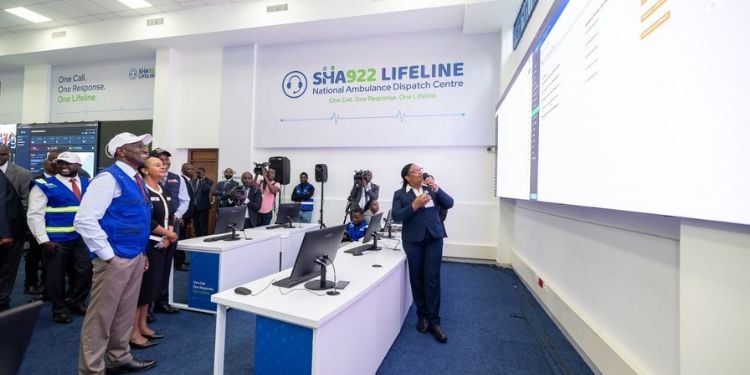
The Ministry of Health said more than 200 ambulances accredited by the Kenya Medical Practitioners and Dentists Council (KMPDC) have already been integrated into the National Ambulance Dispatch Center, with additional public and private providers expected to join the network.
It further highlighted that the operations are supported by 40 trained doctors, medical officers, emergency dispatch officers and customer service personnel, who coordinate emergency responses and patient referrals.
The government also launched seven advanced ambulances equipped for emergency and critical care. The vehicles have been deployed to Nairobi, Wajir, Turkana, Lamu, Mandera, Nyeri and Kapenguria to strengthen emergency medical services.
According to the Ministry of Health, the National Ambulance Dispatch Center is designed to improve emergency response times, referral pathways and coordination of patient care across the country.
Hospitals Risk Losing SHA Contracts for Denying Emergency Patients
The Social Health Authority (SHA), in a statement on August 2, reminded all contracted healthcare providers that emergency medical treatment is a constitutional right and must not be denied, delayed, or withheld because a patient cannot pay.
SHA said hospitals must not refuse emergency care due to a lack of benefit confirmation, inability to pay, or failure to provide a deposit, advance payment or financial guarantee.
According to the authority, the Emergency, Critical and Chronic Illness Fund (ECCIF) will finance eligible emergency treatment for the first 24 hours, after which eligible services will be covered by the Social Health Insurance Fund (SHIF) or other applicable payment arrangements.
Where a healthcare provider is unable to continue managing a patient, the patient must first be stabilized before being referred to an appropriate contracted facility in line with the Ministry of Health referral guidelines.
SHA warned that any contracted provider found denying or delaying emergency treatment could face de-empanelment, termination of its SHA contract and other enforcement action.
Follow our WhatsApp Channel and X Account for real-time news updates.
Comments
No comments yet. Be the first to share your thoughts.