
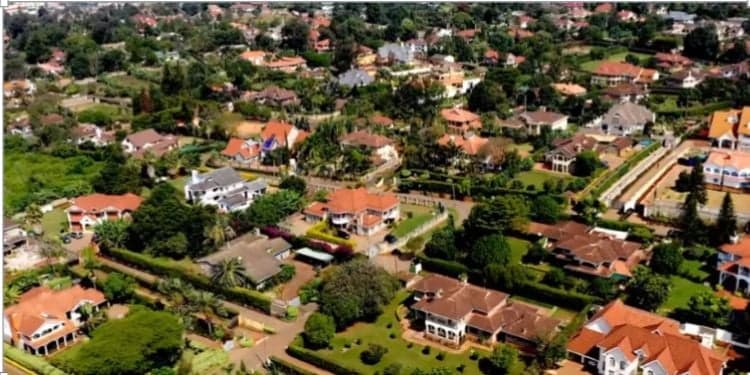
Land buyers are shifting their attention to Langata, Karen, Runda and Nyari, making them Nairobi’s fastest-growing property hotspots in 2026, according to the latest Hass Land Price Index.
The report shows that demand for land strengthened during the second quarter of the year as developers and individual homebuilders turned to comparatively affordable suburbs for detached and semi-detached housing projects.
The renewed activity pushed land prices in Nairobi’s suburbs up by 1.4 per cent, compared to 0.8 per cent in the previous quarter.
According to HassConsult, the rebound was largely driven by the publication of the Nairobi City County Development Control Policy 2026, which addressed uncertainties surrounding planning approvals that had previously caused many developers to delay new projects.
As confidence returned to the market, buyers resumed acquisitions, particularly in suburbs offering relatively lower land acquisition costs.
Langata, Karen, Runda and Nyari Led Nairobi’s Land Market
Langata emerged as the best-performing suburb during the quarter after recording a 4.1 per cent increase in land prices, with the average price of an acre rising to KSh94.7 million.
Karen followed with a 3.2 per cent quarterly increase, taking the average price per acre to KSh79.5 million, while Runda posted 2.9 per cent growth to reach KSh105.6 million per acre.
Nyari completed the list of the top four performers after registering 2.5 per cent growth, pushing the average value of an acre to KSh128.2 million.
HassConsult Co-Chief Executive Officer and Creative Director Sakina Hassanali said Karen and Langata experienced their strongest quarterly performance in a decade as buyers increasingly targeted locations that offer better value for money.
“Karen and Langata recorded their strongest quarterly price growth in a decade as demand increasingly shifted towards suburbs offering relatively lower land acquisition costs for both residential developers and individuals building their own homes,” Hassanali said.
The report says affordability is increasingly driving demand, with developers opting for lower-cost areas where new housing projects remain viable.
Hass Land Reveals Top Nairobi Estates Driving Land Demand
| Estate | Quarterly Growth | Average Price Per Acre |
| Langata | 4.1% | KSh94.7 million |
| Karen | 3.2% | KSh79.5 million |
| Runda | 2.9% | KSh105.6 million |
| Nyari | 2.5% | KSh128.2 million |
| Riverside | 2.1% | KSh382.3 million |
| Kilimani | 1.8% | KSh445.9 million |
| Kitisuru | 1.5% | KSh102.5 million |
| Upperhill | 1.3% | KSh568.7 million |
| Spring Valley | 1.3% | KSh314.5 million |
| Westlands | 1.3% | KSh508.0 million |
Also Read: KBA Survey Shows Mobile Banking Tops Customer Preferences in Kenya
Ruiru, Thika and Ruaka Led Satellite Town Growth
The report, however, shows that the recovery was not uniform across Nairobi.
Muthangari recorded the biggest quarterly decline in land prices at 2.1 per cent, followed by Muthaiga at 0.9 per cent and Gigiri at 0.7 per cent, indicating that some traditionally high-end neighbourhoods continued to experience weaker demand.
Outside Nairobi, satellite towns also experienced a stronger quarter, with land prices rising by 1.4 per cent, compared to 0.5 per cent in the first quarter of the year.
Ruiru led all satellite towns after recording a 4.1 per cent increase to an average of KSh42.2 million per acre. Thika followed with 3.8 per cent growth to KSh32.4 million, while Ruaka posted a 2.8 per cent increase to KSh115.7 million per acre.
HassConsult attributed the performance of Ruiru to major mixed-use developments such as Tatu City and Northlands, which continue to attract workers and create sustained demand for housing.
The firm said Thika’s anticipated elevation to city status has also boosted investor confidence, while Ruaka continues to benefit from the completion of the Nairobi Western Bypass and its proximity to the UN Blue Zone.
Seven of the 14 towns tracked by HassConsult posted negative growth during the quarter, with Ngong recording the biggest decline at 2.5 per cent, followed by Limuru at 0.8 per cent.
According to HassConsult, the findings indicate that Nairobi’s land market is being shaped by underlying economic activity, infrastructure investments and affordability rather than prestige alone.
Areas with expanding commercial centres, improved transport links and growing employment opportunities are attracting the strongest demand from both developers and individual buyers
Follow our and X Account for real-time news updates.


Comments
No comments yet. Be the first to share your thoughts.