
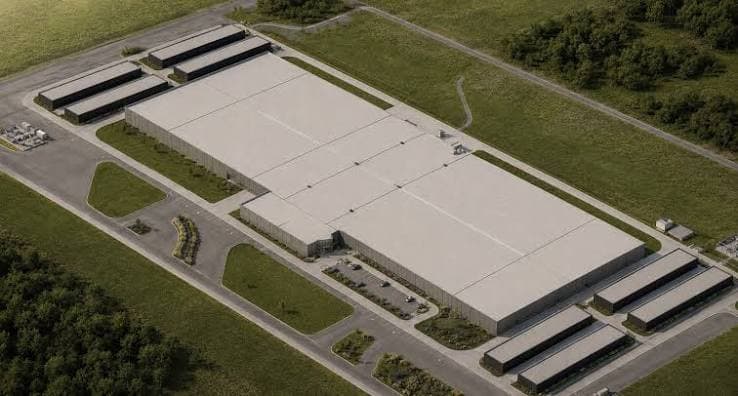
On Thursday, September 24, 2026, the Tuscaloosa County Economic Development Authority approved an incentive package for Applied Digital’s Delta Forge 2 AI data center in Brookwood, Alabama.
The project represents an investment exceeding $3.2 billion and is expected to support more than 1,000 construction workers at peak activity and roughly 100 permanent operational jobs. Size: Spans about 1.26 million to 2 million square feet across 160 acres of a nearly 1,300-acre site near Brookwood Middle School.
In exchange, local authorities approved $314.5 million in tax abatements over 20 years. Applied Digital also committed $270 million in community benefit payments and is projected to generate $131.5 million in non-abatable education taxes over the same period.
Those numbers make the project significant. They also raise a basic question: what exactly is Brookwood receiving in exchange for the public incentives?
The answer depends on more than the headline totals.
The Value of a 20-Year Deal
The first issue is timing.
The tax relief covers construction-period sales and use taxes as well as property taxes over 20 years. The $270 million community benefit commitment is also spread across two decades.
That matters because money received today is not economically equivalent to money received years from now.
The community therefore should not simply compare the $314.5 million incentive package with the project’s projected public revenues and benefits.
It should track when those benefits arrive, how much depends on the project’s continued operation and what happens if investment or employment falls below expectations.
Delta Forge 2 is expected to operate for decades, but the technology inside the facility will change much faster. That creates a long-term question for a deal whose incentives extend through 20 years.
The value of the agreement will ultimately depend not only on the total dollars promised, but on when those dollars arrive and whether the project delivers the investment and activity on which those projections are based.
Putting the Incentive in Perspective
The scale of the incentive becomes clearer when compared with the size of the project.
The $314.5 million package represents about 9.8% of the project’s projected $3.2 billion investment.
Measured against the planned 210 MW of critical IT capacity, the incentive equals roughly $1.5 million per megawatt.
Those figures show the size of the public commitment, but they do not by themselves establish whether the county paid too much.
The more meaningful test will come over time: how much investment is delivered, how many jobs are created, how much tax revenue is collected outside the abatement and whether the promised community benefits are paid as agreed.
The Jobs Reality
The metric receiving the most attention is the relationship between the $314.5 million incentive package and roughly 100 permanent jobs.
On that basis, the public incentive amounts to about $3.1 million per permanent position.
But that comparison needs context.
A data center is fundamentally different from a manufacturing plant. Its economic footprint comes less from a large permanent workforce and more from the capital invested in the facility, electricity consumption, property taxes, technology spending and ongoing operations.
That does not make employment irrelevant. It means job counts alone cannot capture the project’s full economic impact.
The more immediate employment impact will come during construction, when about 1,000 workers are expected to be involved.
The important questions are how much of that work will go to Alabama-based contractors and tradespeople, and how much construction spending will remain in the local economy.
The longer-term question is the quality and local capture of the roughly 100 permanent positions.
How many will be filled by local residents? What will those jobs pay? How many will be technical positions? And how much of the payroll will remain in the community?
Those measures will provide a clearer picture of the project’s employment value than simply dividing the incentive package by the number of permanent jobs.
The Grid and Infrastructure Ledger
The other major variable is infrastructure.
Delta Forge 2 is planned around 210 MW of critical IT load, making it a substantial electricity customer.
Applied Digital has said its cooling system is designed to minimize water use, but electricity infrastructure remains a significant consideration.
A project of this scale requires the community to understand what grid and transmission upgrades are necessary to serve the campus and who will pay for them.
The same question applies to roads and other public infrastructure.
The 15-year take-or-pay lease provides an important level of customer commitment during that period. But some infrastructure built to serve a large data center can have a useful life much longer than an individual tenant agreement.
That creates a question for local officials. What protections are in place if the project’s power requirements or occupancy change over time?
Brookwood is not alone in facing these questions. Oracle’s $165 billion Project Jupiter in New Mexico shows how the rapid expansion of AI data centers is creating similarly large infrastructure and community considerations at a much larger scale.
The 20-Year Tax Question
There is another long-term issue.
The physical building could remain useful for decades, but the computing equipment inside it will have a much shorter economic life.
AI servers and other high-performance computing equipment can be replaced or upgraded on much shorter cycles than the buildings that house them.
That means the value of taxable equipment may change substantially during the 20-year incentive period.
The post-abatement tax base therefore deserves attention.
Will Applied Digital continue investing in new computing equipment at the site? How will that equipment be valued for tax purposes? And what will the site’s taxable value look like when the abatements expire?
Those questions matter because the community is not simply negotiating for today’s data center. It is negotiating around the expected value of the site for the next two decades and beyond.
The Accountability Test
The strongest argument for the project will ultimately be measurable performance.
The community now has several numbers against which Delta Forge 2 can be evaluated. More than $3.2 billion in investment, roughly 100 permanent jobs, about 1,000 construction workers, $270 million in community benefits and the agreed tax incentives.
Those commitments should be tracked over time.
How much investment actually reaches the site?
Are the promised community payments made on schedule?
How many permanent jobs are created?
How much work goes to local and Alabama contractors?
What tax revenues are actually collected?
And what infrastructure costs are associated with serving the campus?
Those are the numbers that will determine the project’s long-term public value.
The debate over Delta Forge 2 should therefore be less about whether data centers belong in Tuscaloosa County and more about whether the public can measure what it received in exchange for the incentives.
A $3.2 billion investment is significant. So is a $314.5 million public concession.
The real test begins now: whether the investment, jobs, tax revenues and community benefits ultimately match the promises made when the deal was approved.



Comments
No comments yet. Be the first to share your thoughts.