
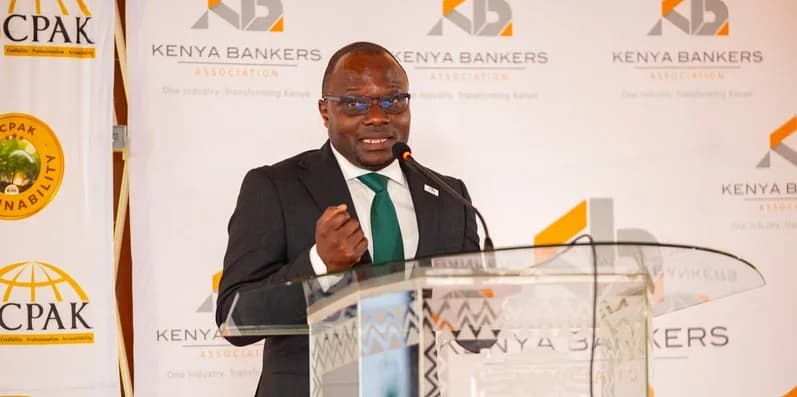
Bankers urge Ruto to cut PAYE tax by five per cent for all workers

Molenje said the country needed to focus on three key goals as it considered changes to income tax. These include increasing local production, creating more jobs for Kenyans and rebuilding public trust in government.
The Kenya Bankers Association (KBA) has called for a five-percentage-point cut in Pay As You Earn (PAYE) tax across all income brackets, not just workers earning Sh32,333 or less per month, as proposed by President William Ruto.
Speaking on Thursday during the release of the 2025 Total Tax Contribution Report, KBA CEO Raimond Molenje said the wider tax relief would give workers more take-home pay, boost consumer spending and help restore public trust in government.
Molenje said the country needed to focus on three key goals as it considered changes to income tax. These include increasing local production, creating more jobs for Kenyans and rebuilding public trust in government.
He said tax changes should go beyond reducing the amount workers pay and help create an economy in which businesses can grow, employ more people and support other sectors.
Molenje used the example of a teacher in Nairobi earning Sh60,000 per month to explain how a tax cut could benefit the wider economy.
“If we make an adjustment to PAYE by just five per cent, a teacher earning that amount would have an additional Sh3,000,” he said.
Latest Stories
- INTERPOL cybercrime crackdown nets 1,462 suspects, recovers Sh13.6 billion
- Barclays to cut 5,000 jobs as AI and automation drive efficiency
- Waititu, wife Wangari to remain in custody as court delays sentencing decision
- Bus driver charged over accident that killed Technical University of Mombasa students in Kisumu
He explained that the extra money would likely be spent locally rather than outside the country, giving businesses and small traders more customers.
“That teacher will not take a flight to Dubai to spend the Sh3,000 extra. What the teacher will do is walk straight to Gikomba and buy a school uniform for the child, a purchase that had been pending,” Molenje said.
He added that the purchase would benefit a tailor who could use the money to repay loans and eventually buy another sewing machine, creating room to employ an additional worker.
“That first employee will go to Mama mboga and be able to buy some groceries,” he said, describing how extra spending could support several businesses.
Molenje said the process would help increase tax revenue through economic activity, create jobs and enable businesses to repay their loans.
“All that change, we are paying tax. All that change, we are creating employment. All that change, we are repaying our loans because we partnered in the past on matters loans,” he said.
He noted that non-performing loans had been declining but warned that the progress needed to continue. He said more lending should go hand in hand with responsible loan repayment, which he linked to increased spending in the economy.
“We are happy the non-performing loans are coming down. However, we have to sustain that. In that, even as we lend more, we need to ensure that Kenyans are disciplined to be able to repay, and that will happen if we have more consumption within the economy,” he said.
The KBA chief said the banking industry, private sector and employed Kenyans were not simply seeking lower taxes but wanted the government to trust them to contribute to economic growth.
“What we are looking for is not purely seeking a tax cut. We are not purely seeking to have money back in the pocket. What we are looking for is trust,” Molenje said.
He argued that Kenya should place greater focus on developing its own economy rather than relying on outside sources, saying more money in workers' pockets could support local production and businesses.
Molenje also referred to the loss of public trust witnessed in Kenya during the June 2024 protests and similar concerns in France, Italy and other European countries, arguing that trust between citizens and governments was necessary for progress.
He emphasised that the banking sector had worked with the government on economic support measures and wanted further engagement on how to grow the economy and create jobs.
He urged the government to consider the proposed five-percentage-point PAYE cut across all income brackets, saying it would help rebuild confidence and support economic activity.
“Let's have this conversation. Let's look at how we grow the economy, create more jobs and restore trust in government. From the banking sector, private sector and employed Kenyans, we are looking to the government to build this trust in Kenya by implementing the five per cent across the board,” Molenje said.


Comments
No comments yet. Be the first to share your thoughts.