
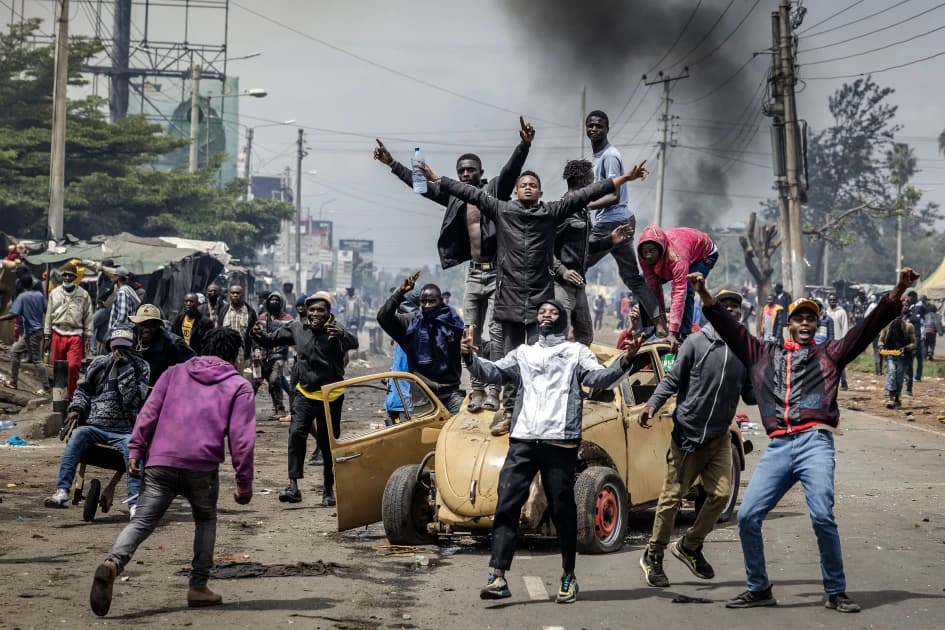
Protesters chant anti-government slogans atop a vandalised car used as a barricade to block a road during Saba Saba Day demonstrations in Nairobi on July 7, 2025. (Photo by Luis TATO / AFP)
Civil society organisations in Kenya have raised concerns over what they describe as a deteriorating human rights situation as the country approaches the 2027 General Election.
Representatives from organisations including the Kenya Human Rights Commission (KHRC), Amnesty International, the Independent Medico-Legal Unit (IMLU) and the Defenders Coalition gathered in Nairobi to release a report assessing the state of human rights in the country.
They say Kenya’s democratic space is shrinking and warn that the situation could create conditions for electoral unrest.
“The Kofi Annan Foundation put Kenya's risk of election violence at 84.1% as Kenya moves towards 2027. These developments cannot be ignored,” KHRC Executive Director David Malombe said.
The report, covering the period between September 2025 and October 2026, highlights what the organisations describe as an increase in political violence, police killings, enforced disappearances and attacks on journalists and human rights defenders.
“These developments cannot be treated as isolated incidents. They signal a wider pattern of democratic regression and growing impunity. The state has a constitutional obligation to protect everyone… ensure that political competition takes place peacefully, lawfully and without intimidation,” added Malombe.
Transparency International Executive Director Sheila Masinde, on her part, said: “We are demanding the guarantee of free, fair and credible elections in 2027 through timely reforms, impartial public institutions, and the prevention of misuse of public resources, through the implementation of the Campaign Finance Act.”
Meanwhile, the Law Society of Kenya (LSK) wants Parliament to enact clear legal provisions requiring the livestreaming of polling station results, arguing that voters must have the opportunity to independently scrutinise and verify election outcomes.
LSK says electronic transmission of results to the Independent Electoral and Boundaries Commission (IEBC) and livestreaming for public scrutiny serve different purposes, and both are necessary to strengthen electoral transparency.
“Parliament must now enact a sound provision that gives practical value to the scrutiny and verification of results. Articles 81 and 86 of the Constitution of Kenya 2010 require transparency, accuracy, accountability and verifiability throughout the electoral process,” LSK President Charles Kanjama said.
The lawyers have warned that they will seek legal redress against any legislation that undermines public scrutiny of election results.
“The Law Society of Kenya will move to court to challenge any law that weakens public scrutiny and verification of election results and seek orders stopping its implementation. We will not stand by as safeguards protecting the vote are dismantled,” Kanjama stated.
The Law Society and civil society organisations are calling for greater accountability, protection of civic freedoms and independent oversight of public institutions, saying the credibility of the 2027 elections will depend on respect for constitutional safeguards and the rule of law.


Comments
No comments yet. Be the first to share your thoughts.