
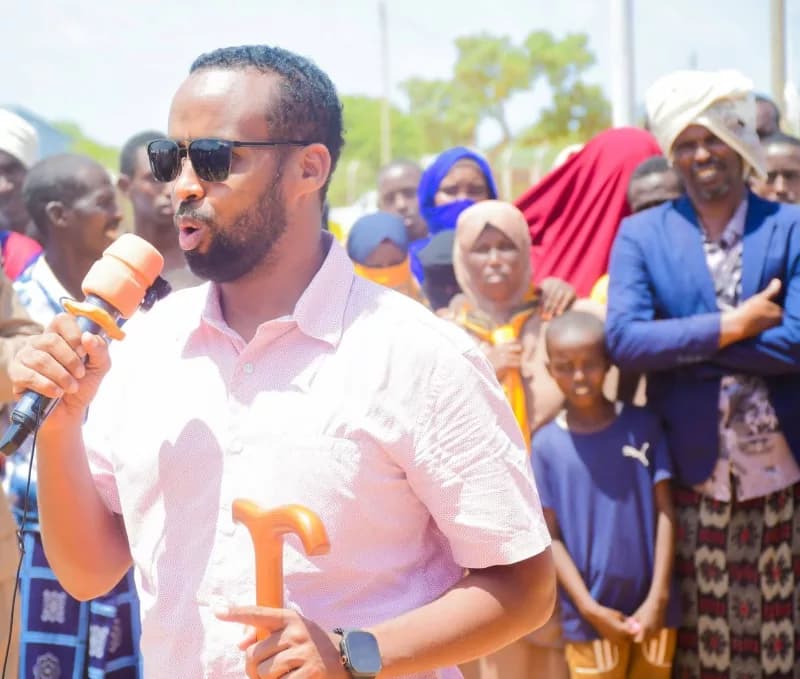
Dahiye said he intends to engage voters directly rather than rely on traditional political networks and community brokers to mobilise support.
Wajir governor aspirant Yahya Mohamed Dahiye with residents of Bulla Hodan, Wajir East

Wajir governor aspirant Yahya Mohamed Dahiye has vowed to maintain his grassroots campaign strategy.
Dahiye, the current Wajir chief finance officer, said his approach was informed by the need to give ordinary residents a greater voice in choosing their leaders and shaping the county’s development agenda.
Speaking during an exclusive interview with the Star newspaper, Dahiye said he would continue taking his campaign to villages, markets and neighbourhoods to listen to residents and understand their concerns firsthand.
“My principle is simple: the seeker of leadership must go to the people directly,” he said, adding that he was determined to lead by example by placing voters at the centre of the political process.
He said his campaign strategy represented a departure from a political culture in which aspirants have traditionally relied heavily on elders, community influencers and political brokers to negotiate support.
While acknowledging the importance of respecting elders, Dahiye argued that their role should not overshadow the electorate’s right to engage directly with those seeking public office.
“There is nothing wrong with respecting our elders, but the voter is also an important part of this process. We want leaders who can come to where they live, listen to them and hear their concerns directly,” he said.
Dahiye challenged young people to reconsider political practices that place considerable emphasis on clan negotiations and endorsements.
He said leadership should be determined by the electorate rather than predetermined arrangements.
“We are not able to defeat clan democracy, negotiated democracy or the negotiations by elders. As young people, we should defeat that system and engage the people directly, without any intermediaries,” he said.
He maintained that political leadership should not be treated as a reward for individuals who had spent years in politics or as a favour extended to candidates through clan-based agreements.
“Leadership is not a job for retirement, nor is it a benefit or a favour that we do for someone simply because he or she has been nominated by a particular clan,” he said.
Dahiye has already begun implementing the strategy through a series of grassroots engagements dubbed Mjadala Mtaani, which he has held in Bulla God-Cade, Waberi and Hodan.
The meetings are intended to provide a platform for direct interaction with residents as he seeks to build support ahead of the 2027 General Election.
Beyond his campaign approach, Dahiye outlined a three-point development agenda centred on early childhood development education, strengthening the county’s own-source revenue and improving the management of Wajir town and other urban centres.
He said addressing these three areas would improve service delivery, strengthen the county’s capacity to finance development projects and enhance residents’ living conditions.
His first priority, he said, would be to improve early childhood education, which he believes has not received adequate attention from successive administrations in the northern region.
“The first is to transform early childhood education. This is a sector that has been neglected by successive authorities in the northern region. I will personally prioritise its improvement by investing in more facilities and enhancing the welfare of children in our early learning centres,” he said.
Dahiye said improving learning facilities and the welfare of children in ECDE centres would provide a stronger foundation for education and better prepare learners for subsequent levels of schooling.
He identified increasing Wajir county’s own-source revenue as his second priority, arguing that the county needed to strengthen its revenue collection systems and tap into sectors with greater revenue-generating potential.
He said greater reliance on allocations from the national government could constrain the county’s ability to respond to local development needs, particularly if local revenue remained below its potential.
“As a region, we have not been collecting or generating sufficient local revenue to support our development needs. I will focus on sectors with the potential to generate more revenue and strengthen our revenue collection systems,” he said.
According to Dahiye, a stronger local revenue base would give the county greater flexibility in financing development priorities and delivering essential services.
His third priority is to improve the management of Wajir town and other municipalities, with an emphasis on urban planning, public spaces and recreational facilities.
He said the county needed to invest more in amenities that promote public welfare and improve the quality of life as urban centres continue to grow.
“As a community, we have not done enough to improve the welfare of the general public through the establishment of parks, playing fields and recreational facilities,” he said.
Dahiye pledged to prioritise the development and management of urban centres to ensure that public spaces and essential amenities respond to residents’ needs.
His entry into the govenro race comes amid consultations and political realignments among various communities and aspirants seeking to succeed incumbent Governor Ahmed Abdullahi.
The Fai sub-clan of the Degodia community has already endorsed Hassan Mohamed Adan as its candidate, while the Matan community has been consulting several aspirants, including Dahiye, former Wajir South MP Ahmed Kolosh and Omar Sheikh.
Other aspirants in the race include Capital Markets Authority chairman Ugas Sheikh Mohamed, former governor Mohamed Abdi, former Cabinet minister Mohamed Elmi and Hassan Wehliye.
With the contest expected to attract candidates from different political and community backgrounds, Dahiye’s grassroots approach places direct voter engagement and service delivery at the centre of his campaign message.
His challenge will be to translate the strategy into broad-based support in a political environment where community consultations and negotiated endorsements continue to influence electoral choices.
Wajir governor aspirant Yahya Mohamed Dahiye during his campaign in Bulla Hodan, Wajir East last week



Comments
No comments yet. Be the first to share your thoughts.