
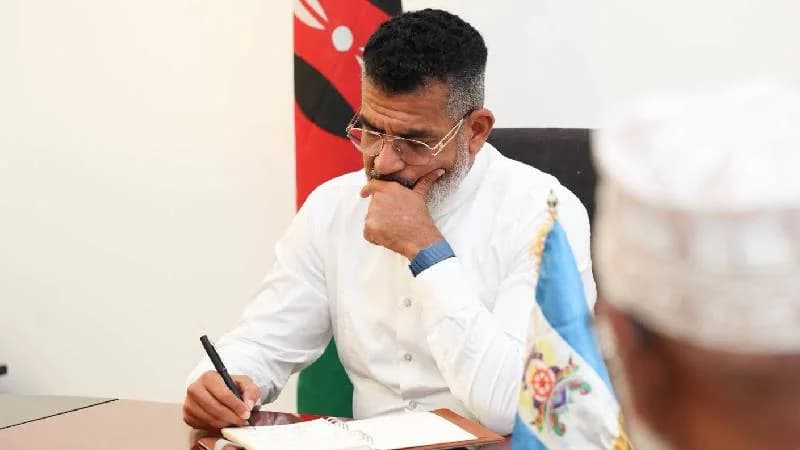
Governor Abdulswamad blames court battles for stalled Mombasa waste management project

He said the county had signed a major contract with partners who were expected to provide waste collection equipment, including machinery that would enable waste to be collected directly from households.
Mombasa Governor Abdulswamad Nassir has admitted shortcomings in the county’s waste management, saying court battles delayed a major project that was expected to introduce door-to-door garbage collection, create thousands of jobs and turn waste into recyclable products.
Abdulswamad said investors who were expected to finance the programme had moved on after the process took longer than anticipated, leaving the county struggling to implement its waste management plans as garbage continues to pile up across the city.
“We take responsibility, and the public needs to be aware as to why I am taking responsibility. People don't want to hear answers as to why you failed. But do I necessarily say that we failed? We probably slept. And I take responsibility for that,” he said.
He said the county had signed a major contract with partners who were expected to provide waste collection equipment, including machinery that would enable waste to be collected directly from households.
“The County Government came up with an ambitious programme, and we signed up for a very huge contract where we had partners who were going to be able to come in. They were to bring in the necessary equipment for door-to-door waste collection,” he said.
The governor said the plan also included employing thousands of young people, some of whom were expected to receive contracts under the collection programme.
Latest Stories
- Kenya seeks bigger slice of EU market with new export catalogue
- 21 counties to benefit from Sh10 billion plan to cut maternal, newborn deaths
- Kenyan working for US child welfare agency arrested over alleged visa overstay
- Court summons Charles Kerich, Governor Sakaja over Sh76.7 million legal fees debt
Under the proposed arrangement, waste delivered to the dumpsite would be processed into recyclable products rather than simply being transported and disposed of.
However, Abdulswamad said the programme was delayed by court cases, which he attributed to political issues.
He said the county eventually won the cases and secured clearance from the relevant agencies, but by then the delays had affected the investors expected to finance the project.
The setbacks have, however, raised questions about how the county intends to address the immediate challenge of garbage collection while pursuing longer-term waste management solutions.
Abdulswamad explained that the existing system, which involves repeatedly moving waste from one point to another, was inadequate for a modern city.
“This whole process took a bit longer than anticipated. On the other side, the financiers were meant to come up with this program. We did a very, very in-depth feasibility study because whatever it is that is currently being done is you're basically moving from hand to shoulder every single day. And it is not something that any modern city needs to be able to do, unfortunately.”
He also linked the city’s waste and sanitation challenges to decades of urban growth that outpaced the development of essential infrastructure.
The governor said the problem predated devolution, arguing that Mombasa’s expanding population had put pressure on systems that were not designed to accommodate current demand.
Abdulswamad added that many buildings constructed decades ago were approved on the understanding that they would use soak pits, while modern technology now offers alternatives such as biodigesters.
He stressed that Mombasa’s growth had outstripped the development of critical infrastructure, including sewerage systems, leaving some areas dependent on arrangements that are no longer adequate for the city’s needs.
“This is not a problem that started yesterday or the day before. It is not a problem that started during devolution. It is a problem that started way, way, way back. Populations have increased. What happened was every single person was given a permit to build decades ago, not now, decades ago, was permitted to build on the auspices that you were going to be able to put a soak pit,” he said.
The governor said wastewater had traditionally been transported to treatment facilities, including plants at Kipevu and Old Town.
However, Abdulswamad said the Old Town facility had been non-functional for about 40 years. A feasibility study found that rehabilitating the plant could cause significant damage because of the age and condition of buildings in the area.
The county is now nearing completion of rehabilitation works at the Kipevu sewerage treatment plant, which Abdulswamad said had been out of operation for about 13 years. The rehabilitation is expected to address part of the city’s longstanding wastewater infrastructure challenges.


Comments
No comments yet. Be the first to share your thoughts.