
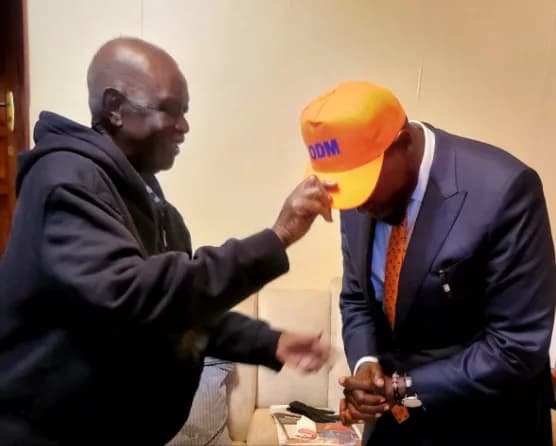
ODM party leader Oburu Oginga receives Nairobi Governor Johnson Sakaja at his home shortly after he defected from UDA on Monday, November 2, 2026. /OBURU OGINGA

Nairobi Governor Johnson Sakaja's defection from the ruling United Democratic Alliance (UDA) to its broad-based government partner, the Orange Democratic Movement (ODM), has raised questions about the political calculations behind his move, even as he maintains that he remains firmly behind President William Ruto's administration.
In the 2022 General Election, Ruto settled on Sakaja as his preferred candidate for the Nairobi gubernatorial seat following an internal power-sharing arrangement that saw Bishop Margaret Wanjiru abandon her gubernatorial ambitions to contest the Senate seat instead.
The deal effectively gave Sakaja a clear path to become UDA's sole candidate.
Over the years, Ruto and Sakaja have maintained a cordial relationship, although the President has occasionally publicly rebuked the governor, including over his dress code during an official function at State House and for mumbling as an official made a presentation on El Niño preparedness at Jamhuri Park.
Sakaja's defection comes months to the 2027 General Election, in which he is seeking re-election as Nairobi governor, this time on an ODM ticket.
The move also follows a February agreement between the national government and Nairobi County to address the city's severe financial and operational constraints, with the national government committing Sh80 billion towards the arrangement.
The deal established a shared-responsibility framework under which the national government would co-manage and execute capital-intensive functions, including solid waste management, public works and water supply infrastructure.
Sakaja maintained that the arrangement was an intergovernmental partnership anchored in law and did not amount to a forced surrender of county functions.
“It is a normal partnership and special focus on Nairobi under Section 6 of the Urban Areas and Cities Act on the Capital City, which is a County. No transfer of functions or NMS-like arrangement,” he said in a radio interview.
The agreement came months after Sakaja survived an impeachment attempt on September 2, 2025, following the intervention of Ruto and the late ODM leader Raila Odinga, who prevailed upon Nairobi MCAs to suspend the push.
A subsequent ouster attempt in March 2026 also collapsed after Azimio MCAs declined to support it, following Raila's intervention to allow the governor to complete his mandate.
Speaking after being received at Chungwa House by senior ODM officials led by deputy party leader Simba Arati, Sakaja attributed his decision to join the party largely to Raila, saying the former opposition leader had personally encouraged him to make the move.
"Baba is the one who told me to join ODM," he said.
Sakaja had publicly signalled the shift during ODM's final rally at Jacaranda Grounds on Saturday, October 31, that marked the culmination of the month-long Mwezi wa Baba activities, where he asked Nairobi residents to guide him on his political future.
The governor faces a potentially bruising re-election contest, with Embakasi East MP Babu Owino among those who have strongly signalled their intention to challenge him.
On one hand, his move could be a calculated attempt to capitalise on ODM's considerable support base in Nairobi as he prepares for the impending battle.
ODM's established grassroots networks and political influence in the capital could therefore offer Sakaja a significant electoral advantage, particularly in a contest where party affiliation and local political alliances are likely to matter.
However, the defection also comes against the backdrop of growing unease within the broad-based political arrangement, raising questions about whether the governor's departure from UDA is purely an electoral calculation or reflects wider tensions within the ruling coalition.
Suna East MP Junet Mohamed has been among the ODM leaders openly expressing dissatisfaction with what he considers the party's marginalisation within the broad-based arrangement.
The National Assembly Minority Leader strongly challenged assertions that UDA is the only governing party, maintaining that ODM is equally part of the government by virtue of the political agreement between Ruto and Raila.
"There are people going around claiming that UDA is the only government party in Kenya. There can be no government in Kenya without ODM," Junet said during a women's empowerment event and the opening of an ODM office in Maralal on Friday, October 30.
"If you could form a government on your own, why did you call us?" he asked.
In a statement issued on the same day Sakaja defected, Junet urged ODM members to prepare for an influx of new leaders and supporters in their thousands.
Sakaja's departure from UDA coincided with that of former Raila aide Silas Jakakimba, who also ditched the ruling party and rejoined ODM.
On Tuesday, November 3, former Senate Majority Leader Samuel Poghisio also officially defected from KANU to ODM.
Taken together, the defections point to ODM's growing importance as political realignments gather pace ahead of 2027.
Sakaja's move may ultimately be part of these strategic realignments as he attempts to secure a stronger electoral platform in Nairobi.
But its timing, coupled with complaints about ODM's position in government, also raises a bigger question: is the broad-based arrangement strengthening political cooperation between its partners or exposing fault lines within the ruling coalition?
Comments
No comments yet. Be the first to share your thoughts.