
Party factor, deep pockets and ethnic re-alignment: The high-stakes battle for Nairobi’s top job

For hopefuls, the contest is not simply about party colours. It is about determining which political platform gives him the strongest coalition of support.
Becoming governor in Nairobi is a Herculean task for political hopefuls. Navigating the tough political landmines to lead the 5.6 million residents of the city demands aligning accordingly with the favourite political party and influencing ethnic alliances while ensuring deep pockets all the time.
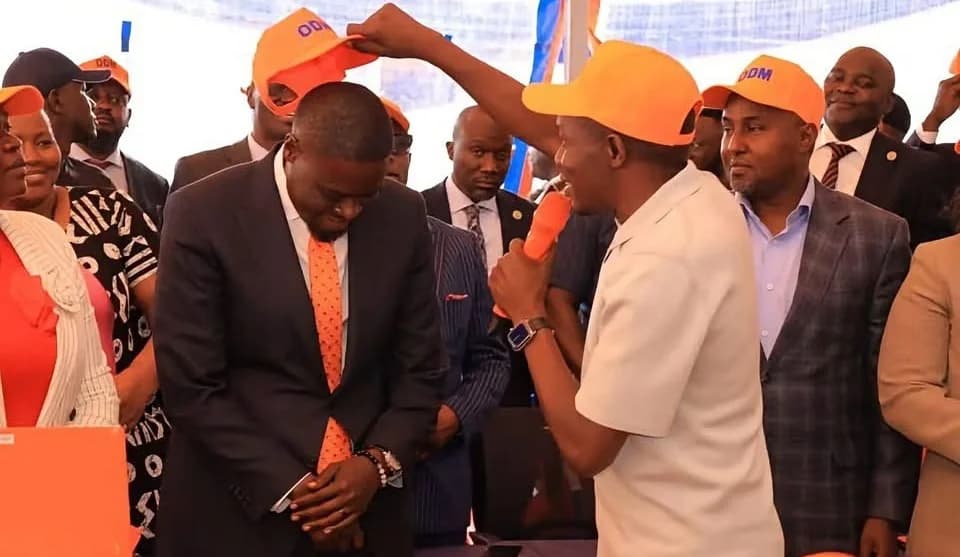
At the centre of the unfolding battle is incumbent Governor Johnson Sakaja, whose 2027 re-election bid is increasingly being complicated by the emergence of heavyweight challengers; among them are Members of Parliament Babu Owino (Embakasi East), Ronald Karauri (Kasarani), James Gakuya (Embakasi North), and George Aladwa (Makadara).
And beneath the contest for City Hall lies an even bigger question: Which political party will carry the most consequential candidates into the Nairobi ballot?
For hopefuls, the contest is not simply about party colours. It is about determining which political platform gives him the strongest coalition of support in a city where party structures, ethnic alliances, youth mobilisation, business networks and individual popularity can intersect in unpredictable ways.
Babu Owino has confirmed that The Mwananchi Party (TMP) will be his political vehicle for the 2027 General Election, including his Nairobi gubernatorial bid. He has also proposed working with Senator in his presidential quest.
Babu's Nairobi strategy is particularly significant because he is seeking to convert his established Embakasi East political base into a citywide movement.
Latest Stories
- The livestock are gone, but a mother’s fight to feed her children in Marsabit continues
- How different election results affect bank stability – global study
- Who mapped Africa? Debunking the myth that Europeans alone plotted the continent
- Human speech follows the same patterns as birdsong — new research
He has already declared that he intends to serve for only one term as Governor before pursuing the presidency in 2032; an indication that he sees the City Hall contest not merely as an end in itself but as part of a longer political journey.
The question, however, is whether his support can travel beyond his traditional political base and translate into a sufficiently broad Nairobi coalition.
The Kasarani MP announced his intention to seek the Nairobi governorship in February, saying he would be on the ballot and framing his bid around what he described as persistent leadership challenges in the capital.
He arrived in elective politics from the corporate and business world and won the Kasarani parliamentary seat in 2022 without the ticket of a major political party.
Now he is attempting something considerably bigger — turning that constituency-level political capital into a citywide gubernatorial campaign.
His challenge will be translating personal networks and a constituency base into an organisation capable of competing across Nairobi's 17 constituencies and 85 wards.
The Embakasi North MP is associated with Rigathi Gachagua's Democracy for the Citizens Party (DCP) and has been positioned as the outfit’s Nairobi gubernatorial candidate.
DCP has been building its Nairobi machinery, with Gachagua publicly predicting a major parliamentary and county assembly presence for the party in the capital.
 National Assembly's Trade, Industry, and Cooperatives Committee Chairperson James Gakuya, MP Embakasi North at Bunge Towers, Nairobi on November 7, 2024. (Photo: National Assembly))
Gakuya therefore enters the contest carrying not only his own political profile but also the organisational ambitions of a relatively new political formation seeking to establish itself as a major force in Nairobi.
The party has also ruled out joining a revived Azimio coalition (now renamed Ukombozi Alliance), with Gakuya saying DCP has no place in that arrangement.
That could make the gubernatorial contest even more fragmented if multiple political formations insist on fielding their own candidates.
Sakaja has the advantage of incumbency and an established City Hall administration. Babu has a highly recognisable political profile and a newly declared party vehicle. Karauri is building from his Kasarani base and wider personal networks. Gakuya is attached to a DCP structure that is actively expanding its Nairobi footprint. Then there are other potential players.
Businesswoman Agnes Kagure is also campaigning for the Governor's seat under the Kenya Patriots Party, meaning the field could become even more crowded.
And, as of September 25, KANU spokesperson Tony Gachoka has also publicly declared his intention to pursue the Nairobi governorship on the said party’s ticket.
For the candidates, the arithmetic is brutal. Nairobi has millions of voters spread across diverse communities, economic classes and political constituencies.
According to political observer George Mboya, the race will require more than loud rallies. It will as well test party organisation, ward-level mobilisation, fundraising, coalition building, candidate visibility and the ability to convert national political alliances into local votes.
"The race will also test whether voters prioritise party identity, individual candidates, performance, promises, local networks or broader national political alignments," said Mboya.
Political pundits aver that Sakaja's defection to the Orange Democratic Movement (ODM) from President William Ruto’s United Democratic Alliance (UDA) prescribes a possible death knell for UDA in Nairobi, with the reality that the Mt Kenya voting bloc has subsequently moved away from his fold to new political formations.
Sakaja rode to victory with 699,393 votes, against the Jubilee and Azimio la Umoja coalition candidate, Polycarp Igathe, who garnered 573,516 votes, with the majority of Sakaja’s support coming from Mt Kenya.
In the last General Election, UDA won only five of the 17 parliamentary seats in Nairobi County. In the Nairobi County Assembly, UDA has 53 Members of the County Assembly, comprising 36 elected and 17 nominated members.
The Azimio coalition, and significantly ODM, won 12 of the parliamentary seats, with ODM MPs including Babu Owino (Embakasi East), Jalang’o (Lang’ata), Tim Wanyonyi (Westlands), Beatrice Elachi (Dagoretti North), George Aladwa (Makadara), Tom Kajwang’ (Ruaraka), Peter Orero (Kibra) and Antony Oluoch (Mathare).
Under Jubilee, Mark Mwenje (Embakasi West), Amos Mwago (Starehe) and Yusuf Hassan (Kamukunji) carried the day. Kalonzo’s Wiper Party retained the Embakasi South seat under the incumbent, Julius Mawathe.
In Nairobi County, ODM has a total of 52 Members of the County Assembly (MCAs) following the 2022 General Election.
Sakaja’s shift has been necessitated by the reality that the Mt Kenya voting bloc has shifted, leaving the incumbent politically exposed. The UDA factor in Nairobi has become marginal, with no known political stronghold in any of the constituencies in the city.
In the last General Election, Gachagua and Ruto’s allies from Mt Kenya were able to rally the Mt Kenya vote in support of Sakaja, and that is what brought him victory.
Comments
No comments yet. Be the first to share your thoughts.