
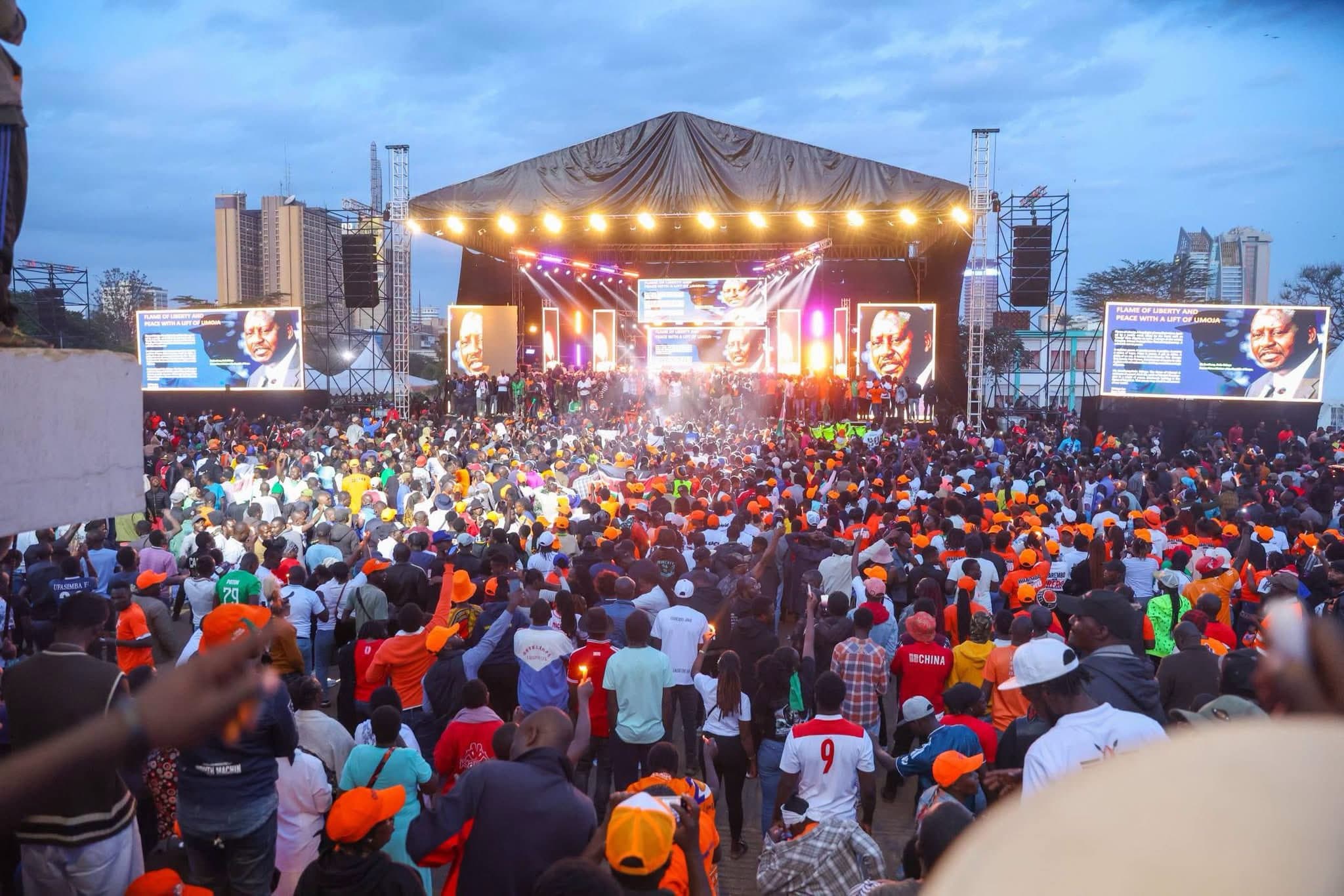
Family members, government officials, political leaders and supporters converged at various parts of the country to remember the late Raila Odinga, a man whose political journey was dotted with struggle for democracy, patriotism, social justice, and reforms.
ODM leaders led tributes, with ODM national Chairperson Gladys Wanga saying, “we began October with a solemn candlelight vigil at Uhuru Park, Nairobi.”
Wanga added: “We remember our hero, mentor, and the father of our democracy; his legacy lives on.”
Odinga served as Kenya’s Prime Minister from 2008 to 2013 under coalition government, and died at the age of 80 on October 15, 2025,
Hours after it emerged that he had suffered a cardiac arrest in Kerala, India, state officials, political leaders and family members were flown to go and coordinate repatriation of the body. Prime Cabinet Secretary headed the team sent by President William Ruto to manage logistics in India. And state funeral ordered by Dr. Ruto.
In the eyes of politicians, Raila was an enigma who played a key role in pushing for multiparty democracy and constitutional reforms in Kenya.
He went to Kisumu Union Primary, then Maranda Primary and Maranda High School in Bondo, Siaya County.
Around 1962 he left for East Germany to study German at the Herder Institute in Leipzig before moving to Magdeburg for technical studies.
In 1970 he graduated with a Master’s-equivalent diploma in Mechanical Engineering and returned to Kenya. He would teach at the University of Nairobi and work at the Kenya Bureau of Standards before he trained his eyes on politics.
His political path would break away from his father’s, slipping out of that long shadow, like a river that knows its source but chooses its own course.
By the 1970s and early 1980s, Raila was deeply involved in political activism, at a time when Kenya’s political space was narrowing.
Then came 1 August 1982.
A section of the Kenya Air Force attempted to overthrow President Daniel arap Moi’s government. The coup failed. In its aftermath, Odinga was accused of involvement, charged with treason and detained. The accusation would remain one of the most contested chapters of his early political life; what is beyond dispute is that the failed coup changed the course of his life. For years, Odinga was in detention.
Odinga spent years behind bars, much of it in solitary confinement. Released in 1988, he was soon detained again, caught up in the turbulent struggle to bring back multiparty politics.
In July 1990, during the Saba Saba pro-democracy agitation, he was detained once more. Freed the following year, he slipped into exile in Norway, fearing for his safety.
In February 1992, Raila came home to a Kenya preparing for its first multiparty elections in decades. He joined FORD-Kenya, the party his father lead, and later that year won the Lang’ata parliamentary seat, a position that would make him one of the most recognisable faces in Kenyan politics.
Comments
No comments yet. Be the first to share your thoughts.