
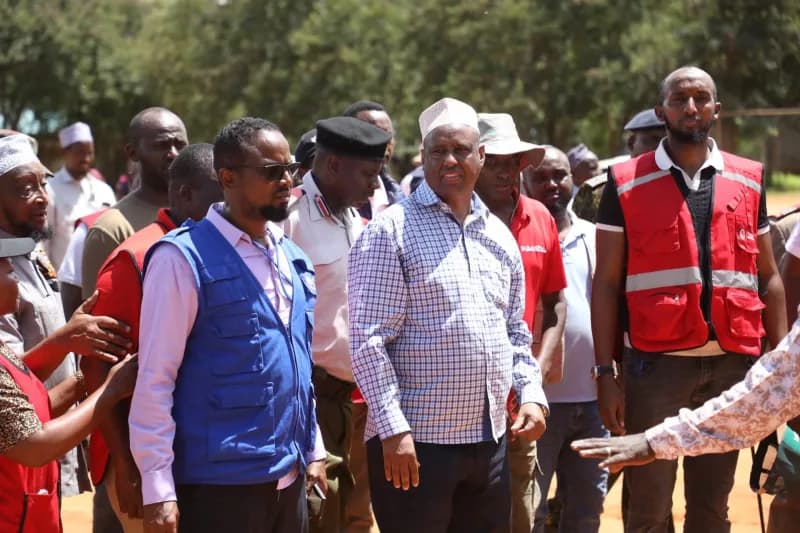
Marsabit Governor Mohamud Ali with humanitarian agencies in Moyale town.

Marsabit Governor Mohamud Ali has criticised some Kenyan leaders over what he termed inflammatory statements and discussions surrounding the ongoing conflict in Moyale.
He warned that their remarks risk escalating tensions and deepening divisions among communities.
Speaking in Moyale town, the governor called on political leaders, particularly those commenting on the conflict from across the border, to exercise restraint and avoid taking sides.
He said their priority should be to promote peaceful coexistence and support people displaced by the violence rather than fuel animosity.
He singled out former Dadaab MP Farah Maalim and former Mandera Senator Billow Kerrow, expressing disappointment over statements and social media discussions attributed to them, which he said could further complicate an already delicate situation.
Ali said leaders had a responsibility to demonstrate maturity and use their influence to promote reconciliation rather than make pronouncements that could be interpreted as taking sides.
His remarks come amid growing concerns over the humanitarian and security implications of the violence.
"I know these are responsible leaders personally, and I have tremendous respect for them. At a time like this, I do not expect them to take sides," he said.
Ali particularly questioned what he described as a departure from the position previously taken by Maalim.
He recalled their working relationship in 2020, when they jointly raised concerns over the alleged persecution of Oromo and Borana communities by the then Tigray administration.
"Hon Farah Maalim, my dear friend, I know you personally and we have been very close friends. In 2020, you stood with me when the Tigray administration was persecuting the Oromo and Borana communities. I do not understand what has changed now to make you fuel animosity among communities," he said.
The governor maintained that the humanitarian situation should transcend ethnic and regional considerations. He insisted that people fleeing violence deserved assistance and protection regardless of their community background.
He said the county was already facing considerable resource constraints as it grappled with growing humanitarian needs arising from the influx of people escaping insecurity in neighbouring Ethiopian areas.
"The people suffering do not need to be identified by the communities they belong to before we extend assistance to them. We have a responsibility to take care of all refugees who have fled the conflict in neighbouring Ethiopia," Ali said.
He also took issue with claims seeking to associate particular territories exclusively with specific communities, warning that such pronouncements were irresponsible and could undermine efforts to restore calm.
According to the governor, questions surrounding territorial ownership and administrative boundaries should be addressed through established government institutions and historical records rather than political declarations.
"For anyone to claim that a particular region belongs exclusively to certain communities is irresponsible. The Ethiopian government is best placed to establish the facts. It is not for Farah Maalim or other leaders to unilaterally declare that a particular area belongs to one community or another," he said.
Ali argued that geographical records, historical evidence and official maps provided a basis for resolving territorial questions. He cautioned against leaders making unilateral claims that could heighten tensions.
"The geography is there, the maps are available and history speaks for itself. Nobody can suddenly wake up and decide that a particular territory belongs to a certain community. We cannot accept such irresponsible pronouncements," he added.
The governor further defended Ethiopian Prime Minister Abiy Ahmed, arguing that his administration should be allowed to address the unfolding crisis without being subjected to what he considered misplaced political accusations.
The latest violence in Moyale is unfolding against a backdrop of longstanding tensions between Ethiopia's Oromia and Somali regional administrations. Disagreements over territorial authority, local administration and community relations have periodically triggered insecurity.
Reports have linked the latest escalation to two incidents, including a dispute over the raising of the Somali regional flag in Moyale and the killing of a 13-year-old girl.
The flag incident reportedly sparked tensions over administrative authority in the border town, which has historical, social and economic connections with communities on both sides of the Kenya-Ethiopia border.
The incidents appear to have compounded existing grievances before armed clashes reportedly intensified on October 22, triggering displacement and heightened security concerns in the affected areas.
The wider dispute is rooted in historical disagreements over territorial boundaries, grazing land, access to water and political authority, as well as complex relations among Oromo and Somali communities, including Borana and Garre communities.
The porous nature of the international border has further complicated the situation, with families, clan networks, livestock movements and commercial activities extending across the two countries.
The governor's remarks come as the displacement crisis places additional pressure on host communities and local authorities, with increased demand for water, food, shelter and other essential services.
He said the county was already experiencing serious resource constraints, raising concerns about its capacity to adequately respond to the growing humanitarian needs without additional support. Reports indicate that more than 40,000 people have been displaced.
The displaced camping in Moyale town.


Comments
No comments yet. Be the first to share your thoughts.