
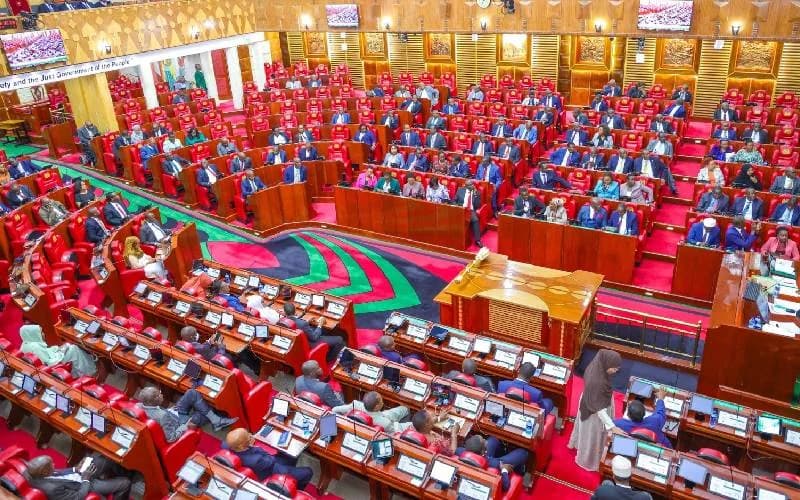
MPs drop proposal requiring county assembly nominees to be registered voters in represented wards

The decision followed the removal of Clause 19 from the Elections (Amendment) Bill 2024, which sought to introduce restrictions on how political parties select their county assembly nominees.
Political party leaders will retain the freedom to nominate county assembly members from anywhere in the country after the National Assembly dropped a proposal that sought to require nominees to be registered voters in the wards they would represent.
The decision followed the removal of Clause 19 from the Elections (Amendment) Bill 2024, which sought to introduce restrictions on how political parties select their county assembly nominees.
The Bill, which was passed by the National Assembly, now returns to the Senate, where it originated, for consideration and concurrence.
The proposed changes, which arose from the National Dialogue Committee (NADCO) report adopted by Parliament, were intended to ensure that nominated MCAs had a direct connection to the areas where they would serve.
However, MPs opposed to the provision argued that the requirement would interfere with the independence of political parties and their right to decide who should be nominated to represent them.
Wajir East MP Aden Mohamed, who moved the amendment to delete Clause 19, said retaining the freedom of political parties to prepare their nomination lists was necessary.
Latest Stories
- MSF: Restrictions in North Kivu deny sexual violence survivors access to vital care
- EACC recommends prosecution of 43 suspects in major corruption, procurement and forgery cases
- Mombasa residents demand accountability on controversial, unfulfilled projects in new county plan
- EU brings security roadshow to Nairobi, signals Western Indian Ocean as global frontline
“The justification is that we want to maintain the autonomy of political parties with respect to party lists,” he said.
Minority leader Junet Mohamed, who represents Suna East and is also ODM's director of elections, supported the removal, arguing that political parties would find ways to avoid complying with the proposed restrictions even if Parliament passed them into law.
“Even if you legislate here, political parties will find a way to circumvent it. I am a party operative, and I know what I am talking about. Do not waste your time. You can legislate, but they will find a way around it. I assure you,” he said.
The deleted provision sought to amend Section 34 of the Elections Act by introducing subsection 8A, which would have made it compulsory for nominees to be registered voters in at least one ward within the county where they were seeking nomination.
The proposed amendment stated, “A person shall not be nominated by a political party unless the person is, on the date of submission of the party list by the political party, a registered voter in any of the wards in the county in which the person is nominated.”
However, Funyula MP Wilberforce Oundo opposed the removal, saying the proposed requirement would help prevent political parties from selecting individuals who had little connection to the communities they were expected to represent.
“This is meant to prevent abuse by political parties and cure all mischief,” Oundo said.
He cited Busia County as an example, claiming some nominated MCAs had no meaningful connection to the areas where they served.
“In Busia, you will find that the nominated MCAs are individuals nobody has ever seen. They do not live there. They merely come, and some of them actually reside in America,” he added.
The National Assembly also removed another proposal that sought to compel political parties to ensure all wards in a county were fairly represented when preparing their nomination lists.
The decision has raised concerns that party leaders could give preference to areas considered politically supportive while overlooking regions viewed as opposed to their leadership.
Article 177(1)(b) of the Constitution provides for special-seat members in county assemblies to ensure that no more than two-thirds of the membership is of the same gender.
The 770 nomination slots across the 47 counties also cater for marginalised groups, including young people, persons with disabilities and ethnic and religious minorities.
The Independent Electoral and Boundaries Commission (IEBC) distributes the slots to political parties proportionately, depending on the number of elected seats each party wins in a county. The nominated members serve alongside the 1,450 MCAs directly elected by voters.
Under the existing law, a person qualifies for nomination if they are a member of the political party submitting the list at the time it is presented.
Section 35 of the Elections Act requires political parties to submit their nomination lists to the IEBC at least 45 days before a General Election.


Comments
No comments yet. Be the first to share your thoughts.