
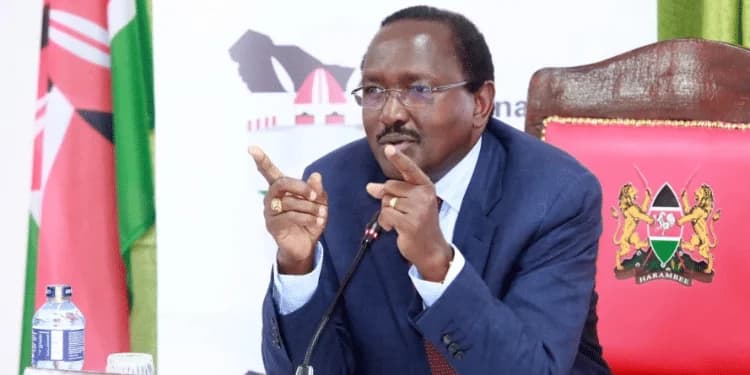
Stephen Kalonzo Musyoka is a Kenyan lawyer and politician who served as the country’s 10th Vice President under President Mwai Kibaki from 2008 to 2013. He is the leader of the Wiper Democratic Movement (WDM)and has held several senior government positions, including Minister for Foreign Affairs, Education, Tourism and Information, Environment, and Home Affairs.
Musyoka has spent more than four decades in public service, first as a Member of Parliament and Cabinet minister before rising to the country’s second-highest executive office.
His political career has taken him through several administrations, political parties and opposition coalitions. He has been a presidential candidate, a running mate to the late Raila Odinga in two general elections, a government negotiator and Kenya’s special envoy to South Sudan.
Musyoka at a Glance
Full name: Stephen Kalonzo Musyoka
Date of birth: December 24, 1953
Age: 72 as of October 2026
Place of birth: Tseikuru, Kitui County
Profession: Lawyer and politician
Current political position: Party Leader, Wiper Patriotic Front
Former national office: Kenya’s 10th Vice President, 2008–2013
Former parliamentary seat: Kitui North (1985–1997) and Mwingi North (1997–2013)
Political party: Wiper Patriotic Front, formerly Wiper Democratic Movement
Education: Bachelor of Laws, University of Nairobi; postgraduate diploma in law, Kenya School of Law; postgraduate diploma in Business Management, Mediterranean Institute of Management, Cyprus
Spouse: Pauline Musyoka
Political experience: More than 40 years in elective and appointed public office
Early Life and Education
Kalonzo Musyoka was born on December 24, 1953, in Tseikuru, an area in present-day Kitui County. He grew up in a rural family before pursuing education that would eventually lead him into law and public service.
He attended Tseikuru Full Primary School from 1960 to 1967 before attending Kitui High School for secondary education.
He later joined Meru School in 1973 for his A-level studies.
After completing his secondary education, Musyoka enrolled at the University of Nairobi, where he studied law and graduated with a Bachelor of Laws degree in 1977.
He subsequently obtained a postgraduate diploma in legal practice from the Kenya School of Law in 1978.
Kalonzo also pursued further studies in business management at the Mediterranean Institute of Management in Nicosia, Cyprus, where he obtained a postgraduate diploma in Business Management in 1979 through a Rotary Club scholarship.
Legal Career Before Entering Politics
After completing his legal studies, Musyoka began his professional career in the public and private sectors.
He briefly worked in the Customs Department at the Port of Mombasa before undertaking his legal pupillage at Kaplan & Stratton Advocates, one of Kenya’s established law firms.
He subsequently joined Comcraft Group, where he worked as a manager in the legal services department.
Musyoka later established his private legal practice through S.K. Musyoka & Co. Advocates.
Kalonzo Musyoka Entry into Politics and Rise Through KANU
Kalonzo Musyoka first contested the Kitui North parliamentary seat in the 1983 General Election but lost to the incumbent, Philip Manandu.
He got another opportunity in 1985 after Manandu died, creating a vacancy in the constituency.
Musyoka contested the subsequent by-election and won, entering Parliament at the age of 31.
His election marked the beginning of a political career that would see him represent the constituency and its successor, Mwingi North, for nearly three decades.
In 1986, he was appointed Assistant Minister for Works, Housing and Physical Planning under President Daniel arap Moi.
He retained his parliamentary seat in the 1988 General Election and was elected Deputy Speaker of the National Assembly, a position he held until the 1992 General Election.
He also became involved in the internal leadership of the Kenya African National Union (KANU), serving as the party’s National Organising Secretary.
The position placed him within the party’s national political machinery during a period when KANU dominated government and national politics.
Kalonzo Musyoka remained associated with the party until 2002, when he left to join the emerging opposition political movement.
Cabinet Career Under Moi and Kibaki
Musyoka’s first major Cabinet appointment came in 1993 when President Moi appointed him Minister for Foreign Affairs and International Cooperation.
He served in the position from June 1993 to July 1998, representing Kenya in diplomatic engagements and regional peace initiatives.
During his time at the Foreign Affairs Ministry, he participated in diplomatic efforts involving Sudan, Somalia and the Great Lakes region through the Intergovernmental Authority on Development (IGAD).
In 1998, he moved to the Ministry of Education and Human Resource Development, where he served until 2001.
He later led the Ministry of Tourism and Information from 2001 to 2002.
After the 2002 General Election, which brought Mwai Kibaki to power, Musyoka joined the new political establishment after leaving KANU and joining the Liberal Democratic Party (LDP).
He returned to the Foreign Affairs docket in January 2003 under the Kibaki administration.
In August 2004, he was transferred to the Ministry of Environment, where he served until 2005.
The 2007 Presidential Election and Appointment as Vice President
The 2007 General Election marked a major turning point in Musyoka’s political career.
After leaving KANU, he became a leading figure in the Orange Democratic Movement-Kenya (ODM-Kenya), which nominated him as its presidential candidate.
He contested against incumbent President Mwai Kibaki of the Party of National Unity (PNU) and Raila Odinga of the Orange Democratic Movement (ODM).
Kalonzo Musyoka finished third with 879,903 votes, representing approximately 8.91 per cent of the presidential vote, according to the election figures recorded by the International Foundation for Electoral Systems.
The disputed presidential results triggered widespread violence and led to negotiations between Kibaki and Odinga.
The negotiations resulted in the National Accord and Reconciliation Agreement, which created a coalition government with Kibaki remaining President and Odinga becoming Prime Minister.
Musyoka subsequently aligned himself with Kibaki’s side of the political settlement.
On January 9, 2008, Kibaki appointed him Vice President and Minister for Home Affairs, making him Kenya’s 10th Vice President.
The appointment was politically significant because Musyoka had contested against Kibaki in the presidential election only weeks earlier.
He served as Vice President until April 2013, when the office was replaced by the Deputy President position under the new constitutional order following the 2010 Constitution.
Vice-Presidency and the 2010 Constitution
Kalonzo Musyoka served as Kibaki’s deputy during the final years of the former President’s administration.
As Vice President, he also held the Home Affairs portfolio and participated in government activities during a period marked by constitutional reforms, institutional changes and major infrastructure programmes.
One of the significant national developments during his tenure was the promulgation of the 2010 Constitution.
Musyoka supported the proposed Constitution during the referendum campaign alongside Kibaki and Odinga.
Kenyans voted on the new Constitution on August 4, 2010, with the Yes campaign securing 68.55 per cent of the vote.
The Constitution introduced a new system of devolved government, strengthened the Bill of Rights, created independent constitutional commissions and replaced the provincial administration structure with a devolved system of 47 county governments.
Musyoka’s political record during the Kibaki administration also included his participation in government initiatives involving infrastructure development, regional diplomacy and public administration.
His five-year tenure as Vice President ended after the 2013 General Election, which ushered in the Jubilee administration under President Uhuru Kenyatta and Deputy President William Ruto.
Return to Opposition Politics and the Wiper Party
After leaving the vice-presidency in 2013, Musyoka remained active in national politics through the Wiper Democratic Movement, the political party that became his main vehicle for contesting elections and negotiating opposition alliances.
The party emerged from the Orange Democratic Movement-Kenya political formation, registered in 2006 after disagreements within the broader opposition movement that campaigned against the proposed Constitution in the 2005 referendum.
Musyoka became one of its leading figures and later became its long-serving party leader.
Wiper became an important political force in the Ukambani region, particularly in Kitui, Machakos and Makueni counties.
In 2025, the party adopted the name Wiper Patriotic Front as part of its political reorganisation.
The 2013 and 2017 Presidential Campaigns
Musyoka returned to the presidential contest in 2013, this time as the running mate to Raila Odinga under the Coalition for Reforms and Democracy (CORD).
The ticket faced Uhuru Kenyatta and William Ruto, who contested under the Jubilee Alliance.
The Uhuru-Ruto ticket won with 6,173,433 votes, representing 50.51 per cent, while the Raila-Kalonzo ticket received 5,340,546 votes, or 43.70 per cent.
The result ended Musyoka’s five-year tenure as Vice President and returned him to opposition politics.
In 2017, he again joined Odinga as running mate under the National Super Alliance (NASA), a coalition of several opposition parties.
The coalition challenged the re-election of President Kenyatta and Deputy President Ruto.
In the August 8, 2017 election, the Kenyatta-Ruto ticket received 8,203,290 votes, while the Odinga-Musyoka ticket garnered 6,762,224 votes.
However, the Supreme Court subsequently annulled the presidential election on September 1, 2017, citing irregularities and illegalities in the conduct and transmission of results.
A fresh election was held on October 26, 2017, which Odinga boycotted after announcing his withdrawal from the contest.
Kenyatta was declared the winner of the repeat election, while Musyoka remained part of the opposition leadership.
Diplomatic Role and South Sudan Peace Mission
Beyond electoral politics, Kalonzo Musyoka has also held diplomatic responsibilities, particularly in efforts to resolve conflicts in the Horn of Africa and the Great Lakes region.
His involvement in regional diplomacy dates to his years as Foreign Affairs minister under Moi and Kibaki.
In July 2019, former President Uhuru Kenyatta appointed him Kenya’s Special Envoy to South Sudan.
The appointment came as South Sudan was implementing a revitalised peace agreement signed in September 2018 to end years of conflict between forces loyal to President Salva Kiir and those associated with opposition leader Riek Machar.
Musyoka’s mandate involved supporting the implementation of the agreement and engaging political leaders in South Sudan to advance peace and stability.
He later met with senior South Sudanese officials, including Vice President Rebecca Nyandeng de Mabior and opposition leader Riek Machar.
His diplomatic engagements continued into 2022 as Kenya sought to support the formation and stability of South Sudan’s transitional unity government.
The 2022 Election and Break with Raila Odinga
The 2022 General Election presented another important moment in Musyoka’s political career, particularly over the selection of Raila Odinga’s running mate under the Azimio la Umoja coalition.
Musyoka was among the senior leaders who supported the formation of the coalition, which brought together several political parties seeking to challenge the Jubilee administration.
On May 16, 2022, Odinga announced Narc-Kenya leader Martha Karua as his running mate, a decision that left Musyoka outside the presidential ticket despite his previous role as Odinga’s deputy in the 2013 and 2017 elections.
Musyoka subsequently announced that he was leaving Azimio and would contest the presidency under the Wiper ticket.
He selected Andrew Sunkuli as his running mate and said he would pursue his own presidential ambitions.
On June 2, 2022, Musyoka announced that he had reconsidered his position and would return to Azimio to support Odinga’s presidential campaign.
He also accepted the proposed Chief Minister position in the coalition’s government structure and congratulated Karua on her selection as running mate.
His withdrawal meant that he did not appear on the presidential ballot in the August 9, 2022 General Election.
Odinga and Karua eventually lost to William Ruto and Rigathi Gachagua, who were declared the winners with 50.49 per cent of the valid presidential votes.
Kalonzo’s Political Style and Public Image
Musyoka has built his political identity around coalition-building, diplomacy and a relatively long association with successive political administrations.
Unlike politicians whose national prominence has largely come through one elective position, his career has involved parliamentary leadership, Cabinet appointments, executive office, party leadership and diplomatic assignments.
His supporters often describe him as a patient negotiator who prefers dialogue and political consensus to confrontation.
His experience in foreign affairs and his appointment as Kenya’s special envoy to South Sudan have also contributed to his public image as a politician with diplomatic experience.
Kalonzo’s critics, however, have questioned his repeated participation in political coalitions in which he has not emerged as the presidential candidate.
His decisions to support Kibaki after the 2007 election and later serve as Raila Odinga’s running mate in 2013 and 2017 have featured prominently in discussions about his presidential ambitions.
The 2022 disagreement over Odinga’s running mate also exposed the difficulty of balancing personal presidential ambitions with coalition negotiations.
Wiper Leadership and Preparations for 2027
On August 7, Kalonzo Musyoka announced changes to the party’s leadership structure as part of efforts to expand its national presence.
Among the appointments was former Kigumo MP Jamleck Kamau, who was named national chairman.
Nyali MP Mohamed Ali was named Deputy Party Leader Designate, while advocate Ndegwa Njiru was appointed the party’s spokesperson.
Ambassador Siyat Osman Ibrahim was also appointed deputy chairperson.
The changes were presented as part of efforts to strengthen the party’s leadership and attract support from different regions and generations.
Musyoka also continued consultations with opposition leaders over the formation of a united political front to challenge President Ruto in 2027.
On September 21, he announced that the Azimio la Umoja One Kenya Coalition had rebranded as the Ukombozi Alliance.
The decision was part of an effort to reorganise opposition parties and establish a new political platform ahead of the next General Election.
The coalition subsequently reviewed its agreement to allow greater flexibility in selecting a presidential candidate, dropping a provision that would have made the coalition party leader its automatic presidential candidate.
The change was intended to accommodate other political formations and leaders interested in joining the alliance.
On October 26, Musyoka met with former Deputy President Rigathi Gachagua at his Wamunyoro home in Nyeri County.
The two leaders agreed to bring their political bases together and work towards presenting a single presidential candidate against Ruto in the 2027 election.
The meeting involved leaders from Wiper and Gachagua’s Democracy for the Citizens Party (DCP), signalling another phase in efforts to consolidate opposition support.
Follow our and X Account for real-time news updates, and subscribe to our YouTube Channel for in-depth interviews.

Comments
No comments yet. Be the first to share your thoughts.