
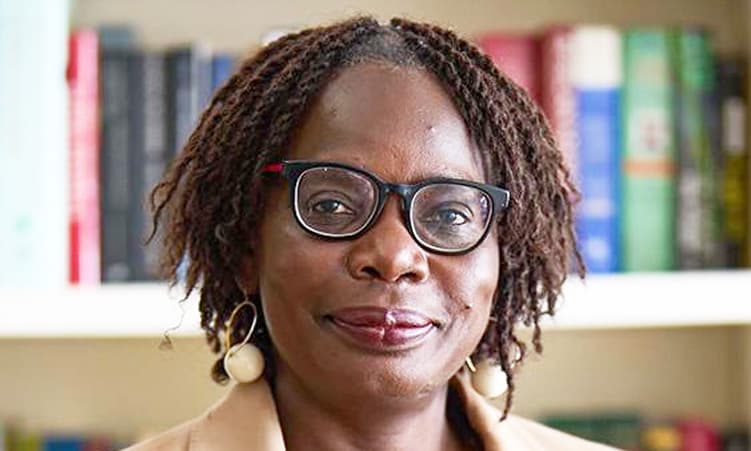
Kenya's Phoebe Okowa, Sierra Leone’s Charles Jalloh renew battle for ICJ seat

Nairobi, eager to keep her at The Hague, has indicated it wants Okowa in the global court for another decade and recently concluded an intense campaign for her re-election ahead of today’s vote.
The race for the International Court of Justice (ICJ) has become a high-stakes rematch between two legal heavyweights: Kenya’s Prof Phoebe Okowa and Sierra Leone’s Prof Charles Chernor Jalloh.
This is not their first encounter. The two jurists battled it out in 2025 for a partial term on the World Court - a gruelling, three-round contest that tested the diplomatic mettle of both Nairobi and Freetown.
Okowa eventually won that historic race, becoming the first Kenyan and only the eighth woman to serve on the ICJ bench. Her term began on November 12, 2025, and runs until February 5, 2027.
Nairobi, eager to keep her at The Hague, has indicated it wants Okowa in the global court for another decade and recently concluded an intense campaign for her re-election ahead of today’s vote.
To understand the current race, you must look back at how Okowa won the previous one.
It was a brutal, simultaneous voting process at the UN General Assembly (UNGA) and the UN Security Council (UNSC), where the two bodies voted concurrently but separately.
Latest Stories
In the first round, Okowa, a professor of public international law, received 6 votes to Jalloh’s 5 at the UNSC, while at the UNGA, Okowa got 78 to Jalloh’s 50.
Neither candidate, nor a third Nigerian contender who later withdrew for lack of momentum, received the absolute majority.
By the second round at the UNGA, Okowa widened her lead to 91 votes against Jalloh’s 66. At the UNSC, the vote was conclusive: Jalloh won an absolute majority of 8 votes to Okowa’s 6.
 International Court of Justice in The Hague. (Photo: File)
Although Jalloh secured the required majority in the chamber, a third round of voting was necessary because the General Assembly reached a different result, giving an absolute majority to Ms Okowa.
A final round of voting in both organs resolved this divergence, and both organs elected Okowa to the court. She received 8 votes in the Council and 106 in the General Assembly, defeating Jalloh, who obtained 7 and 79 votes respectively.
The 2025 vote was a classic display of Kenyan diplomatic muscle, outmanoeuvring a West African rival in the corridors of New York.
Jalloh had the favour of the UNSC - which was under the Sierra Leonean presidency at the time - while Kenya’s Okowa had the favour of the General Assembly.
The rematch
This time, the dynamic is entirely different. Okowa is no longer just a candidate; she is a sitting ICJ judge. She has the advantage of name recognition, a track record at The Hague, and the prestige of the office.
The General Assembly and the Security Council often prefer to retain incumbents to ensure continuity on the bench. However, her incumbency status does not guarantee her re-election because the process is politically motivated, and member states ultimately decide who to vote for.
Complicating the race is the African Union's failure to reach a consensus on a single candidate. The AU has endorsed both candidates for the ICJ seat after failing to reach an agreement during the July foreign ministers' meeting held in Addis Ababa.
This means both candidates must rely heavily on their global diplomatic networks, not just regional loyalty, to clinch the seat.
Kenya has been aggressively lobbying globally and has since received 26 nominations, while Jalloh’s candidacy has received 13.
Kenya’s top diplomat Ekitela Lookale and the mission in New York have been engaging in a strenuous campaign to see Okowa re-elected, focusing on numerous bilateral meetings with as many UN missions as possible at the ambassadorial level.
President Ruto has taken the lobbying a notch higher at the highest level with his peers whenever they met.
Professor Phoebe Okowa addresses delegates during a final engagement in New York as Kenya wraps up its campaign for her full term at the ICJ. (Photo: MFDA)Meanwhile, the Economic Community of West African States (ECOWAS) unanimously endorsed Sierra Leone’s nominee for the seat in July.
This endorsement was announced in the final communique of the 69th ECOWAS summit held in Sierra Leone, where West African leaders expressed their collective support for Professor Jalloh’s candidacy.
The ICJ consists of 15 judges elected for nine-year terms by the Security Council and the General Assembly, with five seats coming up for election every three years.
According to Article 2 of the Statute, the Court shall be composed of independent judges of "high moral character" who possess the qualifications required for appointment to the highest judicial offices, or are jurisconsults of recognised competence in international law.
The nine candidates contesting the five positions are: Dapo Akande (UK), François Alabrune (France), Mahmoud Daifallah Hmoud (Jordan), Luz del Carmen Ibáñez Carranza (Peru), Charles Chernor Jalloh (Sierra Leone), Rena Lee (Singapore), Phoebe Okowa (Kenya), Jin-Hyun Paik (South Korea), and Marcelo Vázquez-Bermúdez (Ecuador).
While the ICJ Statute does not have a formal requirement for the geographical distribution of seats, Article 9 requests that electors consider "that in the body as a whole the representation of the main forms of civilisation and of the principal legal systems of the world should be assured."
Article 3 rules out the possibility of two judges of the same nationality holding seats on the Court. The 2025 election was a nail-biter that required three rounds of voting and went down to the wire.
Today’s rematch will likely be just as fierce, with nine candidates battling for only five seats up for grabs.
Comments
No comments yet. Be the first to share your thoughts.