
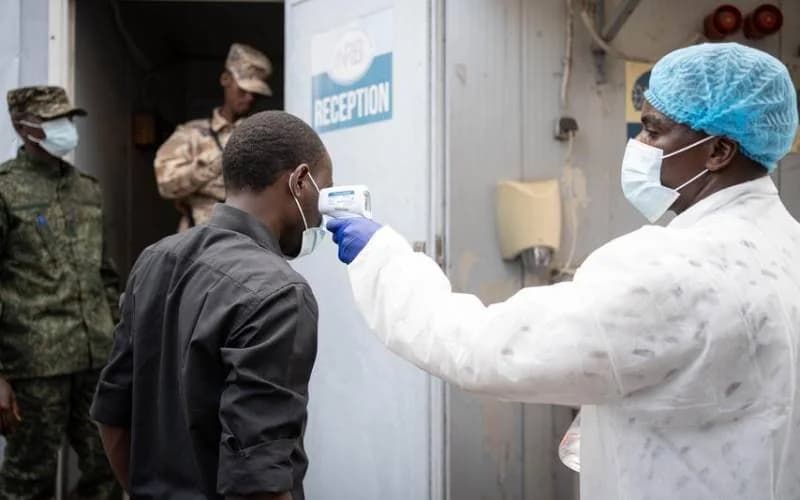
Members of Parliament (MPs) have uncovered gaps in Kenya’s Ebola containment measures, citing inadequate screening at some airports, weak surveillance along informal border crossings and concerns over the country’s ability to manage a possible outbreak.
Appearing before the National Assembly’s Committee on Delegated Legislation, Health Cabinet Secretary (CS) Aden Duale faced tough questions over the Ministry’s emergency preparedness, the enforcement of the proposed Ebola regulations and the resources available to contain the disease.
The Committee, chaired by Ainabkoi MP Samuel Chepkonga, was examining the Public Health (Declaration of Formidable Epidemic Disease) Order, 2026, and the Public Health (Ebola Disease) Rules, 2026, which were introduced following the confirmation of Kenya’s first imported Ebola case.
During the Tuesday meeting at Bunge Towers, legislators questioned whether the government had established effective screening measures at official points of entry, with Kigumo MP Joseph Munyoro recounting an experience in which he reportedly found no health personnel conducting checks at an airport.
“I flew in last week, and there was absolutely no check at the airport. There was no one. This is a disease that takes 21 days to manifest itself,” Munyoro said, questioning the effectiveness of existing surveillance measures.
Bonchari MP Charles Onchoke also challenged the Ministry to explain how it intended to monitor travellers using informal routes, warning that the proposed regulations appeared to focus mainly on official entry points.
“My reading of these regulations gives me the impression that we are essentially addressing official entry points, yet we know that very many people use other corridors. That is where the rubber meets the road: how we manage those other points of entry,” he said.
Beyond surveillance, legislators raised questions over possible inconsistencies in the drafting of the regulations, the absence of public participation before their publication and the financial burden of maintaining mandatory quarantine and isolation facilities.
In response, Duale defended the decision to bypass public participation, citing the urgency of the public health threat and legal provisions that allow emergency action in exceptional circumstances.
He maintained that the government had adopted an open and comprehensive approach to containing the disease, particularly through tracing individuals who had come into contact with the confirmed patient.
“Kenya has been very, very transparent and accountable from day one. We have done 100 per cent contact tracing. The global benchmark is 85 per cent, but as a country, we have achieved 100 per cent,” Duale said.
The Health CS told the Committee that the Ministry had accounted for all 135 people who had come into contact with the index patient. They included transit passengers, flight crew, healthcare workers and border officials.
Ministry officials further informed the legislators that trained health personnel, mobile laboratories and specialised isolation facilities had been deployed to strengthen surveillance, manage identified contacts and prevent local transmission.
The Committee also sought clarification on the duration and expiry of the proposed regulations, reporting requirements and restrictions on attendance at cultural and religious gatherings.
Members called for a balance between disease prevention measures and respect for cultural and religious practices, particularly during burials and other family ceremonies.
On public communication, Duale said the government would issue updates whenever necessary rather than hold daily briefings.
He also assured the legislators that screening at points of entry would continue and that the Ministry remained in contact with Kenyans living in countries affected by the outbreak.
Although the Committee welcomed the Ministry’s explanations, it directed Duale to submit a comprehensive written response addressing the concerns raised during the meeting.
The submission will inform the Committee’s further consideration of the proposed regulations before they are approved.



Comments
No comments yet. Be the first to share your thoughts.