
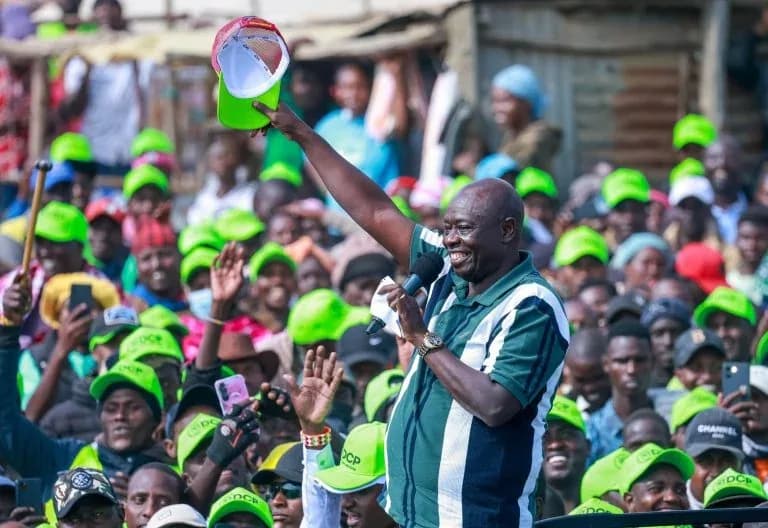
Former Deputy President Rigathi Gachagua / HANDOUT

Mt Kenya MPs allied to President William Ruto’s UDA are devising strategies to navigate the region’s fast-changing political terrain and survive or even thrive ahead of the 2027 general election.
They are trying to avoid the mounting anti-UDA wave in the region.
The region overwhelmingly voted for Ruto’s UDA in 2022, giving him 3.5 million of the 7.1 million votes he garnered in a closely contested race against ODM leader Raila Odinga.
However, since the impeachment of then Deputy President Rigathi Gachagua in October 2024 and subsequent formation of his Democracy for the Citizens Party in early last year, political tides in the region have shifted against MPs who supported his removal, with some being branded “traitors” to the community.
Geographically, Mt Kenya comprises Nyeri, Nyandarua, Murang’a, Kiambu, Kirinyaga, Embu, Meru and Tharaka-Nithi counties, with Nakuru and Laikipia considered diaspora regions.
In his political fightback, Gachagua began popularising DCP across these counties, labelling MPs who supported his impeachment “traitors of the community” (akunyaniri a ruuriri), while celebrating those who stood with him as “heroes of the community” (ituungati cia ruuriri).
The DCP leader borrowed the phrasing from the Mau Mau struggle during which members of the Gikuyu community who collaborated with the British colonial administration in the 1950s were branded traitors and associated with the home guards. Those who fought colonial rule were regarded as heroes.
With his messaging gaining traction and shaping political perceptions in the region, DCP appears to have gained an advantage over UDA, particularly following the Ol-Kalou by-election on July 16. DCP’s Kamau Ngotho defeated UDA’s Samuel Muchina by 35,440 votes to 5, 450 votes.
UDA-allied MPs have consequently begun devising strategies to navigate the political predicament in which they find themselves.
One strategy is to form alternative political parties to gradually distance themselves from UDA, which has gradually lost popularity in the region.
According to the Office of the Registrar of Political Parties, more than 30 of the country’s more than 90 political parties originate from Mt Kenya region.
DCP has been rattled by Kiharu MP Ndindi Nyoro, who defected from UDA and joined the Peoples' Party of Kenya. The party enjoyed a period of perceived political dominance following the Ol-Kalau by-election.
A number of other parties have emerged as alternative political vehicles for politicians seeking to avoid the anti-UDA backlash
Those who formed or joined other parties include Nderitu Muriithi, a former Laikipia governor seeking to reclaim the seat in 2027; Trade Cabinet Secretary Lee Kinyanjui, who has rejoined the Ubuntu Peoples’ Party and Ndia MP George Kariuki, who has reportedly acquired The National Party, previously owned by former Thika Town MP Patrick Wainaina, popularly known as Jungle.
Kinyanjui is seeking the Nakuru governorship, a position he held between 2017 and 2022.
Meanwhile, Kariuki has been trying to position himself as a possible 2027 running mate for President Ruto, presumably bringing many Mt Kenya votes.
Other parties in the region include the Mkenya Solidarity Party, led by former Mungiki leader Maina Njenga and The Service Party, led by Laikipia East MP Mwangi Kiunjuri.
On October 17, Kieni MP Njoroge Wainaina, a close Ruto ally, announced that he had formed his own party, the Ufanisi Kenya Party, as an alternative vehicle to seek reelection.
“Because of the grace of God, and because we have severally been reminded that we went to a wedding with someone else’s vehicle, I have formed my [Peugeot] 504,” he said. “It will carry all the residents of Kieni. This is the Ufanisi Kenya Party. Kieni can also produce good things. I am the second known party leader in Nyeri county after Rigathi Gachagua.”
The Peugeot 504 was a status symbol of government authority and political clout when it was the standard-issue vehicle for the state in the 1970s, ’80s and ’90s.
Last Sunday, Runyenjes MP Eric Karemba, another Ruto ally, announced that he would not defend his seat on a UDA ticket. He said he would announce his new party within two months.
“It is good that I inform you that the time has come for me to look for a party. I know there are many parties. What I know is that next year, I will not contest on the UDA ticket,” Karemba said while addressing constituents in Gikuuri, Runyenjes.
“In less than two months, I will have spoken to my people and leaders of different parties. I will have announced the party I will use to vie for the Runyenjes parliamentary seat in 2027.”
On Monday, Molo MP Kuria Kimani, another close Ruto ally, said he would defend his seat on a UDA ticket next year, but also said he was ready to join Gachagua’s DCP should it win the election.
Pressed on when he would make his decision, Kimani responded, “In the morning!”
He argued that political parties were often vehicles for gaining power rather than institutions to which politicians maintained unwavering loyalty.
“This is a trend that has happened over the years. When politicians realised there is usually no allegiance to political parties, they board political vehicles for convenience,” he said.
Other politicians who have made high-profile defections from UDA include Murang’a Governor Irungu Kang’ata and his Nyandarua counterpart Kiarie Badilisha. Both have joined DCP.
Kiambu Governor Kimani Wamatangi has also publicly distanced himself from UDA, saying he would contest the 2027 election on whatever political platform Kiambu residents prefer.
Nakuru Senator Tabitha Karanja has announced her departure from UDA and plans to contest the Nakuru gubernatorial race on a DCP ticket.
Several MPs have also shifted their political positions. They are Githunguri MP Gathoni Wamuchomba and her Gatundu South counterpart Gabriel Kagombe.
Amid the politicians’ moves to change camps, the central question is whether they can win back the anti-UDA electorate.
Political analyst Prof Macharia Munene says the MPs face a herculean task in winning over a region already “radicalised” against the current administration.
Speaking to the Star, Munene argued that while most MPs may have come to terms with their political predicament, the formation of alternative parties was intended to save them from sinking into political oblivion after 2027.
“Already, most of these MPs and politicians are marked. They may avoid going to the people with their parties directly, but they will still be seen as appendages and extensions of the UDA,” the university don said.
“They may lose their seats, but they will have ensured they are still on people’s lips, courtesy of the parties they have formed.
“It’s the political season. Most will also use the parties to cash in [by selling their parties] as aspirants will be looking for parties to contest for.”
Winning political acceptance is another dilemma for the MPs, particularly those who have defected directly from UDA to DCP.
On August 16, a day after announcing his defection from UDA to DCP, MP Kagombe from Gatungu South pleaded with Gachagua to accept him as a “prodigal son” and not victimise him.
“I was Saul, but now I have seen the light in Damascus; I reformed and became Paul,” Kagombe said.
He invoked the biblical parable of the prodigal son to explain his return to Gachagua’s political camp.
“If you read the Book of Luke 15:11 and the entire chapter, there is the story of the prodigal son. When he suffered, he returned to his father and confessed. I have experienced all the challenges on the other faction [UDA]. I have come to ask for your forgiveness,” he said.
Despite his plea, Kagombe was heckled later that day in Gachagua’s presence during a political rally in Thika town, Kiambu county.
Karanja met the same hostile reception .
Days after defecting from DCP, she organised a meeting for the party’s aspirants seeking elective positions in Nakuru county.
However, the party disowned the meeting and directed its aspirants not to attend, exposing early tensions between the senator and the party leadership.
“The party hereby informs all DCP aspirants in Nakuru county that the meeting convened by gubernatorial aspirant Hon Tabitha Karanja is unauthorised, contrary to established party procedures, and will not take place. All aspirants and party officials are directed not to attend, facilitate, or participate in the said meeting,” party executive director Hezron Obaga said in a notice.
In Kirinyaga, former Kenya Seeds Company chairperson Wangui Ngirichi has also faced difficulties convincing the electorate that she is not a state “mole”.
This followed her resignation from her position and decision to join DCP as she positions herself to run for Kirinyaga governor.
“We are appealing to the opposition leadership and the leadership of all parties which we have united to have one voice. We are coming together as one.
“We are also asking: let’s have political tolerance about the tendencies of people being labelled as ‘mole’,” she said on September 2 during a church service in Kirinyaga.
Nyoro has also been fighting remarks portraying him as a ‘mole’, particularly from DCP politicians.
Political analyst and university lecturer Kipkorir Mutai maintains that while politicians aligned with UDA have time to shed the “mole” label before the 2027 elections, they must do more to regain the electorate’s trust.
“With 10 months to go before the August elections, political tides are subject to change. A shrewd politician can take advantage of the time to endear themselves to the electorate. This will, however, depend on how they lay their strategies,” Mutai said in an interview.
Comments
No comments yet. Be the first to share your thoughts.