
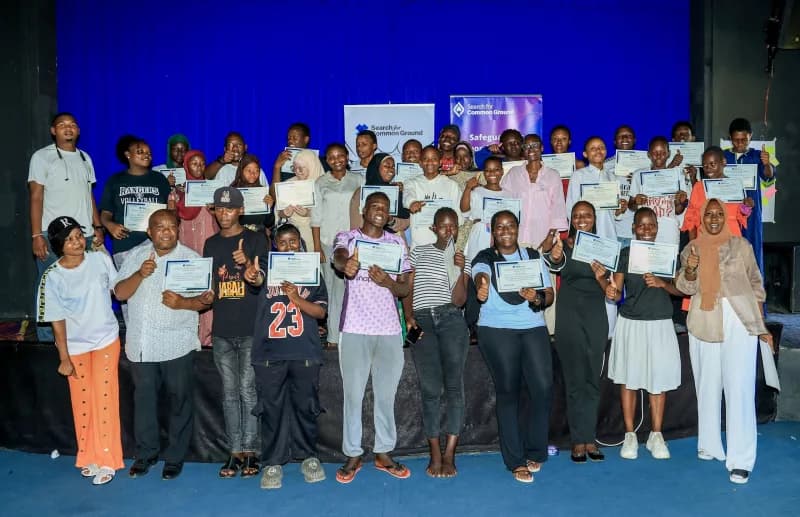
Search for Common Ground’S Wahida Mohamed at Little Theatre Club in Mombasa on Wednesday / BRIAN OTIENO

Politicians are changing tactics and now using younger people aged between 16 and 25 to do their dirty work for them, a forum has heard.
The Youth Talk forum, organised by Search for Common Ground, a peace-building and conflict transformation organisation, heard that older youths aged between 25 and 35 were now more self-aware and could not be easily influenced into crime or hooliganism.
“We have noticed a change in trend when it comes to matters of insecurity. It is no longer adults but children from as young as 16 years all the way to 25 who are engaged in insecurity. It not only shows a change in trend but also a change in values and the value systems,” Mombasa Island Assistant County Commissioner Lucy Kabura said.
She spoke at Little Theatre Club on Wednesday while presenting certificates to 33 young people who had completed a three-day leadership training programme organised by Search for Common Ground for those aged between 13 and 18.
Kabura said young people were emulating society.
“So, I pose this to society. Who are you as a leader? Who are the young people emulating? Are they intolerant? Are the anger bursts we see on social media a reflection of you as a leader in society? This is the challenge to us as leaders,” Kabura said.
She urged parents to provide positive guidance to their children, saying the current generation needed gentle persuasion rather than force.
“Children belong to the parents first before they belong to government,” Kabura said.
She said leaders such as herself acted as mentors to demonstrate that women could also serve in governance.
“I have been in this space for five years now and I am still a youth,” Kabura said, adding that young people needed to register as voters and elect the leaders they wanted.
Search for Common Ground’s Wahida Mohamed, who heads the Youth Talk project, said young people had the potential to become excellent leaders and make a positive impact in their communities but lacked the little push needed to achieve this.
“We are here to harness that potential and from this we hope they can be good role models to those who see them and those they work with,” Mohamed said.
This is particularly important as the long holiday season begins and young people find themselves free for almost two months.
“We know that in every area, there are people who can positively influence other people. These are the ones we target so that this cascades down to the grassroots and eventually we will have a society of mostly good people,” Mohamed said.
She called on religious and political leaders, parents and teachers to use their platforms to promote peace, unity and cohesion and positively influence young people to become better leaders.
“Our youths are able to be led. They just need that someone to lead them. Parents at home need to be aware of their children’s movements. Talk to your children. Make them your friends,” Mohamed said.
Dishas Baraza, a young person from Jomvu, said he had been able to engage his peers, with some taking his advice while others still considered him too young to advise them.
“I am grateful these fora have given me the courage to speak to people. I used to fear speaking in public or approaching people much older than I am, but now I can confidently approach anyone and talk to them about any topic,” Baraza said.
He said that since he began attending the leadership training sessions, he had persuaded some of his peers to abandon vices such as drug abuse and political hooliganism.
“Although some of my friends have stopped abusing drugs altogether, some have only reduced their intake, but I count that as an achievement as well,” Baraza said.
He noted that some of those who had heeded his advice were now forming youth groups through which they applied for grants to start development projects that could empower them financially.
Baraza said crime rates had declined in Jomvu, where he comes from, because most young people were engaging in positive activities.
Youth Talk facilitator Ali Salim said young people from across Mombasa had received training in leadership, governance, effective communication, self-awareness, accountability and other virtues.
“These are life skills that they may not get to learn effectively in other places. This is important because it also engages them while they are on holiday. They get extra skills out of school. We are preparing them for leadership roles in their future,” Salim said.
He said it was important to expose young people to real-life issues and situations to help society prevent potential problems, especially during the long holiday.


Comments
No comments yet. Be the first to share your thoughts.