
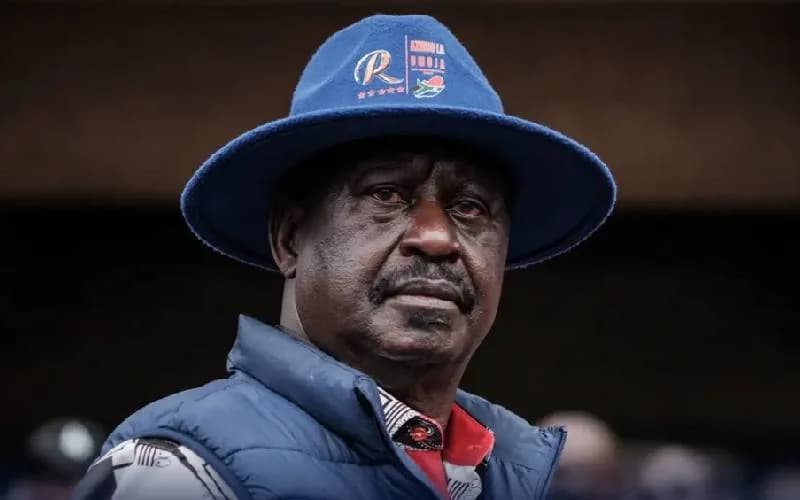
Raila Odinga's death anniversary puts ODM's identity, future in spotlight

The debate over Raila Odinga's legacy is especially pressing within the Orange Democratic Movement (ODM), the party he helped found and led for years.
As Kenya marked the first anniversary of Raila Odinga's death on Thursday, the former prime minister remained a towering figure.
For many, he symbolised the struggle for multiparty democracy and constitutional reforms. For others, his political alliances raised questions about compromise, opposition politics and the direction of the movement he built.
The question was not only how Kenya remembered Raila - but whether the principles he championed could survive. "I wanted his legacy to live beyond the party," 20-year-old Nairobi resident Beatrice Chebet told DW.
Chebet said Raila wanted a Kenya grounded in peace, democracy, constitutionalism and the rule of law. She said younger generations had to carry those aspirations forward.
He had a lasting effect on the experiences and political journey of younger Kenyans, Chebet said. "Some of us were Gen Zs," she said. "We did not know any form of multipartyism without reading Raila.”
Forged in struggle
Latest Stories
- African countries could save billions by cutting air pollution and greenhouse gases at the same time
- Nominated Senator Crystal Asige joins Winnie Odinga and Jalang’o in Nairobi Senate race
- Tusker FC suffer home defeat as Singida strike puts CAF Confederation Cup hopes at risk
- Ecuadorian priest dies after giant wooden crucifix crashes down on him during live-streamed Mass
Raila's influence was shaped by decades of opposition politics, detentions and campaigns for democratic change.
His role in the disputed 2007 presidential election placed him at the centre of one of Kenya's most consequential political crises. The post-election violence killed more than 1,100 people and displaced hundreds of thousands.
A power-sharing agreement brokered with international mediation led by Kofi Annan, the former secretary-general of the United Nations, made Raila Prime Minister in a coalition government with President Mwai Kibaki.
The settlement also established a reform agenda, including constitutional change. Kenya adopted a new constitution in 2010, introducing a devolved system of government.
The security and intelligence strategist Byron Adera said Raila's impact extended beyond electoral politics. "Raila was an institution that rocked institutions, bringing about lasting and very impactful institutional reforms for the betterment of Kenya," Adera told DW. He identifies constitutional reform and efforts to bring competing political interests together as important parts of Odinga's legacy.
Reconciliation also became one of the most contested aspects of Raila's career. His "handshakes" of reconciliation with Kibaki in 2008 and President Uhuru Kenyatta in 2018, and cooperation with President William Ruto in 2024, illustrated his willingness to pursue political agreements with former rivals.
Supporters saw dialogue as a way to reduce tensions and advance national interests; critics questioned what such arrangements meant for an independent opposition. Former Deputy President Rigathi Gachagua has strongly criticised the political rapprochement between President William Ruto and the late Raila.
In May, Gachagua called the handshake process "nonsense" and said it had eroded Kenya's democracy by weakening the opposition's ability to hold the government accountable. His position offers a contrasting view of the alliances that shaped Raila's later political years.
What happens to Odinga's ODM party?
The debate over Raila's legacy is especially pressing within the Orange Democratic Movement (ODM), the party he helped found and led for years.
Edwin Sifuna, a potential presidential candidate in the 2027 election, who describes Raila as both his leader and friend, said the ODM's identity and direction had changed fundamentally.
"We run the risk of losing our core support, people who believed in the ideals of ODM, because we were always the party of the people," Sifuna told DW.
Sifuna said Raila's influence on national politics and public debate was greatly missed.
His remarks point to a central challenge for ODM: whether it can preserve its identity and connection with ordinary Kenyans while navigating a changing political landscape. However, in a bid to keep the Raila name in politics, Winnie Odinga, daughter of Raila Odinga, declared that she will run for Senator of Nairobi County in the 2027 election.
Chebet said Raila's legacy would be measured by whether future generations continue to defend the principles associated with his political journey. Adera, meanwhile, emphasises the lasting importance of institutional reform and building bridges.
Their perspectives highlight the tension at the heart of Raila's legacy: a leader remembered for expanding democratic possibilities, but whose political compromises remain debatable. A year after his death, his influence is still visible in Kenya's political arguments, party divisions and public calls for democratic accountability.
The lasting test will be whether Kenya's institutions, political parties and younger generation can carry those principles forward - and whether the democratic space Raila helped shape can endure beyond the man himself.
Comments
No comments yet. Be the first to share your thoughts.