
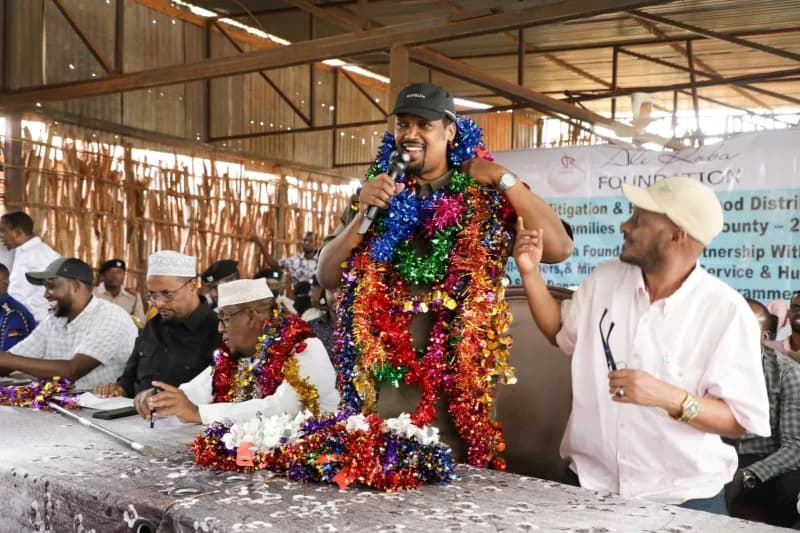
Mandera Senator and United Democratic Movement (UDM) party leader Ali Roba speaking.

Mandera Senator Ali Roba has defended the continued existence of the United Democratic Movement (UDM).
Roba argued that allowing allied parties to compete for elective seats could strengthen President William Ruto’s re-election bid in 2027.
The senator, who leads UDM, said the party was not opposed to the ruling UDA fielding candidates in North Eastern. He dismissed calls for affiliate parties to fold into a single political vehicle.
Speaking to the Star, he argued that competition for governor, senator, parliamentary and ward seats should not distract the President from his primary objective of securing the presidential vote.
“UDA should be allowed to field candidates, just as other parties should be allowed to do so. That way, the President and his team can keep their eyes on the ball. And what is the ball? It is the presidential vote,” Roba said.
He proposed that UDA, UDM and other parties supporting Ruto field separate candidates for local positions while coordinating support for his re-election.
Roba warned that forcing all aspirants into UDA would not eliminate competition, as dissatisfied candidates could seek nominations through other parties.
“If UDA issues nomination tickets to one line-up, that does not mean the other candidates will disappear. This is a democracy,” he said, predicting that at least three political formations would compete in the region in 2027.
He cited the 2022 General Election, when Mandera had three competitive political formations, arguing that a similar arrangement could emerge next year.
UDM has established a strong presence in Mandera, where its representation includes three MPs, a governor, a senator and a woman representative. Nationally, the party has two governors, three senators, eight MPs and several MCAs.
Roba said the party had built an independent political identity that could not be erased by calls to join UDA.
“UDM has emerged as a very strong political force, and it is not going to accept party primaries easily,” he said.
He cited the high cost of mobilising pastoralist communities, registering voters and ensuring they turn out on Election Day as a major obstacle to competitive party nominations.
“Given the prohibitive cost of the exercise, conducting party primaries would effectively mean holding two elections: one for party nominations and another for the general election,” he said.
Roba argued that negotiations and consensus-building had traditionally helped political actors in pastoralist areas agree on candidates. He said this made it difficult to compel all aspirants to accept a single party ticket.
He also questioned whether dissolving UDM would improve Ruto’s re-election prospects, arguing that the President could build a broad coalition without requiring allied parties to surrender their identities.
“Once he secures the presidential vote, will it be difficult for him to build a strong coalition to help him govern the country? No, definitely not,” Roba said.
He maintained that UDM’s continued existence would allow competing local political interests to coexist while supporting the President nationally.
“For that reason, folding UDM would not serve his strategic interests. On the contrary, having UDM remain in the political landscape is strategically important to him,” he said.

Comments
No comments yet. Be the first to share your thoughts.