
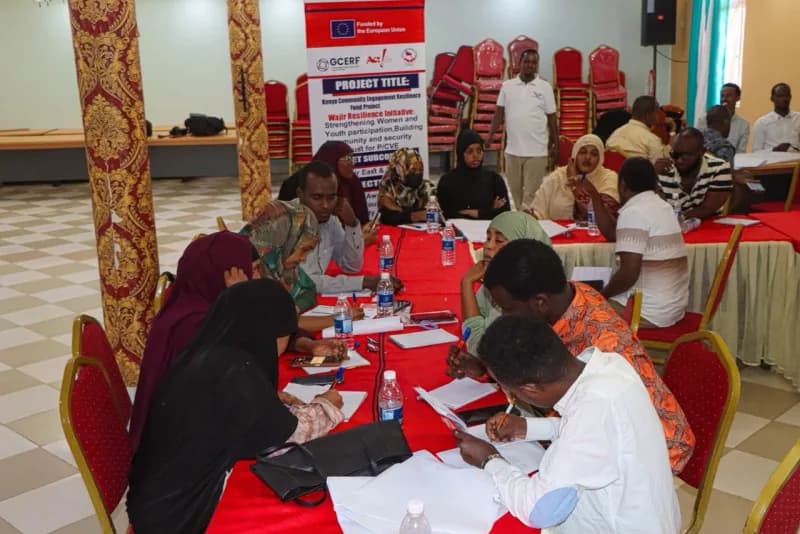
Peace actors from Wajir at the meeting.

Peace actors in Wajir have warned that disputes over new settlements, competition for scarce resources and political rivalries could deepen community divisions and undermine efforts to prevent violent extremism ahead of the 2027 General Election.
The stakeholders also raised concerns about cross-border ethnic tensions and the spread of divisive content on social media.
They warned that unresolved grievances could escalate into wider security threats if not addressed early.
They spoke during a dialogue organised by the Women Rights Advocacy Initiative (WORAI), which brought together community representatives and security officials to discuss emerging threats and strengthen collaboration in preventing conflict.
Wajir County Director of Peace Building Aden Abdi said unresolved disputes and inflammatory public discourse threatened peaceful coexistence.
He called for closer cooperation between communities and security agencies to identify early warning signs and respond before tensions escalated.
He cautioned against the misuse of social media to spread harmful messages, particularly as political activities gathered momentum ahead of the 2027 polls.
“We all have a role to play in ensuring we curb the misuse of social media. The way to go is collaboration between the community and security agents,” Abdi said.
The dialogue also examined links between violent extremism and other security concerns, including human trafficking, disputes arising from new settlements and cross-border ethnic tensions.
Participants called for stronger community-based early warning systems and better information-sharing among residents, peacebuilding organisations and security agencies to enable timely intervention.
Maendeleo ya Wanawake Wajir branch chairperson Rukia Abdullahi Barrow warned that the establishment and expansion of settlements without adequate consideration of available resources could fuel hostility between communities.
“New settlement is a ticking time bomb. The resources we have are already overstretched,” Barrow said.
She accused some politicians of encouraging the establishment of settlements to consolidate electoral support. She warned that political interests should not be allowed to fuel disputes over land, water and other essential resources.
Barrow said women and children would be particularly vulnerable if disagreements escalated into violence. She called for their greater involvement in peace-building initiatives and decisions affecting community security.
“It is very expensive to bring back peace but easy to destroy,” she said.
She urged the National Cohesion and Integration Commission to take action against hate speech and divisive political rhetoric, alleging that some politicians were contributing to tensions through inflammatory messages.
Wajir East Deputy County Commissioner George Onyango welcomed the dialogue, saying it provided an opportunity for communities and security officials to renew their commitment to peace and identify practical ways to address emerging threats.
“I am impressed by this dialogue in bringing peace in our community,” he said.
Onyango urged participants to sustain the engagement beyond the meeting and strengthen grassroots peace-building initiatives.
He emphasised the need for continued cooperation between communities and government agencies to address grievances before they escalated into wider security threats.
Wajir and other arid and semi-arid areas face security and development challenges linked to competition for scarce natural resources, pastoral mobility across administrative and national borders, and tensions that can be aggravated by political competition.
Such disputes can erode trust between communities, while unresolved grievances may create opportunities for criminal networks and extremist recruiters to exploit local tensions.
The dialogue was held under the Kenya Community Engagement and Resilience Programme, funded by the European Union through the Global Community Engagement and Resilience Fund and implemented under the leadership of ACT Change Transform.
The programme seeks to strengthen community resilience and prevent violent extremism through sustained engagement, local partnerships and collaborative approaches to addressing factors that contribute to insecurity.
Wajir’s peace is facing growing pressure from settlement disputes, competition over scarce resources and political rivalries ahead of the 2027 elections. The warning from peace-building actors underscores the danger of allowing local grievances and divisive rhetoric to escalate into wider insecurity. With women and children likely to bear the heaviest cost of violence, early intervention, accountable leadership and stronger cooperation between communities and security agencies are critical to preventing conflict and protecting fragile inter-community relations.


Comments
No comments yet. Be the first to share your thoughts.