
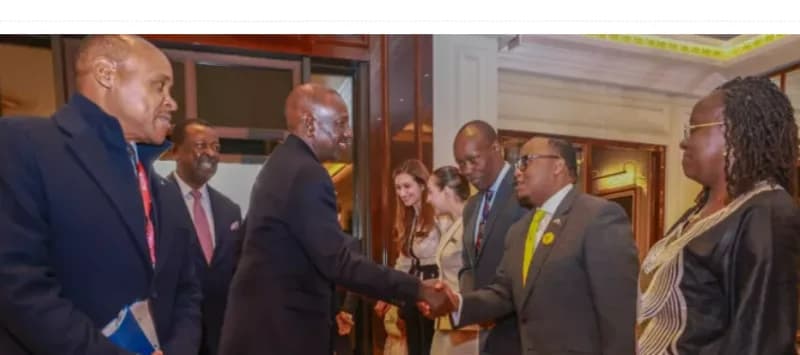
President William Ruto is received by Kenayn embassy officials when he arrived in Moscow on October 28, 2026/PCS

President William Ruto has challenged Russian companies to establish factories in Kenya and invest in local industries, seeking to transform bilateral trade into partnerships that create jobs, transfer technology and boost manufacturing.
Ruto said Kenya wanted to move away from a trade model in which African countries export raw materials and import manufactured goods, arguing that the arrangement denied local economies the full benefits of their resources.
Speaking at the Russia-Kenya Business Roundtable in Moscow on Wednesday, the President said the two countries needed to deepen economic ties by investing in industries that would expand production and create employment.
“For too long, Africa’s engagement with the global economy has been defined by the export of raw materials and the importation of manufactured goods, with much of the value, industry and employment created elsewhere,” he said.
“This model has constrained Africa’s industrial development and denied our people the full economic benefits of their resources. It is neither sustainable nor acceptable.”
The push comes against the backdrop of a significant trade imbalance between the two countries, with Kenya importing far more from Russia than it exports.
According to Ruto, bilateral trade stood at approximately $380 million in 2025, with Kenyan exports valued at $52 million against imports worth $330 million.
Kenya's exports to Russia mainly comprise tea, coffee, flowers, fruits and vegetables, while imports include wheat, fertilisers, iron and steel products.
Russian investment in Kenya is estimated at $22 million, figures Ruto said demonstrated the need to rethink the nature of the economic relationship.
He called for Russian investors to channel capital and expertise into manufacturing, mineral processing, agricultural production, energy, transport and engineering.
“Not the extraction of resources alone, but the creation of value. Not simply markets for finished products, but opportunities to establish industries, transfer technology, develop skills and create jobs,” he said.
Ruto said Kenya wanted partnerships that would enable the country to process more agricultural produce, manufacture goods locally and develop its mineral resources, creating employment while opening up new markets for investors.
“Our ambition is not to divide existing value differently, but to create more value together and share in the prosperity it generates,” he said.
The President identified Russia's expertise in energy, mining, fertiliser production, engineering, transport and manufacturing as areas that could support Kenya's industrialisation agenda.
He also pitched Kenya as a regional production and distribution hub, citing its strategic location and access to the wider African market.
Through the African Continental Free Trade Area, businesses operating in Kenya could access a continental market of 1.5 billion people, he said.
“Our proposition is straightforward: Invest in Kenya, manufacture in Kenya, and serve Africa and the world from Kenya,” Ruto said.
He added that Kenya was mobilising $40 billion for infrastructure development over the next decade, presenting opportunities for private investors through the National Infrastructure Fund.
The country was also seeking investment in geothermal energy, green hydrogen, electric mobility and energy infrastructure, supported by its renewable electricity base.
Ruto urged Russian businesses to identify specific projects, partner with Kenyan enterprises and develop commercially viable investment plans with clear implementation timelines.
He said the success of the partnership should be measured by projects implemented, industries established and jobs created rather than agreements signed.
“The purpose of this Roundtable is to translate the goodwill between our countries into tangible commercial outcomes,” he said.
Comments
No comments yet. Be the first to share your thoughts.