
Wreckage of a Dreamline bus lodged against a Maersk shipping-container trailer after the vehicles collided along the Mombasa-Nairobi Highway near Taru and Mackinnon Road on September 23, 2026.

The government is reviving plans to transform the Nairobi-Mombasa highway into a tolled expressway, reopening the long-running infrastructure project.
The road has witnessed deadly crashes lately, exposing the dangers facing motorists on the busy road.
The latest accident, which killed 23 people, occurred barely three weeks after another collision claimed 17 lives, renewing calls for the government to expand the highway into a dual carriageway.
Currently, heavy trucks, passenger buses, matatus and private vehicles share the narrow road, with dangerous overtaking leaving motorists exposed to head-on collisions.
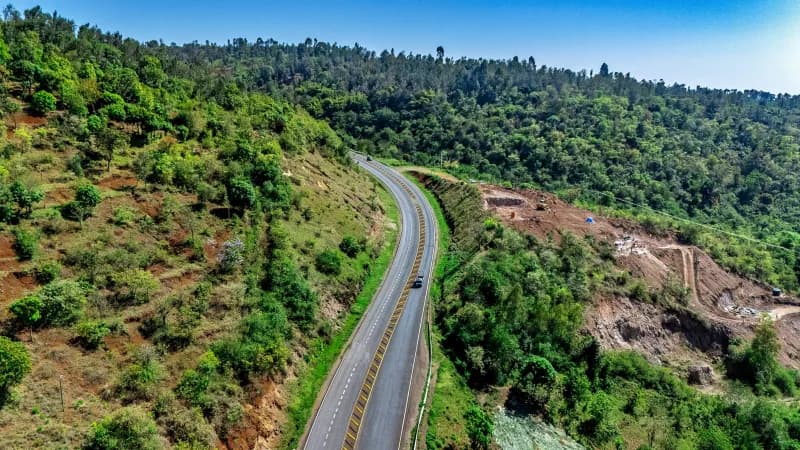
The proposed expressway could provide additional capacity on the 461-kilometre corridor linking the capital to the Port of Mombasa.
Even so, the government has yet to announce when construction will begin or how much the redesigned project will cost.
The plan is contained in the Draft 2027 Budget Policy Statement (BPS), which signals President William Ruto's administration intends to use public-private partnerships (PPPs) to finance major highways amid competing demands on public finances.
“Over the medium term, the Government will ... transition to PPPs for major highways, including the Nairobi-Mombasa Expressway and the Mau Summit-Eldoret-Malaba Highway,” the draft policy statement says.
The proposal marks a fresh attempt to advance a project that suffered a major setback last year when the government abandoned the original Usahihi Express proposal.
In December 2023, the government gave conditional approval for a privately initiated proposal by US investor Everstrong Capital Kenya to develop a new expressway between Nairobi and Mombasa.
The Sh468 billion project was designed as a four-lane, 459-kilometre greenfield highway running from Mlolongo in Machakos County to Bonje in Mombasa County.
Under the proposed PPP arrangement, the private investor would finance, build, operate and maintain the road before transferring it to the government. Toll charges would help the investor recover the investment.
However, the National Treasury's PPP Committee rejected the proposal at its meeting on July 2, 2025, ruling that it did not meet the required criteria under the PPP Act, 2021.
The Kenya National Highways Authority (KeNHA) subsequently announced that the proposal should be abandoned and directed that the project be restructured around expanding the existing A8 highway instead.
The latest plan therefore shifts attention from constructing a new highway to upgrading the existing transport corridor.
According to the Treasury's PPP Directorate, the revised project will expand the current 461-kilometre Mombasa-Nairobi road from two lanes to at least four lanes and convert it into an access-controlled tolled road.
The design is also expected to incorporate measures to minimise disruption to local traffic and connectivity.
The road is part of the Northern Corridor, a major regional transport route connecting the Port of Mombasa to Nairobi and countries in Central and Eastern Africa.
It carries cargo, merchandise and passengers, making it critical to trade and tourism.
As of September 30, 2026, the project was listed among the country's priority PPPs under the Fourth Medium-Term Plan.
The Treasury said procurement of a transaction adviser was underway after a fresh expression of interest was published on August 11, 2026. Evaluation of the bids was ongoing.
The adviser will help structure the project and assess its technical and financial viability before the government proceeds with the selection of a private investor.
The draft BPS does not specify the project's final cost, the proposed concession period or the toll charges motorists and transporters would pay.
Beyond the expressway, the government plans to construct 4,080 kilometres of new roads and 54 bridges over the medium term, rehabilitate 293 kilometres and maintain 121,229 kilometres of roads.
The administration also intends to complete Berth 1 at Dongo Kundu and Berth 19B, rehabilitate the Voi-Taveta railway line and advance Standard Gauge Railway Phases 2B and 2C to 50 per cent completion.
It further plans to mobilise private capital and logistics technology for container terminals, cargo berths, inland container depots and Special Economic Zones in Mombasa, Lamu, Nairobi and Naivasha.
The shift towards PPPs is intended to bring private financing into infrastructure development, reducing reliance on direct government funding.
A number of motorists have stated that their immediate concern remains the highway's safety record, with repeated fatal crashes highlighting the urgency of improving the road.
Comments
No comments yet. Be the first to share your thoughts.