
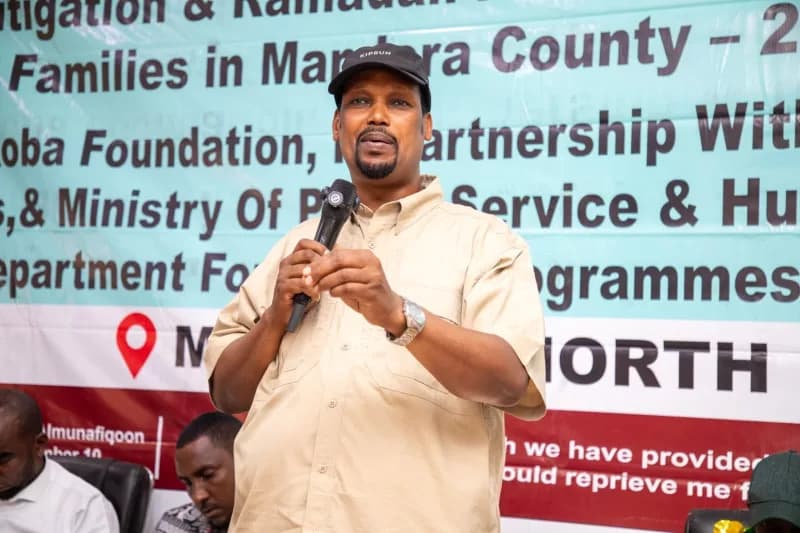
Mandera Senator Ali Roba speaking at a recent function.

Mandera Senator Ali Roba has said his decision on whether to defend his Senate seat in the 2027 General Election remains uncertain.
This puts his chances of contesting at 50-50 as he weighs wider political considerations within the United Democratic Movement (UDM).
Roba, who is also the UDM party leader and former Mandera governor, said he could opt out of the Senate race if circumstances required him to make political sacrifices to advance the party's broader interests and strategic ambitions.
Speaking during an exclusive interview, Roba said his final decision would depend on how political alignments and realignments unfold between now and December or January, when the political landscape is expected to become clearer.
"For now, the chances of running or not running are 50-50. If, for strategic reasons, I consider it necessary to make a sacrifice to ensure that politics takes shape in the direction we desire as a party, it is possible that I may not run," he said.
However, the senator dismissed suggestions that his possible decision not to seek re-election could be influenced by fears of losing the seat. He insisted that he remained confident of his political standing and enjoyed considerable goodwill among the electorate.
Roba, who served as Mandera governor for two terms before joining the Senate, said he was under immense pressure from supporters who expected him to defend his seat, given his political experience and influence in the region.
He said leadership sometimes required individuals to put collective interests ahead of personal ambitions, particularly in a politically complex region where clan considerations, alliances and negotiated political arrangements often influenced electoral outcomes.
"My possible decision not to contest would not be driven by fear of losing an election. It would be informed by prevailing circumstances that might require a different political decision to achieve the results we desire," he said.
He, however, maintained that revealing the considerations behind his possible political withdrawal would undermine the party's strategy. He said some decisions had to remain confidential until the appropriate time.
"A strategy ceases to be a strategy once it is made public. You have to keep certain things close to your heart until the right time when you can make the necessary decisions," he said.
The senator's remarks come as UDM intensifies efforts to consolidate its political influence ahead of the 2027 elections, with the party setting an ambitious target of doubling the number of its elected leaders across the country.
Roba said the party was targeting an increase from its current 64 elected leaders to at least 128 in the next General Election. It also aims to increase its number of governors from two to four.
He said the party's growing appeal was reflected in the increasing number of politicians and aspirants seeking to join it and contest elective positions on its ticket.
"When we started this journey, UDM was practically dormant despite Kenya having about 90 registered political parties. We took it from the shelves and managed to move it to position five nationally," he said.
"If, with the help of Almighty Allah and His will, we managed to move from position 90 to number five, there is no reason to limit our ambitions," he said.
The party has established a particularly strong political base in Mandera, where its elected representation includes three Members of Parliament, a governor, a senator and a woman representative.
Nationally, UDM has two governors, three senators, eight MPs and several Members of County Assemblies. Roba believes this footprint provides a strong foundation for the party's expansion.
He said the party was determined to move beyond regional political influence and establish itself as a major national political force, with ambitions of eventually becoming the country's second- or third-largest political party.
Roba maintained that UDM's growth was not simply about securing elective positions or short-term political gains. Rather, it was about ensuring that pastoralist communities and historically marginalised regions secured meaningful representation in national decision-making.
He said communities in Northern Kenya and other pastoralist counties should have an equal opportunity to participate in shaping the country's political and economic future, rather than merely being presented with decisions made elsewhere.
"Our existence is not about short-term political gains or securing positions. It is about establishing long-term political relevance," he said.
"We do not want a situation where political decisions are made around a table somewhere far away from us, then presented to our communities for acceptance. We want to be part of the discussions, negotiations and decisions that shape the country's political direction," he added.
Roba said UDM was positioning itself as a national party with a strong pastoralist identity, drawing support from communities in Turkana, Samburu, Mandera, Wajir, Garissa, Isiolo, Marsabit and Narok.
On emerging political realignments, Roba said the coming months would be critical in determining the direction of various political parties and coalitions. He noted that several politicians had already begun declaring their ambitions and positioning themselves ahead of the elections.
He said UDM was closely monitoring developments and would make strategic decisions once the political environment became clearer.
"Politicians must understand the political environment and the mood of the electorate. UDM is focused on building a sustainable political movement rather than rushing into electoral arrangements," he said.
On its relationship with the Kenya Kwanza administration, Roba said UDM expected favourable consideration in the political arrangement as the country approaches the next General Election.
He said the party was currently satisfied with its partnership with President William Ruto but expected its contribution to the President's re-election campaign to be recognised.
He noted that UDM had not campaigned for President Ruto in the 2022 General Election but was now committed to supporting his re-election bid.
"We did not campaign for President William Ruto during the last general election. This time around, however, we are committed to campaigning for him with everything we have," he said.
He argued that it was only natural for a political party making a significant contribution to an administration's political fortunes to expect consideration in the distribution of political opportunities and positions.
The senator cited the changing political landscape, noting that parties that were not part of the original Kenya Kwanza electoral arrangement, including ODM and Jubilee, had become beneficiaries of emerging political partnerships.
Roba also defended the loyalty of UDM's elected leaders, saying the party had managed to retain committed members despite lacking the financial and administrative advantages enjoyed by parties controlling government.
He said its members were driven largely by conviction and belief in the party's ideals rather than expectations of financial rewards or government appointments.
"Unlike ruling parties, which have the advantage of running government and distributing positions, parties such as ours depend largely on the natural loyalty and commitment of their members," he said.
Comments
No comments yet. Be the first to share your thoughts.