
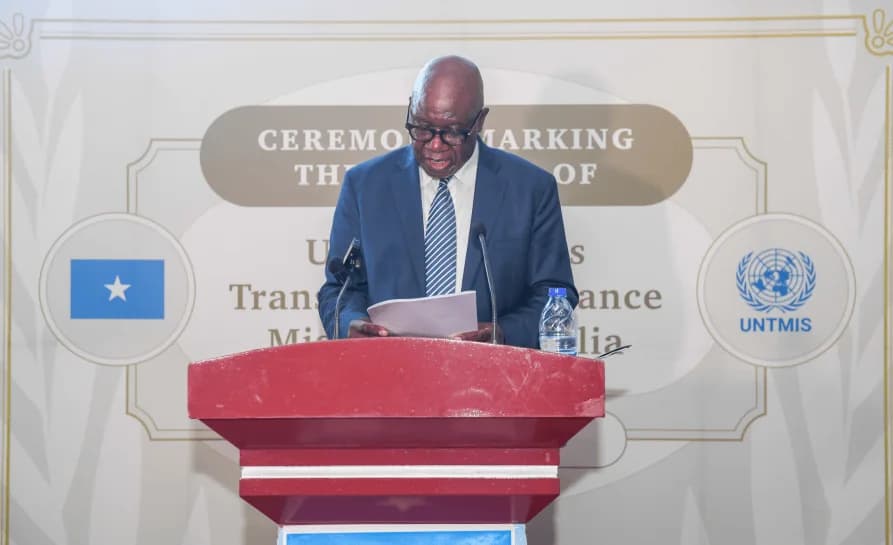
The United Nations (UN) has officially closed its political mission in Somalia, ending more than three decades of direct UN political engagement as responsibilities shift to Somali institutions.
The closure of the UN Transitional Assistance Mission in Somalia (UNTMIS) on October 31 follows a two-year transition process requested by the Federal Government of Somalia and agreed upon with the UN.
In a statement, UN Secretary-General Antonio Guterres called for sustained international support to consolidate progress, advance inclusive political dialogue and reconciliation, strengthen institutions, and promote and protect human rights.
Guterres also underscored the importance of continued support to address the threat posed by Al-Shabaab and facilitate a gradual and sustainable security transition.
UNTMIS was established after the UN Security Council adopted Resolution 2753 in November 2024 to transform the United Nations Assistance Mission in Somalia (UNSOM) following the Federal Government's request to conclude its mandate.
The mission's closure therefore brings to an end a succession of UN political operations in Somalia that began with the UN Political Office for Somalia (UNPOS) in 1995, followed by UNSOM in 2013 and UNTMIS in 2024.
The resolution established a two-year transition framework that culminated in the mission's closure in October 2026 after gradually transferring responsibilities to Somali institutions as the country assumed greater ownership of its political and governance processes.
On Saturday, UNTMIS said the transition involved transferring the mission's responsibilities to Somali government institutions, UN agencies, funds and programmes, and the United Nations Support Office for Somalia (UNSOS).
Over the years, the missions supported peacebuilding, national reconciliation, constitutional reforms, electoral processes, governance and the development of state institutions following the collapse of the central government in the early 1990s.
UNPOS supported early peace initiatives and transitional governance arrangements, while UNSOM worked with the Federal Government, Federal Member States and civil society organisations to strengthen political institutions, promote human rights and advance Somalia's federal system.
UNTMIS Officer-in-Charge Raisedon Zenenga, however, said the closure marked a new phase in the relationship between Somalia and the United Nations rather than an end to international support.
“Today is not an end to the partnership between the United Nations and Somalia - rather, it marks the conclusion of one chapter and the beginning of another,” Zenenga said.
The African Union (AU) has also played a significant role in supporting Somalia's security operations and efforts to extend state authority, helping create conditions for political and institutional recovery.
The mission noted that despite progress in state-building and governance, Somalia continues to face significant security and political challenges, including the threat posed by Al-Shabaab, constitutional and electoral disagreements, and recurrent humanitarian crises driven by drought and flooding.
UN Resident Coordinator for Somalia George Conway paid tribute to personnel who served in Somalia under difficult and dangerous conditions, including those who lost their lives supporting peace efforts.
Conway added that the closure would not affect the organisation's wider presence in the country, with UN agencies continuing to provide humanitarian, development and human rights support in collaboration with national and regional authorities, civil society and the private sector.
“The United Nations remains a committed partner to Somalia through its resident agencies and broader country presence, supporting the country's aspirations for peace, stability, sustainable development and prosperity,” Conway said.
According to Zenenga, Somalia had made significant progress since the beginning of UN political engagement, including the establishment of national and federal institutions, advancement of political inclusion and development of governance structures that support Somali-led decision-making.
He, however, cautioned that sustained international engagement would remain important in addressing outstanding political, security and institutional challenges.
Comments
No comments yet. Be the first to share your thoughts.