
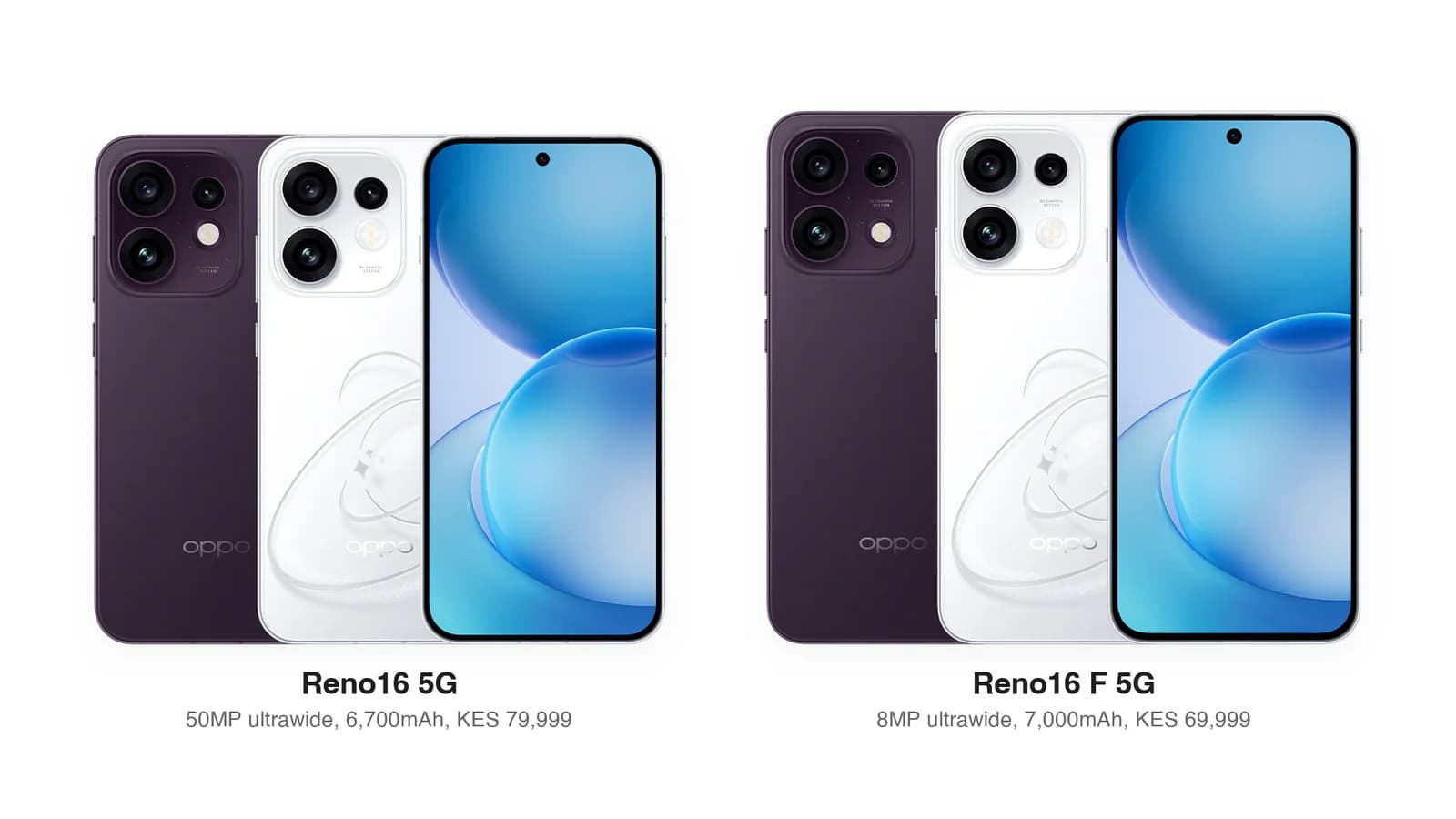
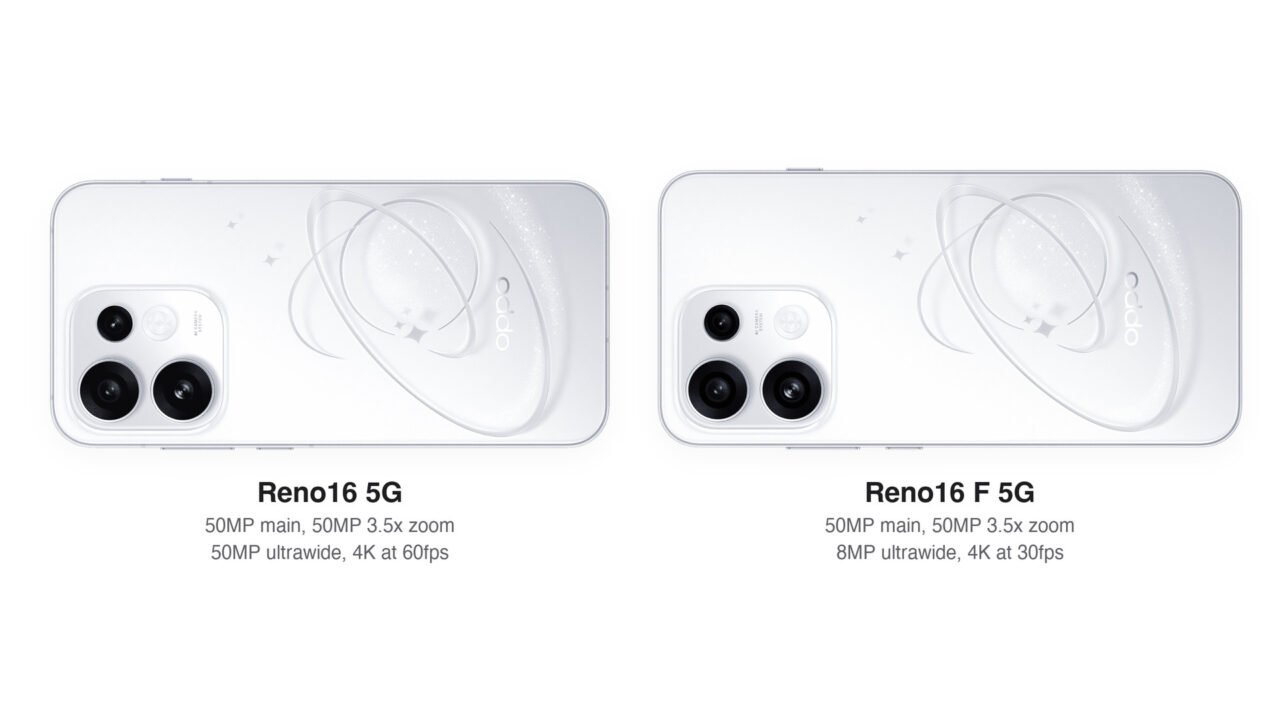
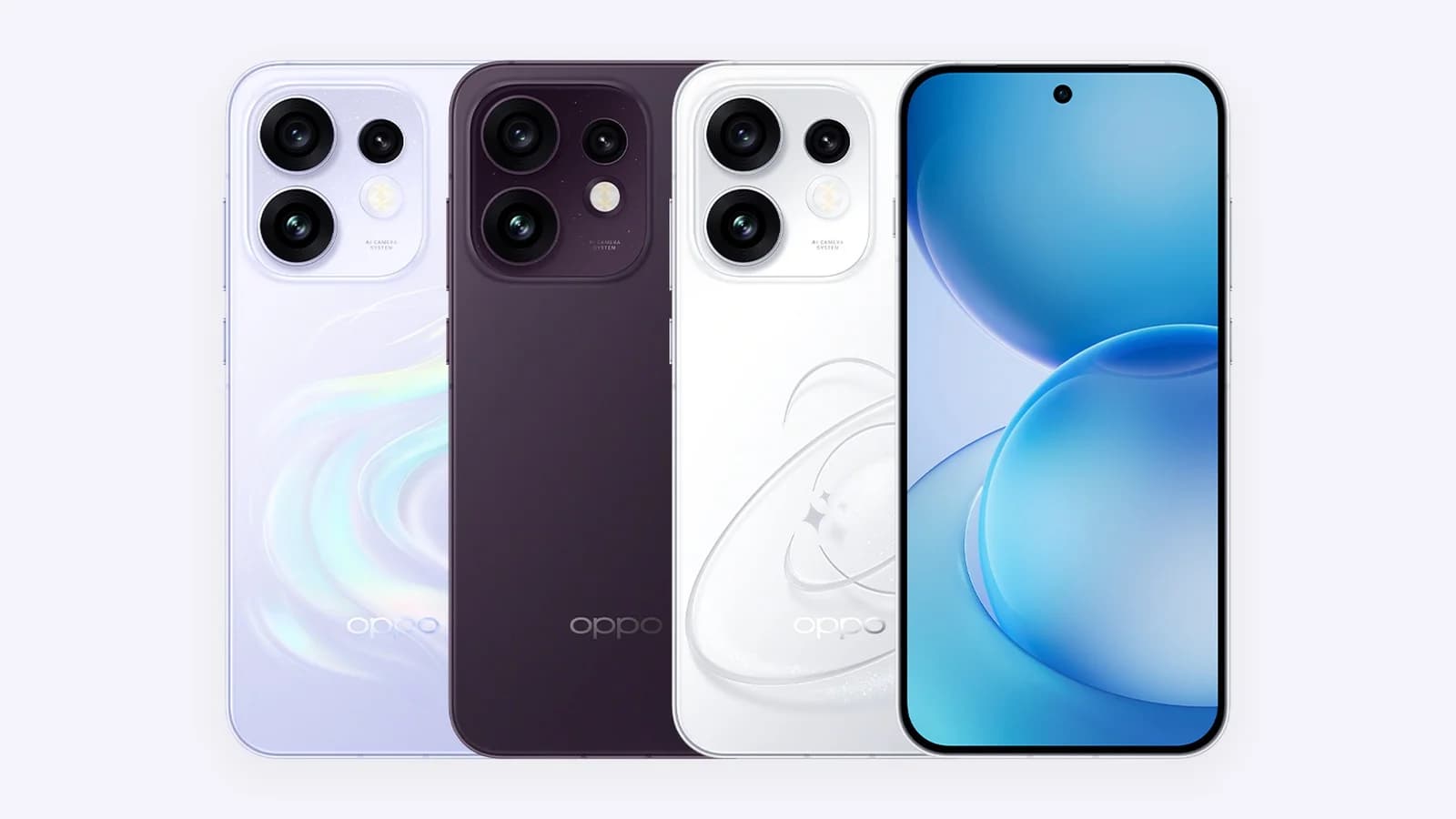
OPPO’s Reno16 and Reno16 F went on pre-order in Kenya on 26th October 2026, at KES 79,999 and KES 69,999. In our launch story we covered the differences you’ll see on the box: the Reno16 has a sharper 50MP ultrawide camera, a brighter screen, 4K video at 60 frames per second and eSIM, while the Reno16 F has the bigger 6.57-inch screen, the bigger battery and a memory card slot. Both have a 50MP main camera and a 50MP zoom camera with 3.5x optical zoom.
OPPO Kenya’s full Reno16 and Reno16 F spec sheets, and the footnotes on their product pages, show more differences than the box does: in the memory, the chip, the screen and a few extras.
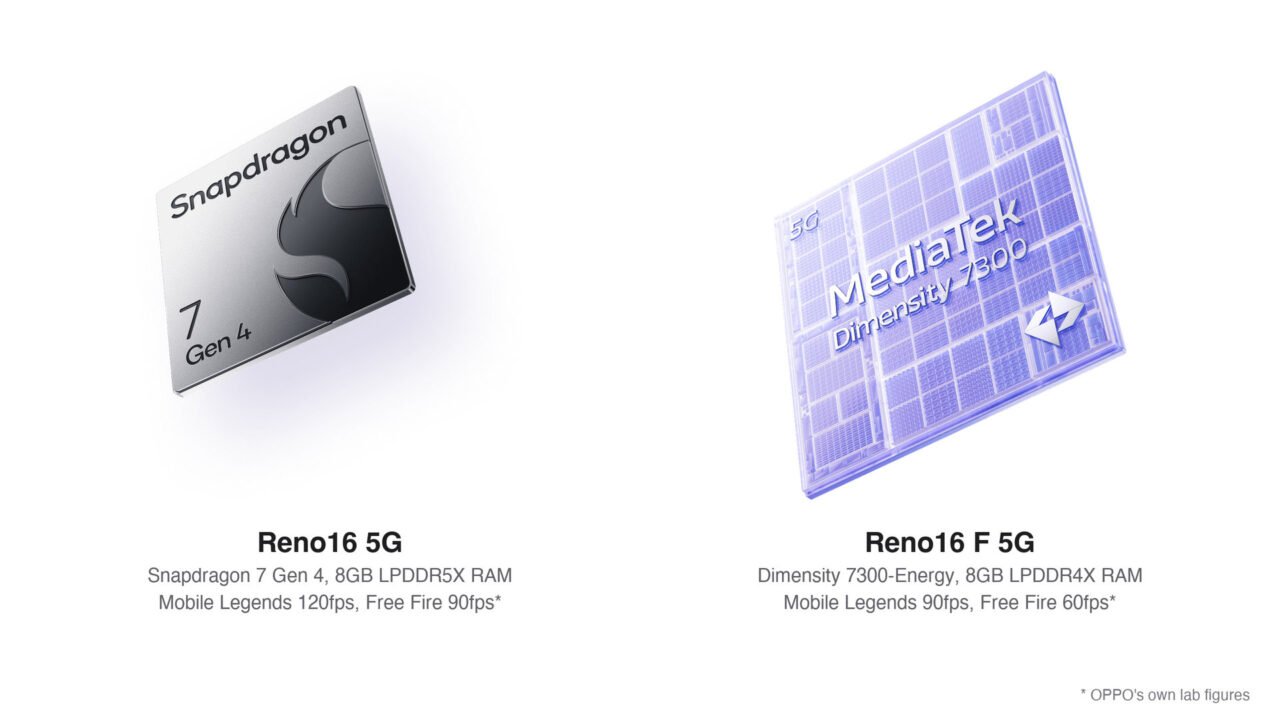
Both phones come with 8GB of RAM and 256GB of storage in Kenya, so on paper they’re the same. But the Reno16’s RAM is LPDDR5X and the Reno16 F’s is LPDDR4X. RAM is the working memory that open apps run in, and it comes in generations, with each newer one moving data to the processor faster. LPDDR5X is the newer generation. LPDDR4X is the older type we flagged on the vivo V80 earlier this month, though it’s nothing new for the Reno16 F line, since the Reno15 F uses it too. The storage itself is the same UFS 3.1 type on both.
The chips differ too. The Reno16 runs Qualcomm’s Snapdragon 7 Gen 4, whose fastest core runs at up to 2.8GHz. The Reno16 F runs MediaTek’s Dimensity 7300-Energy, a version of the Dimensity 7300, with four main cores at up to 2.5GHz. Both chips are built on a 4nm process.
In OPPO’s own lab tests, with each phone in its pro gamer mode, the Reno16 runs Mobile Legends: Bang Bang at 120 frames per second and Free Fire at 90. The Reno16 F runs them at 90 and 60. Frame rate is how many new pictures the game draws every second, so a higher number means smoother movement on screen, as long as the screen can show it, and both of these have 120Hz screens. So if you play either game seriously, the Reno16 gives you the smoother picture. If you mostly scroll, chat and watch video, we don’t think you’ll notice the chip difference day to day.
OPPO’s Reno16 page says the phone has an aerospace-grade aluminium frame, the band that runs around the sides. The Reno16 F’s page doesn’t say what its frame is made of. Both have a one-piece back that runs into the camera bump, and both carry the same lab-tested IP69K, IP69, IP68 and IP66 water and dust ratings.
On the screen, the Reno16’s page lists 3840Hz “eye-caring dimming”. OLED screens like these dim by switching the pixels off and on many times a second, and at low brightness some people get tired eyes or headaches from slower switching, so a higher rate is gentler on the eyes. The Reno16 F’s page doesn’t list a dimming rate. The Reno16’s screen is also packed tighter, at 460 pixels per inch against 397 on the F, because it fits more pixels into a smaller screen. Both have 120Hz refresh, a 240Hz touch response, 10-bit colour and 600 nits of normal brightness (nits measure how bright a screen is).
A few smaller extras are on the Reno16 only:
- An infrared blaster, so it can work as a remote for a TV or air conditioner.
- Two extra Bluetooth audio formats, aptX Adaptive and LHDC 5.0. These are the formats that carry sound to wireless earbuds, and they only help if your earbuds support them too. Both phones have LDAC, aptX HD, aptX and AAC.
- 4K video at 60 frames per second from the selfie camera as well as the back camera, plus 4K HDR video and a Pro Video mode.
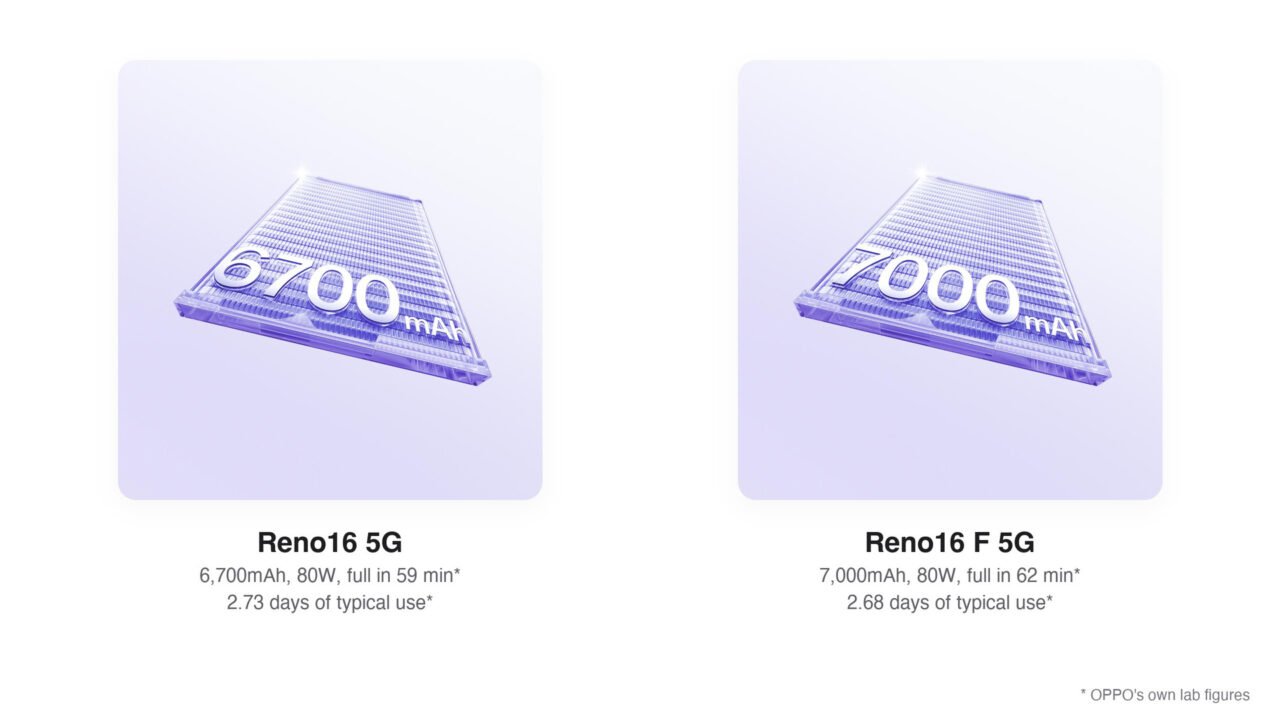
The Reno16 F’s battery is bigger, at 7,000mAh against 6,700mAh. Yet OPPO’s own lab gives the two phones almost the same battery life: 2.73 days of typical use for the Reno16 against 2.68 days for the Reno16 F, and 67.26 hours of calls against 69.6 hours. OPPO doesn’t say how it measured a day of use. We’ll test the Reno16’s battery in our review.
If you’re thinking of buying a unit brought in from abroad, check the battery size before you pay, because the model number won’t tell you.
| Reno16 5G | Reno16 F 5G | |
|---|---|---|
| Kenyan price | KES 79,999 | KES 69,999 |
| Model number | CPH2865 | CPH2859 |
| Chip | Snapdragon 7 Gen 4, 4nm, up to 2.8GHz | Dimensity 7300-Energy, 4nm, up to 2.5GHz |
| Graphics | Adreno 722 | Mali-G615 |
| RAM | 8GB LPDDR5X | 8GB LPDDR4X |
| Storage | 256GB UFS 3.1 | 256GB UFS 3.1 |
| microSD card | No | Yes |
| Screen | 6.32 in AMOLED, 2640 x 1216, 460 ppi | 6.57 in AMOLED, 2372 x 1080, 397 ppi |
| Refresh and touch rate | 120Hz, 240Hz touch | 120Hz, 240Hz touch |
| Brightness | 600 nits, 1,800 nits high-brightness mode | 600 nits, 1,400 nits high-brightness mode |
| Dimming rate | 3840Hz | Not stated |
| Main camera | 50MP, f/1.8, OIS | 50MP, f/1.8, OIS |
| Telephoto camera | 50MP, f/2.8, 3.5x optical, OIS, 30 degrees | 50MP, f/2.8, 3.5x optical, OIS, 26 degrees |
| Ultrawide camera | 50MP, f/2.0, 116 degrees | 8MP, f/2.2, 116 degrees |
| Selfie camera | 50MP, f/2.0, 100 degrees | 50MP, f/2.0, 100 degrees |
| Rear video | 4K at 60fps, 4K HDR | 4K at 30fps |
| Selfie video | 4K at 60fps | 4K at 30fps |
| Digital zoom | Up to 120x photo, 18x video | Up to 60x photo, 10x video |
| Game frame rates (OPPO lab) | Mobile Legends 120fps, Free Fire 90fps | Mobile Legends 90fps, Free Fire 60fps |
| Battery | 6,700mAh (24.93Wh) | 7,000mAh (27.44Wh) |
| Battery life (OPPO lab) | 2.73 days, 67.26 hours of calls | 2.68 days, 69.6 hours of calls |
| Charging | 80W, full in 59 min | 80W, full in 62 min |
| Frame | Aluminium | Not stated |
| Water and dust | IP69K, IP69, IP68, IP66 | IP69K, IP69, IP68, IP66 |
| Infrared remote | Yes | No |
| Bluetooth | 5.4; LDAC, aptX HD, aptX Adaptive, LHDC 5.0 | 5.4; LDAC, aptX HD |
| Wi-Fi | Wi-Fi 6 | Wi-Fi 6 |
| NFC | Yes | Yes |
| eSIM | Yes | No |
| Size | 151.21 x 72.42 x 8.22 to 8.36mm | 158.16 x 74.93 x 8.44 to 8.58mm |
| Weight | 182g to 193g | 195g to 197g |
| Software at launch | ColorOS 16 | ColorOS 16 |
| Security updates (UK statement) | Until 3rd July 2032 | Until 3rd July 2032 |
| Android version upgrades | Not announced | Not announced |
| Speakers | Not stated | Not stated |
| In the box | Charger, cable, case | Charger, cable, case |
So the KES 10,000 between these phones buys more than the ultrawide camera and the brighter screen we covered at launch. It also buys newer memory, a chip OPPO rates higher in games, a screen with a listed 3840Hz dimming rate, an aluminium frame where the Reno16 F’s page names no material, and a few extras. The Reno16 F keeps the parts most people will use every day: a 50MP main camera and a 3.5x zoom camera, the bigger screen, about the same battery life by OPPO’s numbers and the same update period. That’s why we still think the F is the better buy for most people, and why the Reno16 makes more sense for anyone who plays Mobile Legends or Free Fire most evenings.

Comments
No comments yet. Be the first to share your thoughts.