
Kenya’s 15 runners take on the world in gruelling Backyard Ultra Championship

The Kenyan event is scheduled to start at 3:00 pm East African Time, with runners required to complete each loop within 60 minutes before returning to the starting line for the next hourly departure.
15 Kenyan runners will line up at Tatu City on Saturday, October 17, to represent the country in the 2026 Backyard Ultra World Team Championship, a global endurance contest in which athletes must complete a 6.706-kilometre loop every hour until they can no longer continue.
The Kenyan team will join 69 participating nations in the unusual international competition, which will see runners race simultaneously in their respective countries rather than gather at a single venue.
The Kenyan event is scheduled to start at 3:00 pm, East African Time, with runners required to complete each loop within 60 minutes before returning to the starting line for the next hourly departure.
The format is deceptively simple: run the distance, recover, and be ready to start again when the bell rings.
Runners who finish early have the remaining time to eat, hydrate, change clothes and rest before the next lap. Those who fail to complete the loop within the hour or miss the next start are eliminated.
There is no predetermined finishing distance, and the race can continue through the night and into the following day as fatigue, sleep deprivation and the physical demands of repeated running take their toll.
Latest Stories
- African countries could save billions by cutting air pollution and greenhouse gases at the same time
- Nominated Senator Crystal Asige joins Winnie Odinga and Jalang’o in Nairobi Senate race
- Tusker FC suffer home defeat as Singida strike puts CAF Confederation Cup hopes at risk
- Ecuadorian priest dies after giant wooden crucifix crashes down on him during live-streamed Mass
Unlike conventional world championships, where athletes compete against one another on the same course, the Backyard Ultra World Team Championship is a satellite event.
Each country hosts its own race, with all national teams starting at precisely the same time. Although the runners never share a physical course with their international rivals, their performances contribute to a collective global competition.
Each completed lap counts towards the national team's overall tally, making consistency across the 15 runners central to a country's performance.
The competition therefore places as much emphasis on collective contribution as individual endurance. Every additional lap completed by a team member helps strengthen the country's total, regardless of whether that runner eventually becomes the last person standing at the local venue.
The format was created by Gary Cantrell, popularly known as Lazarus Lake, who founded Big Dog's Backyard Ultra in Bell Buckle, Tennessee, in the United States.
The original event has become the international reference point for the format, which tests not only physical conditioning but also pacing, nutrition, recovery and mental resilience.
Team Kenya
The Backyard Ultra World Team Championship is held every two years, with the team competition bringing together countries from around the world in a simultaneous test of endurance. Kenya made its debut in the 2024 edition, finishing third in Africa after a demanding 38-hour event that featured 14 national participants.
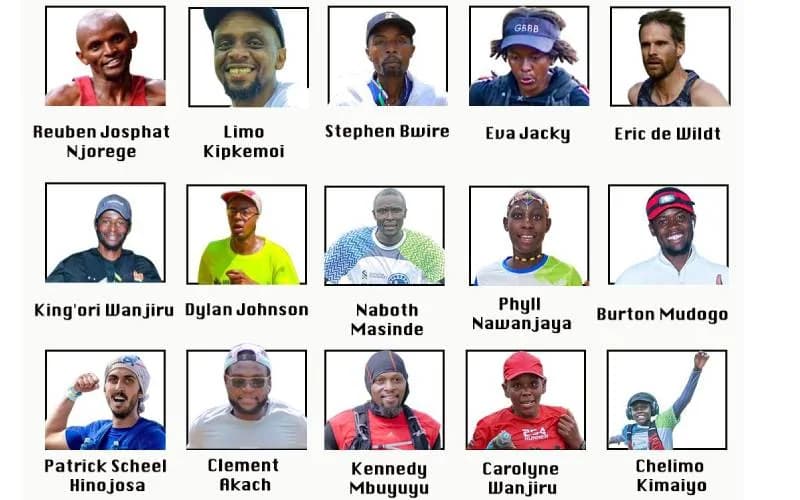
Kenya’s standout performer was Reuben Josphat Mgonga Njorege, who completed 38 yards to emerge as the national race winner, setting both a Kenyan national record and a course record.
Kenya’s other 14 representatives in the 2026 race are Limo Kipkemoi, Stephen Bwire, Eda Jacky, Eric de Wildt, King'ori Wanjiru, Dylan Johnson, Naboth Masinde, Phyll Nawanjaya, Burton Mudogo, Patrick Scheel Hinojosa, Clement Akach, Kennedy Mbuyuyu, Carolyne Wanjiru and Chelimo Kimaiyo.
The runners face the challenge of managing their individual races while contributing as many completed loops as possible to the national team's combined score.
In a competition where athletes may spend hours repeatedly covering the same distance, early speed is not necessarily the decisive advantage. The ability to maintain a sustainable pace, eat and drink consistently, recover within tight time limits and cope with mounting fatigue can become increasingly important as the race progresses.
The hourly format also creates a psychological challenge. Runners must repeatedly commit to another lap without knowing how many more they will be able to complete. As the hours pass, what initially feels like a manageable routine can become a battle against exhaustion, discomfort and the temptation to stop.
While the Backyard Ultra is often associated with the individual contest to determine the last runner standing, the World Team Championship introduces another dimension: national pride and collective endurance.
For Team Kenya, the challenge will be to maximise the contribution of all 15 runners rather than focus solely on the performance of one athlete.
Encouragement between laps, practical support at the race venue and careful management of nutrition and recovery could all play a role in helping runners extend their time on the course.
The event also offers Kenyan spectators an opportunity to experience a distinctive form of endurance sport, in which success is measured not simply by finishing first but by repeatedly meeting the same physical challenge for as long as possible.
Organisers and supporters are encouraging the running community to turn up at Tatu City to cheer the national team as the runners take on the demanding hourly cycle.
For the athletes, a word of encouragement from the sidelines could prove particularly valuable during the difficult overnight hours, when fatigue and sleep deprivation begin to weigh heavily.


Comments
No comments yet. Be the first to share your thoughts.