
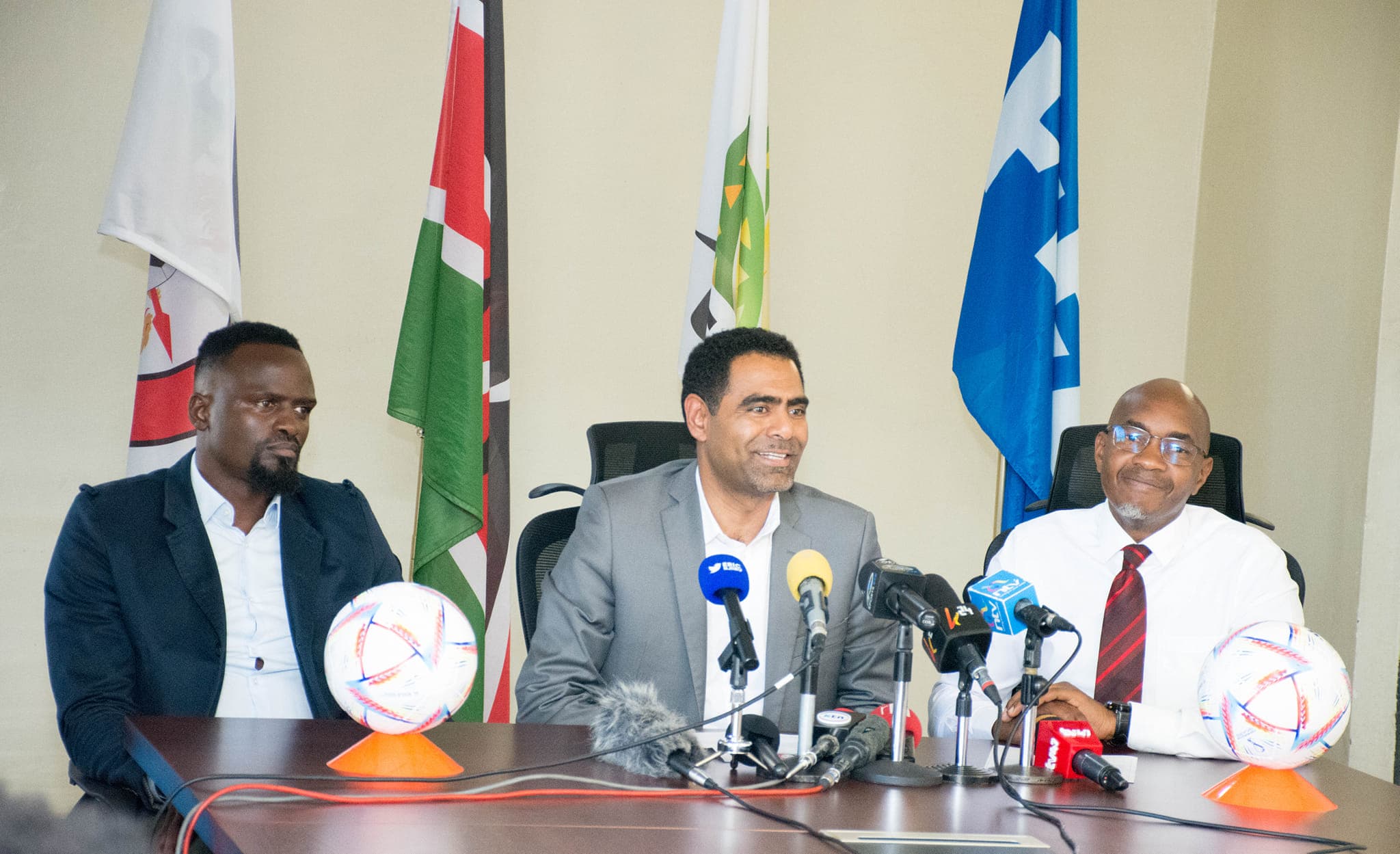
Why seven FKF NEC members are staying away from federation meetings

President Hussein Mohammed has described the latest failure as the fourth attempt to convene the NEC that has collapsed because of a lack of quorum.
Why would seven members of the Football Kenya Federation’s National Executive Committee choose to stay away from a meeting where they could sit at the same table, challenge proposals and vote against decisions they oppose?
That is the question at the centre of the latest power struggle at FKF.
The seven NEC members, led by Vice-President McDonald Mariga, have repeatedly stayed away from meetings, leaving the federation struggling to raise the numbers required to conduct official business. President Hussein Mohammed has described the latest failure as the fourth attempt to convene the NEC that has collapsed because of a lack of quorum.
At first glance, the decision to boycott may appear counterproductive. If the seven have concerns about what is being presented to the NEC, why not attend, debate the issues and vote against them?
The answer lies in the numbers. And more importantly, it lies in what happens after the required quorum has been reached and a vote ends in a tie.
The numbers behind the standoff
Latest Stories
- African countries could save billions by cutting air pollution and greenhouse gases at the same time
- Nominated Senator Crystal Asige joins Winnie Odinga and Jalang’o in Nairobi Senate race
- Tusker FC suffer home defeat as Singida strike puts CAF Confederation Cup hopes at risk
- Ecuadorian priest dies after giant wooden crucifix crashes down on him during live-streamed Mass
The FKF NEC has 14 members, with Hussein Mohammed as president and McDonald Mariga as vice-president.
The current political divide has effectively produced two camps. Mariga is backed by six other NEC members, Gabriel Mgendi, Daniel Shikanda, Collins Kalee, Violet Kerubo Momanyi, Robert Macharia and Bernard Lagat, giving that side seven members.
Hussein has six elected members aligned with him, while the two co-opted members are also part of the 14-member NEC. That makes every meeting a numbers game.
Under Article 40(1) of the FKF Constitution, the NEC cannot engage in valid debate unless more than 50 per cent of its members are present.
With 14 members, that means at least eight members must be present for the NEC to conduct valid business. That is where the boycott becomes significant. Seven members alone cannot form a quorum.
If the seven aligned with Mariga stay away, the remaining members may not have the eight required to constitute the meeting, meaning the NEC cannot proceed with its business.
So, the absence of the seven is not simply about refusing to sit through a meeting. Their attendance can determine whether the meeting can happen in the first place.
But why not attend and vote against the agenda?
This is where the FKF Constitution introduces another important element.
Article 40(2) provides that NEC decisions are reached by a majority of the valid votes cast. It also states that in the event of a tied vote, the President has the casting vote.
Every NEC member has one ordinary vote, including the President.
But Hussein has an additional constitutional power that becomes relevant when the ordinary votes are tied.
For example, imagine all 14 NEC members are present, and an agenda item produces a 7-7 vote.
Hussein's ordinary vote would already be included among the seven supporting the proposal.
Because the vote is tied, he can then exercise his casting vote to break the deadlock.
The final result would therefore become 8-7.
It is important to understand that this does not mean Hussein has two ordinary votes. He has one ordinary vote and, only in the event of a tie, a casting vote.
That distinction could be central to understanding why the seven members have chosen not to simply walk into the NEC room and vote against proposals they disagree with.
The boycott as a numbers strategy
If the seven attend, the NEC can reach the required quorum.
Once the meeting is properly constituted, the agenda can be debated and put to a vote.
If the two sides remain evenly divided on an issue, the President's casting vote can then become decisive.
But if the seven stay away and the remaining members cannot reach the eight-member threshold, the voting stage is never reached.
There is no vote to win if there is no quorum to begin with. That is the basic arithmetic behind the current standoff.
It does not necessarily mean the seven members agree with every proposal being brought before the NEC. Rather, their position appears to be that they do not want to give the meeting the numbers required to proceed while their outstanding concerns remain unresolved.
What are the seven members demanding?
The seven have said their absence is linked to governance and procedural concerns they want addressed before major decisions are taken.
In their October 14 statement, they said they had presented 13 issues during consultations with Hussein but only four had been discussed before the talks were adjourned.
They accused the President of abandoning the consultation process and proceeding with a formal NEC meeting before the outstanding matters had been addressed.
Their concerns include the management of league competitions, vacancies in judicial and electoral bodies, the roles of NEC members and standing committees, financial controls and banking mandates, and the proposed appointment of an Acting General Secretary/CEO.
They have also sought further documentation and clarification on issues including the 2025 audited accounts, the 2026/27 budget, constitutional amendments, the Technical Centre project and proposed ad hoc committees.
Their argument is that these matters should first be discussed and clarified before the NEC is asked to make decisions on them.
There is also a question of notice. The dispute does not end with voting.
Article 38(3) of the FKF Constitution sets out the procedure for NEC agendas. It provides for the President to compile the agenda, while NEC members can propose items for inclusion.
The provision also requires agenda items to be submitted to the General Secretariat at least seven days before the meeting and the agenda to be circulated to NEC members at least seven days before the meeting.
The seven members have questioned whether the requirements were properly followed in relation to the latest meeting.
For them, therefore, the dispute is not simply about whether they agree or disagree with individual agenda items. It is also about whether the process leading to those decisions has been properly followed.
Hussein, however, has taken a very different view of the continued absences.
He has argued that NEC members have a responsibility to attend meetings and participate in the running of Kenyan football.
Following the latest failed attempt, he accused some NEC members of refusing to attend and said the federation could not allow a small group to hold the country's football hostage.
His argument is essentially that disagreements should be dealt with inside the NEC rather than by preventing the body from meeting.
Both positions create a difficult situation for FKF.
The seven members have a powerful tool in their numbers because seven absences can make it impossible to reach the eight-member quorum required for the NEC to conduct business.
But the President also has a powerful tool once a properly constituted meeting reaches a tied vote: the casting vote provided for in the Constitution.
That is why the dispute has gone beyond disagreements over individual agenda items.
It has become a battle over whether the NEC can get into the room, whether it can reach quorum, and what happens once it does.
For the seven members, attending could mean allowing the NEC to proceed to a vote where a tied outcome could ultimately be decided by the President's casting vote.
For Hussein, their absence means an elected executive organ of the federation is repeatedly unable to perform its functions.
And that is the paradox at the heart of the FKF crisis: the seven members may need to attend the meeting to challenge decisions they oppose, but their decision to stay away may be the strongest mechanism they currently have to prevent those decisions from being made.
Until the two sides resolve their differences, FKF's biggest problem may therefore not be what is on the NEC agenda, but whether the NEC can get enough members into the room to discuss it.

Comments
No comments yet. Be the first to share your thoughts.