
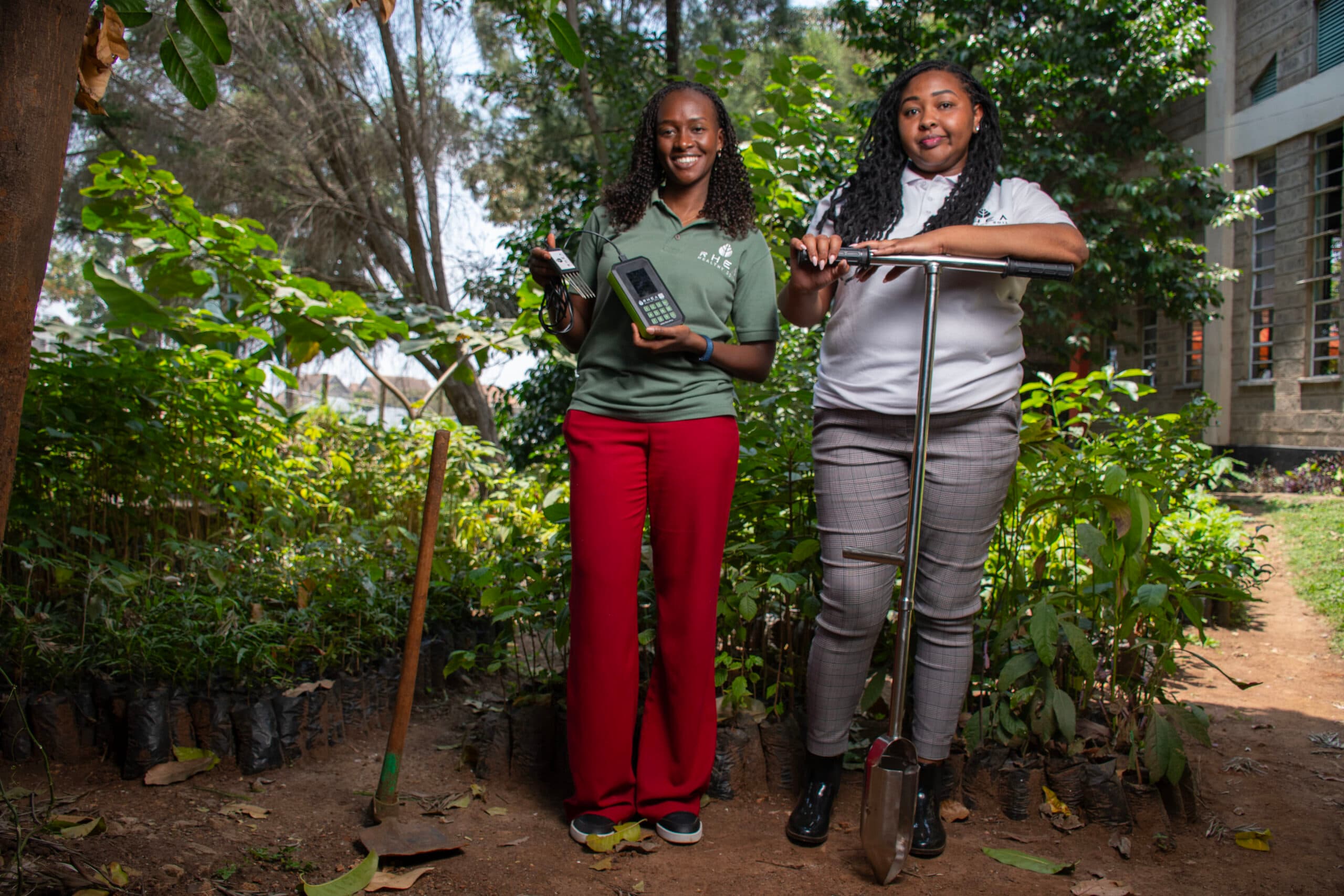
Kenyan agritech startup Rhea Soil Health Management is taking a fresh $100,000 investment into an expansion strategy that could take its soil-intelligence technology from Kenyan farms into other agricultural markets across East Africa.
Founded in 2022 by Priscilla Wakarera and Soinato Leboo, Rhea has built its business around a problem that sits at the foundation of farming but is often overlooked in discussions about agricultural technology: farmers need better information about the soil before they can make better decisions about what to put into it.
The company’s flagship product, the RHEA AgriPad, is a portable soil-testing device designed to collect soil information in the field and combine sensor technology, software and machine learning to generate information that can support fertilizer and soil-management decisions.
The investment comes from Obudu Capital, which announced a $100,000 commitment to Rhea through a convertible note. The funding is tied to milestones that include commercializing the AgriPad, deploying 100 devices, reaching 5,000 farmers and expanding into Tanzania.
For Rhea, the funding is significant because it comes at a point when the company is attempting to move beyond developing a technology product and prove that soil intelligence can become a scalable business.
Farmers make some of their most important economic decisions without always having timely information about the condition of their soil. Fertilizer is one of the largest variable costs in crop production, yet applying more does not necessarily mean producing more.
A farmer who applies too little fertilizer can limit crop performance, while applying too much can increase costs without delivering a comparable improvement in output. Soil testing can help narrow that information gap by showing what nutrients are present and what may need to be replenished.
The problem is that conventional soil testing can be difficult to access for smallholder farmers. Samples have to be collected, transported and processed, with farmers then required to interpret the results and decide what to do next.
Rhea’s approach is to move more of that process closer to the farm.
The RHEA AgriPad is designed as a portable testing system, while the company’s digital platform is built to process soil information and provide recommendations. Rhea also uses digital channels, including WhatsApp, to deliver information and agronomic advice to farmers.
The result is intended to be more than a laboratory report. It is a system designed to connect measurement with a farming decision.
Rhea’s development has also involved learning what farmers will actually use and pay for. Priscilla Wakarera has previously said the company went through three prototypes over almost two years while working with farmers to understand their needs and affordability constraints.
That process is particularly important in African agritech, where a technically sophisticated product can still struggle if it does not fit the economics and working practices of smallholder farmers. Rhea has therefore been building a distribution network around agronomists who can operate closer to farmers.
During the first half of 2026, the company said it recruited and trained 135 agronomist agents across Makueni, Taita Taveta and Kajiado. It also launched the Rhea Agent App to support field operations and introduced Rhea Optima, a product aimed at medium and large-scale farmers, agronomists and laboratories.
This gives the company a model in which technology and human expertise operate together. The device produces the soil measurements, the software processes the information and agronomists can help farmers understand what the results mean for their particular crops and fields.
That last step can be critical. Agricultural technology does not create value simply because data exists. The value comes when the information changes a decision and that decision produces a measurable economic benefit.
The AgriPad is the visible part of Rhea’s technology, but the data generated by the system could ultimately become more important to the company’s business model.
A single soil test tells a farmer something about a particular field at a particular point in time. Thousands of tests can create a much broader picture of soil conditions, nutrient requirements and agricultural patterns across regions.
That creates potential applications beyond fertilizer recommendations.
Rhea has positioned its soil-performance data for possible applications in agricultural finance, insurance and carbon markets. Those markets require their own verification, commercial relationships and regulatory frameworks, so soil testing alone does not automatically translate into credit, insurance or carbon revenue.
But the opportunity illustrates why Rhea is building a broader soil-intelligence platform.
Financial institutions need better information to assess agricultural risk. Insurers need data to understand farms and potential losses. Input companies need to understand what farmers require. Agricultural programs need reliable measurements to determine whether interventions are producing results.
Farm-level soil data can potentially become useful to all of them.
The business challenge for Rhea is turning that potential into recurring commercial demand.
Obudu Capital’s $100,000 investment is therefore less about simply financing another product development cycle and more about testing whether Rhea can move toward commercial scale.
Discover more
Startup funding guide
Form An LLC
Try Operations Software
Access Online Encyclopedias
Mobile app reviews
Get Business Reports
The investor said the funding would support milestones including commercialization of the AgriPad, deployment of 100 devices, reaching 5,000 farmers and expansion into Tanzania.
Rhea had previously received $75,000 through Village Capital’s program backed by Standard Chartered’s Women in Tech initiative.
The new capital gives the startup additional room to expand, but it also raises the expectations that come with institutional backing.
The company now has to demonstrate that farmers will use the technology, that they will use it repeatedly and that the economics work for both Rhea and its customers.
That is a more difficult test than demonstrating that a device can produce a soil reading.
One of the biggest challenges facing Rhea is the purchasing power of its target market.
Smallholder farmers operate within tight financial constraints. Even when a farmer understands the potential value of better soil information, the cost of testing must compete with spending on seed, fertilizer, labor, transport and other farm requirements.
The company’s proposition therefore depends on demonstrating a clear economic return.
If soil testing helps a farmer avoid unnecessary fertilizer purchases, correct a nutrient deficiency, improve yields or make better use of existing inputs, the farmer has a reason to keep paying for the service.
If the information does not translate into a noticeable improvement in farm economics, adoption becomes harder to sustain.
This makes measurement of customer outcomes as important as measurement of technological accuracy.
Rhea has said its technology is capable of high-accuracy soil analysis, but the larger commercial question is whether that accuracy produces better agricultural decisions at scale.
The next stage of Rhea’s growth will also test whether its Kenyan model can work beyond its home market.
Tanzania is one of the company’s stated expansion targets under the Obudu Capital investment.
The opportunity is substantial. East Africa has millions of smallholder farmers operating across different soil types, crops and climatic conditions, creating a large potential market for agricultural information.
But regional expansion is not simply a matter of shipping devices across a border.
Soil conditions differ by geography. Cropping patterns change. Agricultural extension systems vary. Farmers have different purchasing behaviors, while regulations and commercial relationships have to be established in each market.
Rhea will therefore need to demonstrate that its technology can be standardized while its recommendations and distribution model remain relevant to local farmers.
Its intellectual-property strategy also points to an effort to build proprietary technology rather than operate purely as an agronomy service provider.
A 2025 patent application published by the Kenya Industrial Property Institute describes a handheld soil-testing kit and system designed to collect soil nutritional data, incorporate GPS connectivity and transmit information to a web-based fertilizer recommendation system.
That combination of hardware, software and data collection is central to the company’s broader strategy.
The significance of Rhea’s business lies in what happens after the soil has been tested.
Agriculture has become increasingly data-driven at the level of weather, satellite imagery, farm management and markets. Soil remains one of the most important variables, yet access to detailed and timely soil information remains uneven.
Rhea is attempting to close that gap.
If the company succeeds in deploying its devices, building its agronomist network and reaching thousands of farmers, it could create a growing database of soil conditions across East Africa.
That could give the company an opportunity to build additional services around the data while continuing to provide farmers with recommendations for managing their land.
The immediate customer may be a farmer seeking a better fertilizer decision. The longer-term customer could also be an agribusiness, financial institution, insurer, laboratory or agricultural program seeking reliable information about farms.
That is what makes Rhea’s expansion worth watching. The company is not simply trying to make soil testing faster. It is trying to establish a technology layer between the farm and the decisions made about agricultural inputs, productivity and risk.
The $100,000 investment gives Rhea a defined set of targets against which its next stage can be measured: commercialize the AgriPad, deploy 100 devices, reach 5,000 farmers and begin expansion into Tanzania.
Those targets will provide a clearer test of the company’s model than early prototypes or pilot deployments. Rhea will need to demonstrate adoption, repeat usage and sustainable economics while showing that its technology works across different farming environments. It will also have to determine how much of its future revenue comes from farmers and agronomists and how much can come from larger institutions that value the underlying agricultural data.
For a young Kenyan technology company, that is an ambitious path. But the opportunity is equally straightforward. Farmers cannot optimize what they cannot measure, and soil is one of the most important things they need to measure.
Rhea’s bet is that making that information accessible can become a business in its own right. With $100,000 in fresh capital and an expansion target that includes Tanzania, the startup is now moving from proving the idea to proving whether soil intelligence can scale across East Africa.



Comments
No comments yet. Be the first to share your thoughts.