
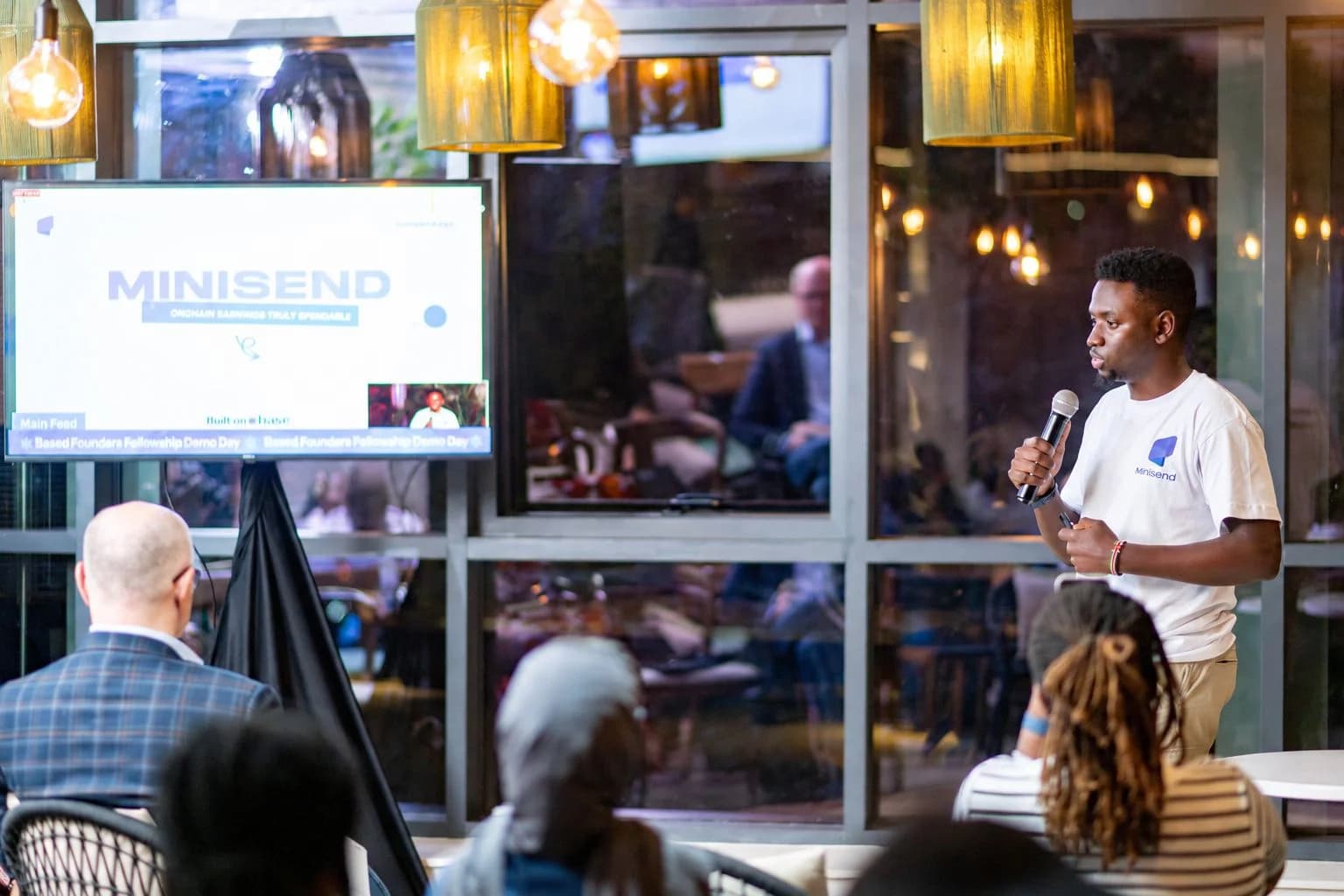
Minisend is the official payment partner of Africa Blockchain Festival 2026, the conference running from 15 to 17 October at the Sarit Expo Centre in Nairobi. The company announced the partnership on 21 September and said Kenya is now a priority market for its next phase of growth.
A stablecoin is a cryptocurrency pegged to an ordinary currency, almost always the US dollar, so one USDC or one USDT is meant to stay worth one dollar. Stablecoins move on blockchains, the public networks that record who holds what. The catch is that a blockchain balance isn’t money you can spend at a duka. Somebody has to turn it into shillings, and that somebody is called an off-ramp.
Minisend is an off-ramp. You send USDC or USDT to a single address from any of the networks it supports, and it pays you out in local currency. Its site lists 19 Ethereum-compatible chains plus Solana and Stellar for USDC, and 15 chains for USDT. Payouts go to M-Pesa in Kenya, bank transfer in Nigeria, and mobile money in Ghana and Uganda.
That sounds like a small convenience until you’ve done it the long way. Chris Oketch, who founded Minisend and built it in Nairobi, described the old route like this: “It was hectic. You’d have to move funds through Binance or OKX, pay a lot in fees, and risk sending to the wrong address.” Minisend collapses all that into one deposit and one payout.
Minisend’s own site says it has settled more than $500,000 across over 10,000 orders for more than 1,000 users, at a 94.5% success rate. M-Pesa payouts complete in about 10 seconds once the deposit settles. Bank and mobile money payouts take 5 to 30 minutes. Idle USDC sitting in a Minisend balance earns 5.7% a year.
Those are the company’s own figures and we haven’t seen them independently verified. Minisend doesn’t publish its fees on either its consumer page or its business page, and the announcement doesn’t give them either.
Africa Blockchain Festival is convened by Olubunmi Fabanwo. The 2026 edition is co-hosted with World Token Summit, which is making its African debut in Nairobi, and the festival lists Binance as title sponsor with Cardano Foundation, OKX, Polygon, Tether, Stellar, Bybit and Animoca Brands among its series sponsors. The theme on its own site is “Shaping Africa’s Decentralized Future”.
Fabanwo’s line in the announcement is the standard one: “Kenya represents exactly the type of market where the next phase of blockchain adoption can take place. People are already comfortable sending, receiving and paying digitally.”
The comfort is real. Kenyans moved KES 426.4 billion, about $3.3 billion, in stablecoins in the year to June 2024, according to Chainalysis. Across Sub-Saharan Africa, more than $205 billion in on-chain value arrived between July 2024 and June 2025, up roughly 52% year on year, with Kenya in the regional top five.
Kenya regulates this now. The Virtual Asset Service Providers Act, 2025 was gazetted on 21 October 2025 and took effect on 4 November 2025. It hands payment-type crypto services to the Central Bank of Kenya and investment-type ones to the Capital Markets Authority. The rules that switch licensing on were gazetted as Legal Notice 134 on 22 July 2026, and we went through the capital requirements when they were published: KES 10 million for a payment processor, KES 150 million for a wallet provider, KES 300 million for a stablecoin issuer.
Anyone already serving Kenyans when the Act commenced has until 4 November 2026 to comply. That is 18 days after the festival packs up.
CBK and CMA said in their 18 November 2025 public notice that they “have not licensed any VASPs under the Act to operate in or from Kenya”, and neither regulator has published a register of licensees since. CMA has been busy at the other end of the pipe: on 11 September it named 15 investment platforms taking money from Kenyans without a licence.
The announcement doesn’t say whether Minisend has applied for a Kenyan licence, which of the ten regulated activities it would apply under, or which entity would hold it. Minisend’s website is silent on all three. The yield offer muddies it further, because paying 5.7% on an idle balance is a different activity from moving money, and the Act splits those between two regulators.
Off-ramps solve a real problem. We’ve covered enough of them to know the demand is there, and the freelancer waiting on a wire from a client abroad is not a made-up customer. The festival and the compliance deadline just happen to fall less than three weeks apart.
The festival runs 15 to 17 October. The deadline falls on 4 November. If you’re routing money through an off-ramp between now and then, ask which licence it’s operating on, and check the CBK and CMA registers once the regulators publish them.



Comments
No comments yet. Be the first to share your thoughts.