
The Artificial Intelligence era must expand the ability of nations to shape their own future rather than create new forms of technological dependency, President William Ruto has said.
The President called for stronger international cooperation to build the infrastructure, skills, research and governance capabilities needed for AI systems.
He advocated shared sovereignty, where countries pool capabilities at scale is indispensable, while retaining national control where accountability is essential.
“Political sovereignty without technological agency risks becoming sovereignty in law but dependency in practice,” he said.
He added: “Shared sovereignty is not sovereignty surrendered. It is agency enlarged through organised cooperation.”
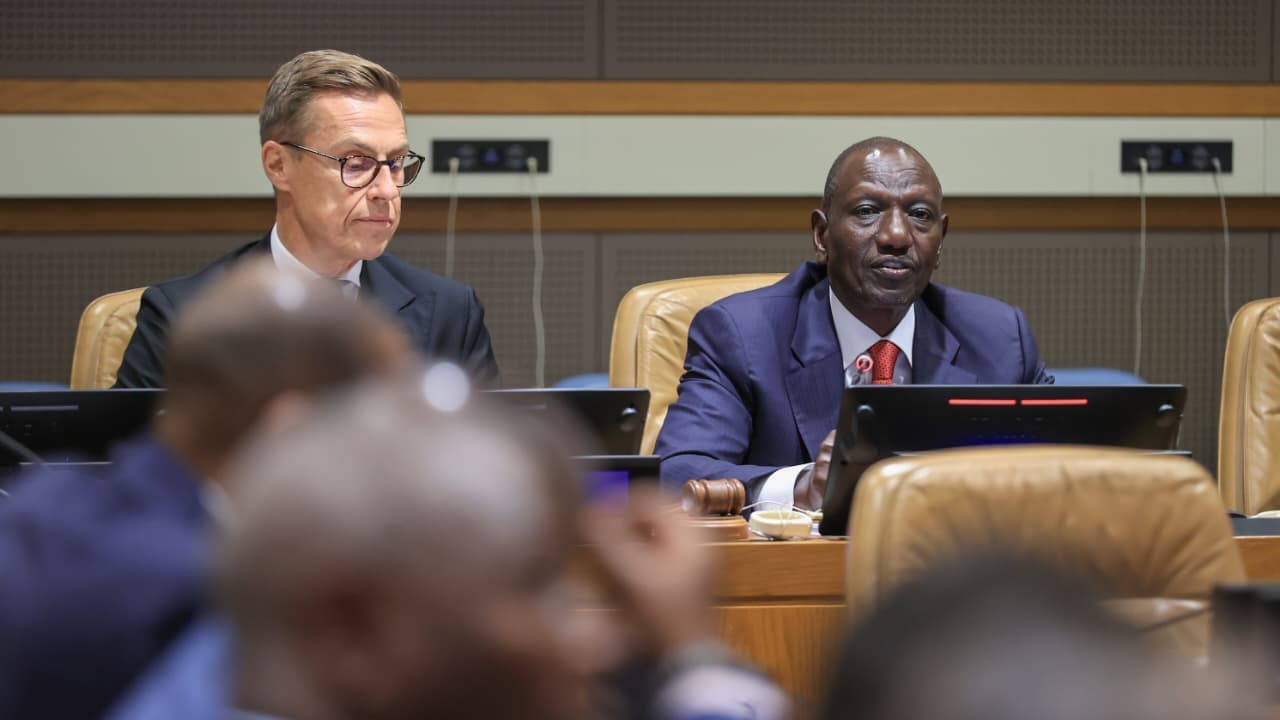
President Ruto made the remarks while co-chairing the High-Level Artificial Intelligence Middle Powers Coalition meeting on Monday with President Alexander Stubb of Finland on the sidelines of the United Nations General Assembly in New York.
For Africa, President Ruto said, the priority is to capture more value created through AI by using the continent’s energy, resources, data and talent to build capabilities, enterprises and solutions.
He warned against the continent reproducing the old extractive economy in digital form, saying Africa cannot provide the minerals, energy, data, content, and talent of the AI revolution and then import the resulting intelligence at a premium.
“We possess talent, resources, markets, and diplomatic weight. But few countries can command the entire AI value chain. No nation can efficiently secure every critical mineral, fabricate every advanced chip, build every data centre, train every frontier model, and determine every global standard,” he said.
The President said Kenya is pursuing this agenda through the National Artificial Intelligence Strategy, focusing on digital infrastructure, data and AI governance, research, innovation and commercialisation.
“Our purpose is practical. We want AI that raises agricultural productivity, strengthens healthcare, expands access to education, improves public services, advances financial inclusion, and creates enterprises and jobs,” he said.
President Ruto also called on the United Nations to remain central to global AI governance.
“AI governance must be globally shaped, not globally imposed. The rules of the intelligence era cannot be written by a handful of governments, companies or laboratories. Those affected by these technologies must have a meaningful hand in shaping them,” he said.
On his part, President Stubb said nations must have a stake in the development of AI, noting that the technology is too consequential to be left to tech giants alone.
“We can’t be in a situation where we have no skin in the game,” he said, citing critical inputs such as electricity.
He proposed that AI be addressed at three levels – companies, governments and regional regulatory frameworks while also developing a global system through the United Nations.
Comments
No comments yet. Be the first to share your thoughts.