
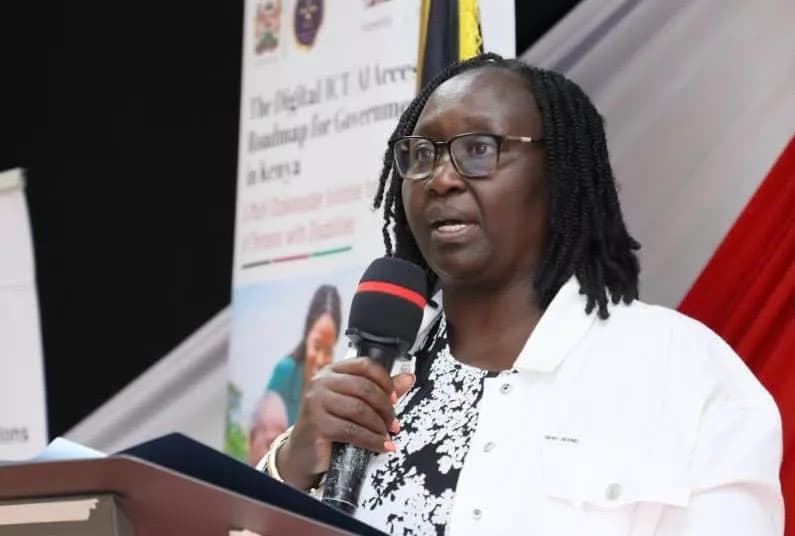
Cabinet Secretary for Gender, Culture and Children Services Hannah Wendot Cheptumo speaking at the Roadmap Validation and Inception Forum on Digital and ICT Accessibility Maturity at the Kenya School of Government on October 30, 2026 / HANDOUT

The government is stepping up efforts to make public digital services accessible to persons with disabilities, with institutions expected to conduct accessibility audits and develop plans to address barriers in their online platforms.
Speaking at the Roadmap Validation and Inception Forum on Digital and ICT Accessibility Maturity at the Kenya School of Government on Friday, October 30, Cheptumo said inclusive access must be a defining feature of Kenya's digital transformation.
“The most salient feature of our true digital transformation is that it is inclusive. The Persons with Disabilities Act, 2025 provides an important legal foundation for advancing disability rights and strengthening institutional accountability,” she said.
Cheptumo, who represented Chief of Staff and Head of Public Service Felix Koskei, called on government institutions to translate the legal commitments into practical improvements in public service delivery, including accessible online platforms, information and communication systems.
She said accessibility should not be treated as an afterthought or left to ICT departments, but incorporated into institutional planning, budgeting, procurement and service delivery.
The growing shift towards online government services has created challenges for people who cannot independently navigate digital platforms because of visual, hearing, physical and other disabilities.
Inaccessible online forms, websites and public documents can prevent persons with disabilities from accessing information, applying for jobs and completing routine government transactions without assistance.
Head of the Office of Diversity, Inclusion and Disability Rights Isaac Mwaura said the government was also developing inclusive communication guidelines to ensure public information reaches persons with different disabilities.
The proposed guidelines will provide for sign-language interpretation, captioning, accessible digital documents, voice narration and simplified information formats.
Mwaura said inaccessible government communication could exclude persons with disabilities from public service recruitment, state tenders and announcements on essential services.
He said access to information was fundamental to participation in public life and should not depend on an individual's disability.
The National Council for Persons with Disabilities Chief Executive Officer Munene Michael called on institutions to move beyond policy commitments and take measurable steps towards improving accessibility.
He urged public institutions to appoint accessibility focal persons at director level, conduct comprehensive accessibility audits and develop funded plans to address identified gaps.
Munene said the audits should cover websites, digital platforms and physical environments, adding that the council was ready to provide technical support to institutions undertaking the assessments.
He also called for regular reporting on progress to ensure accessibility gaps are addressed and the necessary resources incorporated into institutional budgets.
Principal Secretary for Gender, Culture and Children Services Karen Ageng'o welcomed the proposed audits, saying the State Department for Children Services had already assessed its website to establish its level of digital accessibility.
She said the transition to automated systems and online service delivery had exposed barriers that required urgent attention.
Ageng'o also pledged continued efforts to improve digital access for children with disabilities, particularly through services such as the Child Helpline.
Leaders at the Roadmap Validation and Inception Forum on Digital and ICT Accessibility Maturity at the Kenya School of Government on October 30, 2026 / HANDOUT

Principal Secretary for Immigration and Citizen Services Belio Kipsang said government digital platforms must accommodate persons with disabilities as more public services move online.
He said the government's e-system had brought together more than 26,000 government services and attracted 600,000 users, making accessibility an important consideration in the expansion of digital service delivery.
British Deputy High Commissioner Ed Barnett reaffirmed the United Kingdom's support for Kenya's digital inclusion efforts, citing joint programmes that have reached more than 1.2 million citizens with digital literacy training.
He said 30,000 young people had received basic digital literacy training, while more than 10,000 people had acquired advanced digital employability skills.
Barnett also cited the launch of Kenya's National ICT Accessibility Standards in May 2022, which was supported by the UK and established benchmarks for accessible digital design.
The forum brought together representatives from government institutions and development partners, including the Kenya Bureau of Standards, Kenya National Library Service, the Judiciary, the National Council for Persons with Disabilities and UK International Development.
The discussions focused on validating a roadmap for improving digital and ICT accessibility across institutions, with participants emphasising the need to translate existing policies and standards into practical measures.
The proposed audits and institutional action plans are expected to help identify accessibility gaps and guide improvements in government digital services.



Comments
No comments yet. Be the first to share your thoughts.