
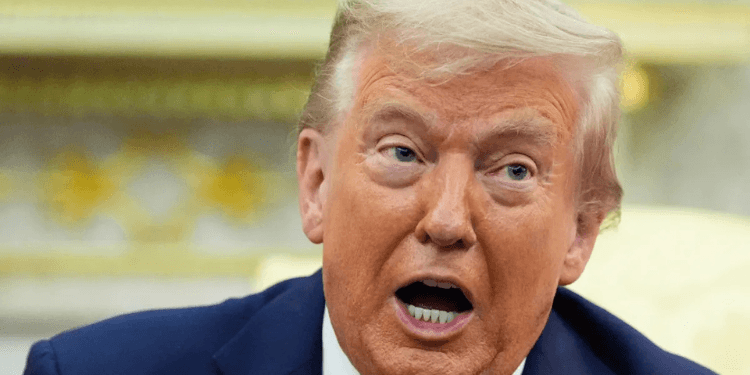
US President Donald Trump has warned Iran against charging fees to oil tankers passing through the Strait of Hormuz, after reports emerged that Tehran had begun demanding payments from vessels seeking safe passage through the vital waterway.
In a post on his Truth social media platform on April 9, Trump said there were reports Iran was charging tankers transiting the strait and warned that if the reports were true, the practice must stop immediately.
“There are reports that Iran is charging fees to tankers going through the Hormuz Strait. They better not be and, if they are, they better stop now,” read part of the statement by President Donald Trump.
The statement came amid rising tension over the fragile US‑Iran ceasefire and growing concern in global energy markets.
Ceasefire Tested as Shipping Remains Limited
The ceasefire, announced on April 8, was meant to reduce weeks of military confrontation that began after US and Israeli strikes on Iranian targets in late February.
One of its key conditions was the reopening of the Strait of Hormuz to commercial traffic.
Despite the truce, shipping remains extremely limited.
According to ship-tracking services, fewer than ten vessels passed through the strait in the first 24 hours after the ceasefire, far below the normal daily average of more than 100 ships.
Many major oil companies and shipping firms are still keeping their vessels anchored, citing uncertainty over security, toll demands, and unclear transit rules.
Iran has publicly insisted that the strait is open, but Iranian officials have also said ships must coordinate passage with its armed forces.
Tehran has been drafting a protocol that would require vessels to obtain permits, and Iranian state‑linked media have confirmed discussions around collecting transit fees.
These moves have deepened confusion in the shipping industry.
Several reports indicate that Iran’s Revolutionary Guard is selectively allowing passage to vessels linked to countries it considers friendly, while others are refused or delayed.
Trump’s Response and Global Impact
Trump’s swift response signals US opposition to any attempt to turn the strait into a paid chokepoint.
International maritime law, including the United Nations Convention on the Law of the Sea, protects innocent passage through international straits and does not allow unilateral tolls.
White House officials said Trump wants the Strait of Hormuz reopened “completely, immediately and without limitation,” including any form of tolls.
US officials have warned that charging tanker fees would undermine the ceasefire and raise broader legal and security concerns.
The situation has already had a major economic impact.
Oil prices climbed back above $100 (Ksh12,910) per barrel on April 9 as traders reacted to the slow return of shipping and fears that the truce could collapse.
Dozens of oil tankers remain stranded in or near the Persian Gulf, waiting for clarity.
Gulf states, including the United Arab Emirates (UAE) and Qatar, have also voiced concern, stressing that the strait must remain a free international waterway and should not be used as leverage in political disputes.
The ceasefire held in formal terms on April 9, but conditions showed little improvement.
No direct US‑Iran clashes were reported, yet shipping through the Strait of Hormuz remained heavily restricted.
Fewer than a dozen vessels transited the waterway during the day, most of them non‑oil carriers operating under Iranian coordination.
Oil tankers largely stayed anchored outside the Gulf amid uncertainty over transit rules and security guarantees.
Iran continued to require ships to seek clearance from its forces, while warning that any violations linked to Israel’s operations in Lebanon could affect its commitment to the truce.




Comments
No comments yet. Be the first to share your thoughts.