
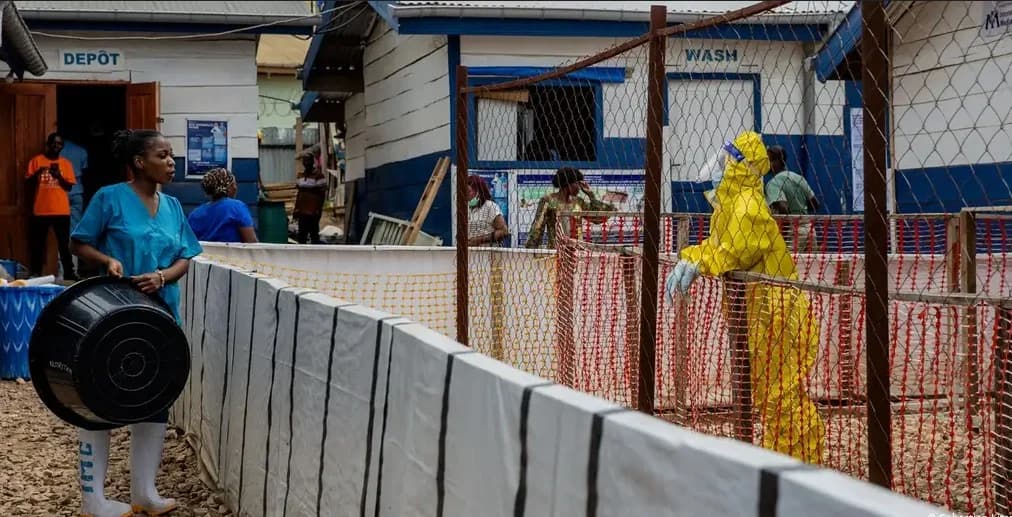
Africa faces its widest-ever Ebola outbreak as DR Congo cases near 10,000 and new infections emerge

Africa CDC warns of unprecedented cross-border spread as DR Congo records 9,637 cases and 4,646 deaths, with new infections reported in Kenya and Nigeria.
Africa is battling what health officials describe as the most geographically widespread Ebola outbreak in history, with cases in the Democratic Republic of the Congo (DRC) nearing 10,000 and fresh infections reported in Kenya and Nigeria raising fears of further cross-border transmission.
The Africa Centres for Disease Control and Prevention (Africa CDC) has warned that the outbreak is spreading across multiple countries and three African regions, calling for urgent international support to prevent the virus from reaching more communities.
Nearly five months after the outbreak was declared in the DRC, the epidemic has killed more than 4,600 people and spread to eight of the country's 26 provinces. Imported infections in neighbouring countries have also exposed gaps in cross-border disease surveillance, increasing pressure on health authorities to contain the spread.
Cross-border spread raises alarm
Nigeria on Tuesday confirmed its first case of Ebola caused by the Bundibugyo virus, the same strain responsible for the ongoing epidemic in the DRC. The country has become the fifth to detect the virus since the outbreak began in May, according to Nigerian health authorities.
The patient, a woman who had recently travelled through Uganda, developed symptoms on October 7 and sought medical attention at a private hospital in Abuja four days later. Her infection was confirmed on October 20.
Latest Stories
- Tsavo communities to benefit from Sh20.8 billion plan targeting jobs, tourism and wildlife protection
- UN condemns drone strikes killing civilians and damaging critical infrastructure in Sudan
- AU marks 40 years of African Charter on Human Rights with renewed commitment
- ‘We want to go home’: Congolese refugees face desperate conditions in Burundi camp
Nigerian authorities have identified 44 contacts for monitoring, while the patient remains in isolation and is receiving medical care.
Uganda's Ministry of Health said the woman had travelled to eastern DRC for business before passing through Uganda in early October without showing symptoms. The ministry stressed that her transit through Uganda did not establish where she contracted the virus, adding that investigations were ongoing.
Uganda, which previously recorded 20 confirmed Ebola cases and two deaths linked to the DRC outbreak, was declared Ebola-free on August 27 after completing a 42-day monitoring period without detecting new infections.
The ministry reiterated on Tuesday that Uganda still had "no confirmed active Ebola cases" and pledged to strengthen health screening and surveillance at points of entry.
Meanwhile, Kenya reported its ninth confirmed Ebola case on Tuesday, with all infections linked to an initial imported case involving a Kenyan national who had travelled from the DRC through Uganda and died in Nairobi on October 5.
The latest patient was already in quarantine when symptoms developed. Kenyan health authorities said there was no evidence of transmission beyond the identified cluster, adding that 134 of the 135 identified contacts had been placed under quarantine.
DR Congo outbreak nears grim milestone
In the DRC, the outbreak continues to claim lives despite signs of slowing transmission in some areas.
The country had recorded 9,637 confirmed cases and 4,646 deaths as of October 19, representing a case fatality rate of 48.2 per cent, according to the latest situation report released on Wednesday by the country's health authorities.
The eastern province of Ituri remains the epicentre, accounting for 72.7 per cent of cumulative infections. Neighbouring North Kivu has also emerged as a major transmission hotspot, recording 2,117 confirmed cases and 1,191 deaths, with a case fatality rate of 56.3 per cent.
The virus has also recently spread to the northern province of Nord-Ubangi, bringing the number of affected provinces to eight and the number of affected health zones to 66.
The outbreak's geographical expansion has heightened concerns about the risk of the virus reaching Kinshasa, the country's densely populated capital, which has nearly 20 million residents.
Former health minister Jean-Jacques Mbungani Mbanda warned on Tuesday that the detection of infections in the northern provinces of Sud-Ubangi and Nord-Ubangi had increased the risk of imported cases reaching the capital through river transport, air travel and road networks.
He urged authorities to strengthen surveillance at airports, river ports and other entry points, warning that temperature screening alone could not identify infected travellers during the incubation period.
Mbungani also called for stronger community surveillance and infection prevention measures in healthcare facilities, stressing that Kinshasa should reinforce its preparedness before recording its first confirmed case.
Africa CDC calls for urgent global action
Africa CDC Director-General Jean Kaseya warned on Tuesday that the outbreak's continued geographical spread, combined with a case fatality rate approaching 50 per cent in the DRC, posed an extremely serious public health threat.
In a statement following Nigeria's confirmation of its first case, Kaseya said Africa CDC had begun mobilising support for Nigeria while intensifying its response in the DRC and Kenya and maintaining heightened vigilance in Uganda.
He appealed for urgent international support, including flexible financing, medical supplies, diagnostic tools, trained responders and stronger community-based surveillance.
"We cannot allow this outbreak to spread to more countries or continue for another year," he warned.
World Health Organisation (WHO) Director-General Tedros Adhanom Ghebreyesus also called for sustained regional preparedness following Nigeria's confirmation of its first Bundibugyo Ebola case.
In a social media statement on Wednesday, Tedros urged countries across the region to maintain a high level of readiness to detect cases early, prevent further transmission and protect healthcare workers and communities.
The outbreak is caused by the Bundibugyo virus, for which no vaccine or specific treatment has yet been approved. Early detection, supportive care and effective infection control therefore remain crucial to reducing deaths and interrupting transmission.
The epidemic was declared in the DRC on May 15 and designated a public health emergency of international concern by WHO two days later. Africa CDC subsequently declared it a public health emergency of continental security.
The current outbreak has become the largest and deadliest Ebola epidemic ever recorded in the DRC and the second-largest globally, after the 2014–2016 West Africa epidemic.

Comments
No comments yet. Be the first to share your thoughts.