
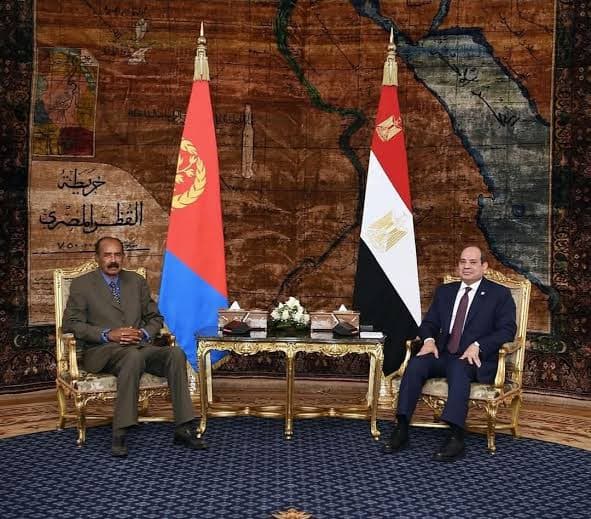
Eritrean President Isaias Afwerki arrived in Egypt on Saturday for a working visit at the invitation of Egyptian President Abdel Fattah el-Sisi, as diplomatic relations between Eritrea and Ethiopia collapsed and fighting intensified in northern Ethiopia’s Tigray region.
Afwerki is participating in a Summit of Heads of State on collective security, stability and partnership, a continuation of periodic forums addressing issues concerning the Red Sea region, the Gulf of Aden, the Arabian Gulf and the Nile Basin. He and el-Sisi held extensive talks in New Alamein City on bilateral ties, regional developments and matters of mutual interest. Afwerki underlined the convergent positions of Eritrea and Egypt on regional matters, particularly regarding respect for sovereignty and territorial integrity and non-interference in internal affairs.
On Sunday, Egypt will host a four-way summit bringing together el-Sisi, Afwerki, Somali President Hassan Sheikh Mohamud and Sudan’s Sovereign Council Chairman Abdel Fattah al-Burhan. The Egyptian presidency said the summit comes as part of “consultation and coordination about regional issues of mutual concern”.
The visit comes days after Ethiopia and Eritrea severed diplomatic ties. On Thursday, Ethiopia announced it was closing its embassy in Asmara and ordered 10 Eritrean diplomats to leave within 48 hours, accusing them of activities threatening national security. Ethiopia’s Foreign Ministry said the decision was in response to Eritrea’s “direct and indirect acts of hostility and belligerence”. Eritrea’s foreign ministry responded that it “has no option but to reciprocate in kind and sever all diplomatic ties with Ethiopia,” describing Addis Ababa’s decision as “astounding”.
The diplomatic rupture followed a sharp deterioration in relations, with Addis Ababa accusing Eritrea of supporting an alliance of armed groups fighting the Ethiopian government—an allegation Asmara has repeatedly denied. The two countries were allies during the 2020-2022 Tigray war, when Eritrean troops fought alongside Ethiopian federal forces against the Tigray People’s Liberation Front (TPLF). Relations later deteriorated over Ethiopia’s push for direct access to the Red Sea, with Eritrea accusing Addis Ababa of harbouring ambitions over its ports.
The diplomatic fallout came hours after powerful explosions were heard overnight in Addis Ababa, including near Ethiopia’s military headquarters. An overnight explosion at the Ethiopian National Defence Force headquarters shook the surrounding area and triggered significant panic, though the cause and any casualties remain unknown. Ethiopia’s National Intelligence and Security Services subsequently ordered a ban on all drone flights around the capital.
Fighting resumed in northern Ethiopia on 23 September when TPLF forces stormed three national airports in Tigray and launched attacks into neighbouring Amhara and Afar states alongside local militias. Ethiopian government forces are now engaged in a counter-offensive pushing into Tigrayan territory along three axes towards the regional capital Mekelle.
At least 52 civilians were killed during three days of heavy fighting around Alamata in southern Tigray, hospital sources told the BBC. Civilian deaths included a three-day-old infant, and 12 people died from a bombing of the city’s central market. Medical charity Doctors Without Borders said it had registered more than 420 wounded at Korem and Alamata. Human Rights First raised concerns that more than 70 civilians may have been killed in recent incidents around conflict fronts, while stressing that figures require further verification.
A pro-government militia commander told the BBC that Eritrean soldiers had been involved in the fighting, though verification is difficult as media are prevented from travelling to affected areas and communications are significantly disrupted.
Ethiopian Prime Minister Abiy Ahmed, who is due to be sworn in for a new term after winning elections in June, faces conflict on multiple fronts as several armed groups have formed an alliance against him. Last month, the TPLF joined six other armed movements, including the Fano militia from Amhara, to form an alliance whose stated objective is to remove Abiy’s government from power. Conflict monitor ACLED said drones suspected to be linked to the anti-government alliance targeted army and civilian airports in Oromia and Amhara states on Sunday.
The African Union has called on Ethiopia, Eritrea and Egypt to exercise “maximum restraint” and take steps to de-escalate the situation amid growing diplomatic tensions in the region.



Comments
No comments yet. Be the first to share your thoughts.