
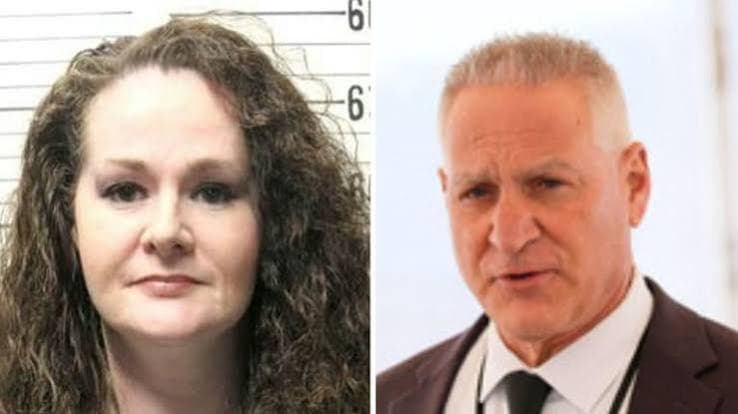
The head of Tennessee’s prison system is resigning after the failed execution of Christa Pike, Gov. Bill Leeannounced Saturday.
Tennessee Department of Correction Commissioner Frank Strada said in a statement that stepping aside “is in the best interests” of the state as an independent review is carried out to determine why Pike’s execution failed Wednesday.
Pike was placed on a ventilator and remained unconscious in a hospital, her attorneys said in a court filing Friday.
Hospital staff, her lawyers said, were working to save Pike’s life and as of late Thursday were trying to clear the two doses of the drug that the state uses to execute prisoners.
Pike was unconscious, intubated and on a ventilator on Thursday night after authorities failed to execute her by lethal injection, her lawyers have said in court filings. Pike, 50, was injected with two lethal doses of pentobarbital on Wednesday but remained alive. She was then sent to hospital in an ambulance.
Pike remained critically ill and was being treated at a Nashville-area hospital.
Lawyers for Pike, who was sentenced to death in 1996 for the murder of Colleen Slemmer, are seeking to have her sentence commuted after the failed execution attempt.
Pike’s lawyers filed an emergency motion on Friday to preserve “any and all evidence” related to her botched execution.
Hospital staff are working to save her life and clear the drug used, pentobarbital, from her system, the filing states.
During the execution attempt, prison officials tried to start intravenous (IV) lines by using at least seven needles on Pike, according to her lawyers.
At one point, Pike herself offered guidance of where they could try.
“One needle was bent in a 90-degree angle when it was removed,” the filing states.
While receiving the two doses, “she could be heard crying, whimpering, and breathing loudly throughout the procedure”, her lawyers said.
Tennessee Governor Bill Lee ordered an independent review into Pike’s botched execution and he halted all executions in the state for the year.
The state’s department of correction has defended the method it used, saying “the protocol does not allow for additional procedures beyond what was carried out”.
Authorities are yet to say whether they will try again to execute Pike. They have not not offered any explanations about what went wrong.
Pike’s attorneys previously warned that her conditions, including thrombocytosis (a blood-clotting condition) and small veins meant there was a risk she would experience “unnecessary” pain and suffering during a lethal injection.
In the latest filings, her lawyers allege that “at no point did any member of the execution team realise that the IV lines were not correctly placed or that the veins had blown and that the pentobarbital was, in whole or in part, entering Ms Pike’s body”.
They are requesting that all relevant physical, written and electronic evidence is preserved.
By Agencies



Comments
No comments yet. Be the first to share your thoughts.