
Sep 29 – India’s latest BRICS summit was about more than the future of an expanding international grouping. It also offered a window into how countries in Southeast Asia are navigating an increasingly fragmented global order without committing themselves exclusively to either side of the geopolitical divide.
New Delhi has considerable experience in this balancing act. When India hosted the G20 in 2023, it presented itself as a country capable of bringing competing interests around the same table while placing development and the concerns of the Global South at the centre of the conversation.
The same diplomatic instinct was evident at the recent BRICS summit. While the international environment has changed considerably since 2023, India again sought to emphasise dialogue, development and a more representative multilateral system rather than portraying BRICS as an alternative to the Western-led global order.
That distinction matters increasingly for Southeast Asia.
Indonesia’s admission as a full BRICS member, together with Malaysia, Thailand and Vietnam becoming partner countries in 2025, means that four ASEAN members now have formal relationships with the grouping. Their participation has inevitably prompted questions about whether Southeast Asia is gradually moving closer to China and Russia.
The reality is more nuanced.
For most ASEAN governments, engagement with BRICS is being pursued alongside, rather than instead of, existing relationships with the United States, Europe and other Western partners. Strategic autonomy remains an important principle, allowing governments to cooperate across competing geopolitical platforms without formally aligning with one camp.
India fits comfortably within that approach.
Its participation in BRICS gives Southeast Asian countries an influential partner that maintains substantial economic, political and security relationships with Western countries. India is a member of the Quad, works through the Indian Ocean Rim Association and has been deepening its engagement with the European Union.
That gives New Delhi a distinctive position within BRICS and helps explain why some Southeast Asian countries see value in India’s role.
The Philippines’ participation in the New Delhi summit provided a particularly clear illustration. Manila attended as ASEAN chair while remaining a treaty ally of Washington and strengthening its defence relationship with the United States.
Its presence at the BRICS summit did not necessarily signal a shift in that strategic relationship. Instead, it demonstrated how Southeast Asian countries can participate in emerging multilateral arrangements while preserving established alliances.
The interaction between US and Philippine officials during the summit further underscored this point. US Ambassador to India Sergio Gor met Philippine President Ferdinand Marcos Jr in New Delhi, demonstrating that participation in BRICS could coexist with close ties to Washington.
For India, this is an important diplomatic advantage.
New Delhi has developed strong bilateral relationships with several key ASEAN economies. Its relationship with Vietnam has been elevated to an Enhanced Comprehensive Strategic Partnership, while Indonesia and Malaysia have Comprehensive Strategic Partnerships with India. Thailand also maintains a Strategic Partnership with New Delhi.
These relationships increasingly extend into practical areas such as technology, semiconductor manufacturing, defence production and regional connectivity.
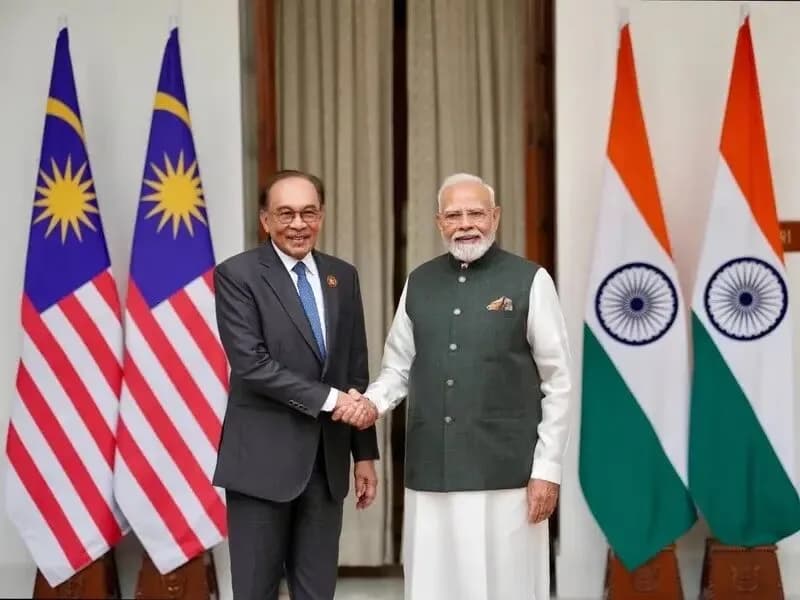
Malaysia’s engagement is particularly significant. Prime Minister Anwar Ibrahim has previously highlighted India’s role in BRICS, suggesting that stronger bilateral relations can contribute to a more balanced dynamic within the grouping.
This is important because BRICS is frequently viewed through the lens of Chinese and Russian influence. India’s presence introduces another major Asian power with its own strategic interests and longstanding relationships with Western countries.
India has also sought to make its Global South agenda more tangible through initiatives outside the traditional geopolitical debate.
The Coalition for Disaster Resilient Infrastructure is one example. The initiative focuses on a practical challenge shared by developing countries, particularly those exposed to climate-related disasters and vulnerable infrastructure. Its endorsement by BRICS gives India an additional platform for advancing cooperation around development rather than geopolitical rivalry.
The Philippines’ decision to join the coalition as its 71st member during the BRICS summit was significant for the same reason. Manila’s participation demonstrated that countries can support Indian-led initiatives on development and resilience while maintaining close strategic ties with the United States.
This may ultimately be the most consequential aspect of India’s BRICS strategy.
Rather than presenting BRICS as a replacement for institutions such as the G20, India appears to be seeking greater influence within a wider and increasingly interconnected multilateral system. Its emphasis on inclusive decision-making allows it to engage with emerging powers while continuing to work with established Western institutions.
For ASEAN, that creates diplomatic room.
The region has little interest in being forced into a binary choice between Washington and Beijing. Its governments have instead pursued multiple partnerships based on economic interests, security considerations and the principle of strategic autonomy.
India’s position within BRICS complements that approach.
The longer-term question will be whether India can maintain this delicate balance as geopolitical competition intensifies. The more BRICS becomes associated with opposition to the West, the more difficult that balancing act could become.
But if the grouping continues to focus on economic cooperation, development, institutional reform and issues of common interest, India could remain an important bridge between BRICS and countries that want deeper engagement without geopolitical alignment.
For Southeast Asia, that makes India’s role particularly consequential. New Delhi is not simply participating in BRICS. It is helping shape the terms under which countries outside the traditional Western alliance system can engage with the grouping.
That measured approach may determine whether BRICS becomes another arena for geopolitical confrontation or evolves into a broader platform for cooperation among countries seeking greater influence in the international system.



Comments
No comments yet. Be the first to share your thoughts.