
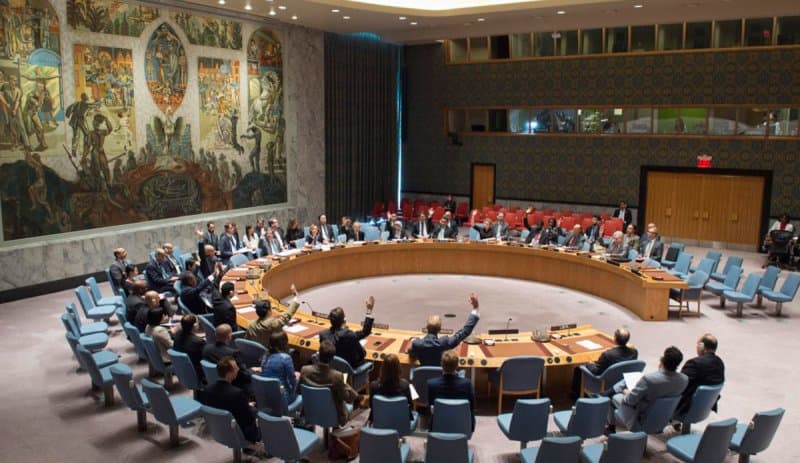
Kenya launches bid for UN Security Council return for 2037-2038

The move signals Nairobi’s long-term ambition to remain a major diplomatic player and to keep pushing for permanent African representation on the global body.
Kenya has formally notified the African Union of its intention to run for a non-permanent seat on the United Nations Security Council (UNSC) for the 2037–2038 term, this outlet has learned.
The decision is detailed in a 67-page report documenting the decisions made by African foreign ministers during the Executive Council meeting in Addis Ababa in July.
The move signals Nairobi’s long-term ambition to remain a major diplomatic player and to keep pushing for permanent African representation on the global body.
Kenya is seeking to bounce back to the Council after previously serving in 1973–1974, 1997–1998, and most recently in 2021–2022.
During its last term, Kenya held the monthly rotational presidency in October 2021, led by then-Permanent Representative to the UN, Martin Kimani, who now serves as UN Assistant Secretary-General for Africa.
Kenya’s 2021–2022 mandate focused on four main pillars: regional peace and security (particularly in the Horn of Africa and the Great Lakes region), counterterrorism and violent extremism, peace support operations, and climate and security.
Latest Stories
The queue: Africa’s long game for UNSC seats
Kenya is not alone in eyeing a seat at the global high table.
The document reveals a complex, decades-long queue of African nations positioning themselves for future UNSC terms:
· 2028–2029: Nigeria, Guinea-Bissau, Morocco, and Libya have shown interest, with elections slated for June 2027 in New York.
· 2029–2030: Tanzania is eyeing a seat. Additionally, South Africa is eyeing the Presidency of the UN General Assembly for this period.
· 2030–2031: Nigeria (again), Burundi, Chad, and Congo are considering bids.
· 2031–2032: South Africa is eyeing a seat.
· 2032–2033: Mauritania and Senegal are considering bids.
· 2033–2034: Uganda is targeting this term.
· 2034–2035: Egypt and Burundi are eyeing the post of President of the 89th session of the UNGA.
· 2037–2038: Kenya.
The AU’s push for consensus
To avoid splitting the African vote and losing seats to other regions, the AU is taking a proactive approach.
The report notes that the Northern and Western African regions have been directed by the Council to consult at the highest political level to reach an agreement on one candidate for each region.
“The candidatures committee within the African Group in New York is instructed to urgently address this matter based on the current criteria and report back to the ministerial committee on African candidatures during the AU summit of January 2027,” the report noted.
This coordinated approach is critical. In the UN General Assembly, a divided continent often means a lost seat.
By forcing regions to settle on a single candidate early, the AU hopes to present a unified front and maximise Africa’s influence in the Security Council.
However, the AU’s track record on reaching consensus is mixed. The continental body has previously failed to endorse a single candidate, leaving the field open for Africans to battle for influence at the global stage.
A case in point is the upcoming International Court of Justice (ICJ) elections, where the AU failed to reach a consensus on a single African candidate during the July foreign ministers meeting in Addis Ababa.
The AU instead endorsed both Kenya’s Prof. Phoebe Okowa and Sierra Leone’s Prof. Charles Jalloh, splitting the African vote and turning the contest into a diplomatic fistfight.

Comments
No comments yet. Be the first to share your thoughts.