
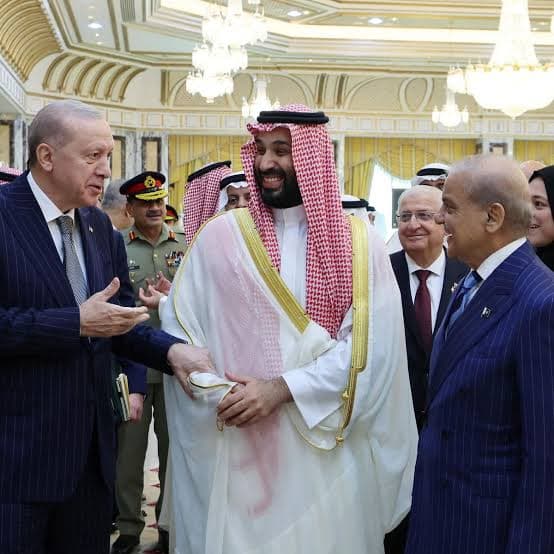
The Mecca Joint Defense Agreement has moved from paper to the battlefield. In an emergency meeting held Monday in Riyadh, the Political and Defense Strategy Committee of the Makkah Defense Alliance; comprising Saudi Arabia, Turkey, and Pakistan — decided to immediately implement collective defense commitments, agreeing to a “rapid deployment” of military forces and capabilities to Saudi territory.
The decision marks the first operational activation of the pact signed just two months ago and comes as Saudi Arabia faces a sharp escalation in cross-border attacks from Yemen’s Iran-backed Houthi movement.
The catalyst for the emergency session was a drone attack on September 29 targeting the Taibah electricity distribution station in Medina, which supplies power to the Prophet’s Mosque; one of Islam’s holiest sites. Coalition spokesman Maj. Gen. Turki al-Maliki confirmed the attack occurred at 5:11 am local time and said forensic analysis of the drone wreckage “proved the Houthi militia’s involvement in planning and carrying out this act”.
The strike caused one transformer to go offline without affecting the wider grid, but the symbolic weight was immense. The Organization of Islamic Cooperation condemned the targeting of vital infrastructure in Medina as “a dangerous escalation and a blatant violation of the sanctity of holy sites”. Turkey’s foreign ministry called it a “provocative attack” that “threatens Saudi Arabia’s sovereignty and security”.
The Houthis have denied involvement, though the Saudi-led coalition maintains that operational data and debris analysis confirm their participation.
The joint statement issued after Monday’s meeting was unambiguous. The three nations agreed “to move immediately to the practical implementation of the collective defence commitments and to take the necessary measures to provide the agreed military forces and capabilities and ensure their rapid deployment in the Kingdom”.
Specific troop numbers and deployment timelines were not disclosed, though the statement noted the deployment will proceed “in accordance with previously approved arrangements and the national laws of Pakistan, Saudi Arabia and Türkiye”. The stated objectives are to enhance combat readiness, military integration, and the collective capacity to counter threats.
The committee also appointed retired Lieutenant General Nauman Mahmood of Pakistan as the alliance’s first Secretary-General for a three-year term. He will lead the General Secretariat being established in Riyadh.
The Makkah Joint Defence Agreement was signed on August 7, 2026, by Saudi Crown Prince Mohammed bin Salman, Turkish President Recep Tayyip Erdoğan, and Pakistani Prime Minister Muhammad Shehbaz Sharif during a trilateral summit in Mecca.
Its core provision mirrors NATO’s Article 5: an armed attack against any one member “shall be regarded as an attack against them all”. Turkish Foreign Minister Hakan Fidan described the commitment as “technically the same” as NATO’s collective defense clause, while noting that allies would determine the degree and form of assistance through consultation.
The pact builds on the Strategic Mutual Defence Agreement endorsed by Pakistan and Saudi Arabia in September 2025 and the quadrilateral consultative mechanism that includes the three signatories and Egypt.
The three signatories bring substantial capabilities to the table. According to the Global Firepower Index 2026, the combined forces include approximately 1.4 million active-duty personnel, over 6,000 tanks, 3,415 military aircraft, and defense spending exceeding $124 billion annually. Pakistan, the Muslim world’s only nuclear-armed state, provides strategic depth and manpower. Turkey contributes NATO’s second-largest military and a mature defense-industrial base. Saudi Arabia brings financial weight and energy infrastructure.
The activation coincides with a major military campaign launched by Yemen’s Saudi-backed government to retake territory controlled by the Houthis. Yemeni President Rashad al-Alimi announced the offensive in a televised address, vowing to press on “until the country is liberated”. The Saudi-led coalition has announced it will support the government’s offensive with air power.
Middle East Eye reported that the public deployment of Pakistani and Turkish troops carries deep symbolic weight, with one Western official in the Gulf noting that Riyadh wanted to ensure it had “international buy-in” to launch a counter-offensive against the Houthis.
Pakistan already maintains tens of thousands of troops in the kingdom, and Reuters reported last week that Pakistan sent four planeloads of weapons to the port city of Aden to support the Saudi-backed Yemeni government.
The immediate focus will be on the logistics and scale of the deployment. While exact figures remain undisclosed, the decision to invoke the pact’s collective defense clause signals that all three nations are prepared to back their commitments with tangible military assets.
For Saudi Arabia, the activation provides a public demonstration of regional support as it escalates its campaign against the Houthis. For Turkey and Pakistan, it formalizes their roles as security stakeholders in the Gulf and Red Sea corridor; a region where both have significant economic and strategic interests.
The Makkah Defense Alliance has stated it is open to other countries joining. Syria’s foreign minister has already indicated Damascus is considering membership. Whether the pact’s first operational deployment sets a precedent for deeper military integration or remains a limited symbolic gesture — will depend on how the situation in Yemen evolves in the coming weeks.


Comments
No comments yet. Be the first to share your thoughts.