
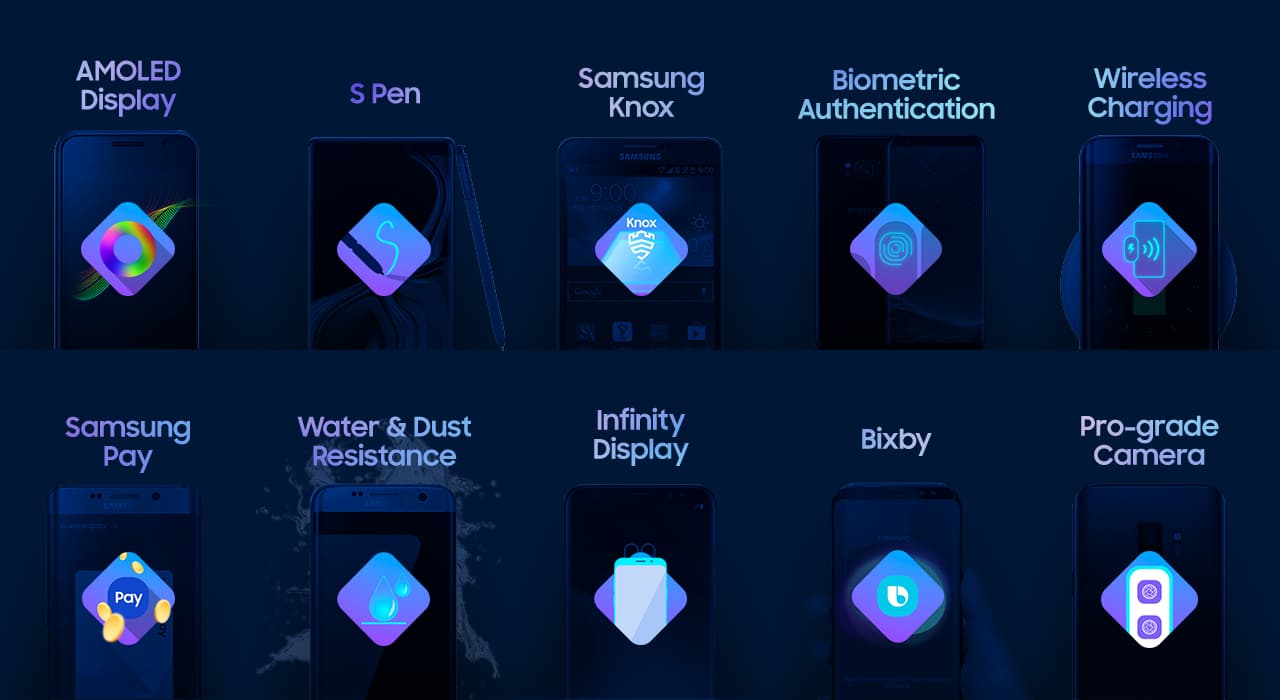
Samsung’s history in technology is marked by a series of products and technologies that challenged established ideas about how people use electronics.
The company traces its origins to 1938, while Samsung Electronics was established in 1969. Over the decades, it has expanded from consumer electronics into smartphones, televisions, home appliances, displays, semiconductors, wearables and artificial intelligence.
Some of its products introduced technologies that later became more common across the industry, while others created entirely new product categories.
From Super AMOLED displays and the S Pen to foldable smartphones and on-device artificial intelligence, Samsung has repeatedly experimented with new ways of combining hardware and software.
Here are some of the milestones that have shaped that journey.
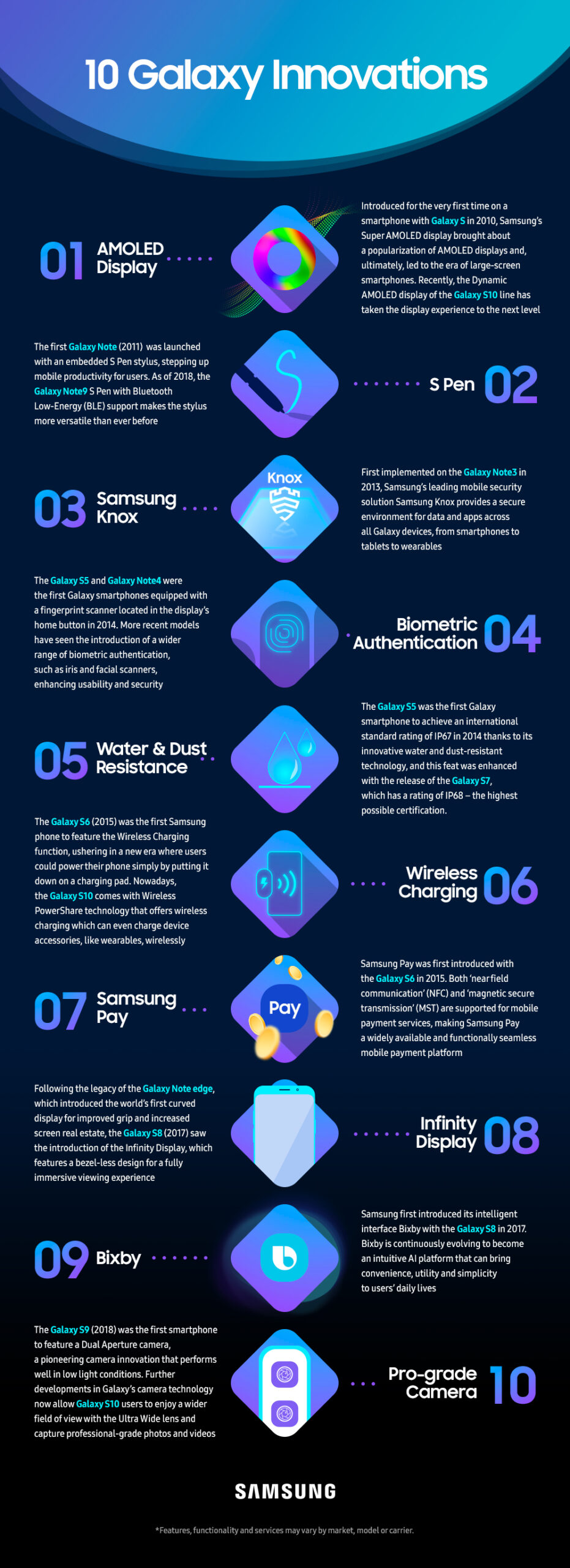
In 2010, Samsung launched the Galaxy S with a Super AMOLED display, which the company described as the first smartphone launched with the technology.
Super AMOLED combined the touch sensor and display into a single layer, helping produce a thinner device while delivering strong contrast and vivid colours. The technology also helped establish the display as one of the defining features of the modern smartphone.
Samsung continued developing its AMOLED technology through successive generations of Galaxy smartphones, eventually moving to Dynamic AMOLED and other advanced display technologies.
The evolution reflected a broader shift in smartphones, where the quality, brightness, colour reproduction and size of the screen became central to the user experience.
Samsung took another step in 2011 when it introduced the Galaxy Note, combining a large smartphone display with the S Pen digital stylus.
The concept was straightforward: a smartphone could also serve as a digital notebook.
Users could write notes, draw, annotate documents and interact with the phone using the pen. At the time, the large-screen design was unusual, but the Note helped establish a category of devices that sat between conventional smartphones and tablets.
The S Pen subsequently became one of Samsung’s defining Galaxy features and remains part of the company’s flagship productivity-focused devices.
As smartphones became increasingly important for work, the security of mobile devices and corporate information became a bigger concern.
Samsung introduced Knox in 2013 as a security platform designed to protect devices and data. One of its early approaches was to create a secure environment that could separate work information from personal data on the same smartphone.
Knox has since expanded beyond a single device-security feature into a broader security platform covering Samsung smartphones, tablets, wearables and other connected products.
The development reflected another change in the smartphone market: phones were no longer simply personal communication devices but increasingly became tools for business and professional work.
Samsung introduced Bixby with the Galaxy S8 in 2017, giving users another way to interact with their smartphones through voice commands and other intelligent functions.
The assistant represented Samsung’s attempt to make interaction with smartphones more conversational and context-aware.
While the technology and capabilities of smartphone assistants have evolved significantly since then, the underlying idea has remained relevant as artificial intelligence has become increasingly integrated into consumer devices.
Samsung has continued developing Bixby as part of its broader connected-device ecosystem.
Samsung’s experimentation has not been limited to smartphones.
In 2013, the company unveiled what it described as the world’s first Curved UHD TV, combining ultra-high-definition resolution with a curved display.
The curved design was intended to create a more immersive viewing experience while offering a different approach to the traditional flat-screen television.
Five years later, Samsung introduced another major display concept with The Wall.
The 146-inch MicroLED display, unveiled in 2018, was described by Samsung as the world’s first modular TV for consumers. Its modular architecture allowed the screen to be configured to suit different spaces.
The products reflected a shift in television design that went beyond increasing resolution. Manufacturers were also experimenting with screen size, form factor, installation and the role of the television within the home.
Some of Samsung’s technology milestones have been less visible but more directly connected to everyday life.
In 1995, the company introduced Twin Cooling technology for refrigerators, using separate cooling systems for the refrigerator and freezer compartments.
The approach allowed the two sections to be managed independently, helping maintain different temperature and humidity conditions and limiting the transfer of odours between compartments.
Samsung has continued building on the idea of more intelligent household appliances. Its connected-home strategy now includes SmartThings and appliances equipped with artificial intelligence and other connected features.
Samsung also applied technology to one of the most routine household tasks: laundry.
Its Eco Bubble technology mixes air, water and detergent to create bubbles that can penetrate fabrics more quickly. The technology is designed to deliver effective cleaning at lower temperatures, potentially reducing the energy required to heat water.
The technology illustrates a recurring theme in Samsung’s product development: taking an established household process and changing the way it works rather than simply adding more features.
That approach has continued with connected washing machines and other appliances that use sensors, automation and AI to optimise household tasks.
Samsung made one of its biggest bets on a new product category in 2019 with the launch of the Galaxy Fold.
When opened, the device featured a 7.3-inch Infinity Flex Display, giving users access to a larger screen while retaining a more compact form factor when folded.
Samsung described it as the first device with a 7.3-inch Infinity Flex Display.
The significance of the Fold was less about screen size alone and more about challenging a basic assumption about smartphones: that the shape and size of the display had to remain fixed.
Samsung subsequently expanded the concept through the Galaxy Z Fold and Galaxy Z Flip families, making foldable displays a more established category within the smartphone market.
Samsung’s latest major shift has been toward artificial intelligence.
In 2024, the company introduced the Galaxy S24 series with Galaxy AI features built directly into the smartphone experience.
Among the features were Circle to Search, Live Translate and Chat Assist, bringing AI into activities such as searching, communication, translation and content creation.
The significance was not simply that Samsung added AI features to a smartphone. It was that the company positioned AI as part of everyday interaction with a device people already use for communication, work, entertainment and information.
Samsung has since expanded its AI strategy across more of its Galaxy ecosystem, including smartphones, tablets, wearables and other connected devices.
Samsung’s technology history spans very different categories, from refrigerators and washing machines to televisions, smartphones and artificial intelligence.
Yet a common thread runs through many of its major milestones.
The company has repeatedly taken products that consumers already understand and experimented with changing how they work.
A smartphone could become a notebook through the S Pen. A conventional display could become a foldable screen. A television could become a modular wall-sized display. A refrigerator could use independent cooling systems. And artificial intelligence could move from a separate technology into the devices people use every day.
Not every experiment becomes an industry standard, and not every Samsung “first” represents the first appearance of an underlying technology in the world. But the company’s willingness to commercialise new form factors and technologies has helped shape the direction of consumer electronics.
From Super AMOLED to foldable displays and Galaxy AI, Samsung’s strategy has increasingly centred on bringing emerging technologies into products designed for mass-market use.
That evolution reflects the company’s long-standing vision to “Inspire the world and create the future” — not simply by producing new devices, but by testing what familiar technology could become next.


Comments
No comments yet. Be the first to share your thoughts.