
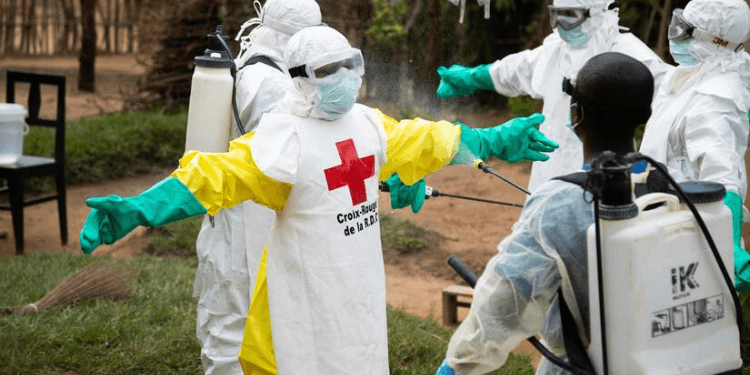
Laboratory Test Results Confirm the Cases
According to the agency, preliminary laboratory tests conducted by the Institut National de Recherche Biomédicale (INRB) detected the Ebola virus in 13 of 20 samples analyzed.
Early findings suggest the outbreak may involve a non-Zaire ebolavirus strain, with full sequencing underway to determine the exact variant.
Africa CDC said the results of the sequencing will guide response measures, including the selection of appropriate vaccines and treatments.
The agency reported that most infections and deaths have been recorded in the mining areas of Mongwalu and Rwampara, while other suspected cases have also been identified in Bunia, the provincial capital, and are waiting for laboratory confirmation.
Africa CDC noted four of the deaths so far have been confirmed among laboratory-positive cases, while the wider toll includes suspected cases still under investigation.
Africa CDC Raises Concern of Risk of Wider Spread
Regional Response Efforts
In response to the developing situation, Africa CDC said it has convened an urgent coordination meeting bringing together health authorities from the DRC, Uganda and South Sudan, alongside key global partners including the World Health Organization and UNICEF, the United States CDC, the European CDC, China CDC, the Public Health Agency of Canada, Gilead Sciences, Merck & Co., Johnson & Johnson Innovative Medicine, Regeneron Pharmaceuticals, Roche, Abbott Laboratories, Cepheid, BioNTech, and Moderna.
Africa CDC said the meeting is focused on strengthening surveillance, laboratory support, infection prevention, risk communication, safe burials, and cross-border coordination to contain the outbreak.
“Africa CDC stands in solidarity with the Government and people of the Democratic Republic of the Congo as they respond to this outbreak,” said H.E. Dr. Jean Kaseya, Director General of Africa CDC.
“Given the high population movement between affected areas and neighboring countries, rapid regional coordination is essential. We are working with DRC, Uganda, South Sudan, and partners to strengthen surveillance, preparedness, and response, and to help contain the outbreak as quickly as possible.
DRC Fighting with Ebola
The Democratic Republic of Congo has experienced several Ebola outbreaks since the virus was first confirmed in 1976.
Previous outbreaks have been among the deadliest in the world, including the 2018–2020 epidemic in eastern DRC that killed more than 1,000 people.
Ebola is a dangerous disease spread through direct contact with infected body fluids or contaminated materials, making early detection, isolation, and community cooperation important to controlling outbreaks.
The agency said further updates will be provided as more information becomes available, particularly once laboratory tests confirm the specific strain leading to the outbreak.


Comments
No comments yet. Be the first to share your thoughts.