
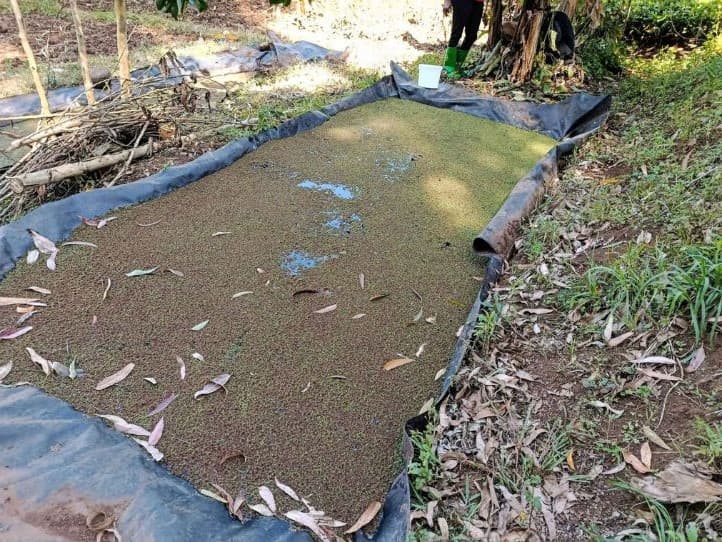
At her farm in Mahiga Ward, Othaya Constituency, Nyeri County, Agnes Gathondu tends to three small ponds measuring just 5 by 10 metres.
The ponds may look modest, but they have become an important part of her fish and poultry business, helping her cut feed costs and create an additional income source.
“I have been a fish and poultry farmer for more than five years, and the cost of commercial feeds almost made me close the business because I was relying on my father for most of the finances,” says Gathondu.
Gathondu’s journey in Azolla farming began in 2021 after years of struggling with costly commercial feeds.
She began with a small aquatic plant that she now grows in the ponds and uses to supplement commercial feed for her fish and poultry.
“I started Azolla farming in 2021 after feed prices hiked due to scarcity. Since then, I no longer rely on my father because the business is profitable,” she says.
Gathondu says the change has significantly reduced the amount of commercial feed she needs to buy. A 25-kilogramme bag of commercial fish feed costs about Sh4,700 and lasts her roughly eight days.
By alternating commercial feed with Azolla, she estimates that she has cut her production costs by about 40 per cent.
Her entry into farming, however, was not without challenges. Coming from a community where girls traditionally do not inherit land from their parents, Gathondu had to seek permission from her father to access land for her enterprise.
What started as a small experiment has since developed into another income stream. Besides feeding her own livestock and fish, she sells Azolla planting material to other farmers at Sh1,000 per kilogramme.
“The ponds have also become a business. I sell Azolla planting material at Sh1,000 per kilogramme. I have so far introduced 120 women to the technology,” she says.
What is Azolla?
Azolla is a small, free-floating aquatic fern that grows rapidly on the surface of freshwater. Its ability to produce large amounts of biomass is linked to a natural partnership with a nitrogen-fixing blue-green alga, Anabaena azollae, which lives within the plant.
Through this relationship, Azolla can fix atmospheric nitrogen, allowing it to grow with limited reliance on synthetic fertilisers. The resulting biomass can be harvested regularly and used as a supplementary source of feed for livestock, poultry and fish, as well as an organic input for crops.
A potential low-cost feed option
Azolla contains about 19 to 35 per cent crude protein, as well as vitamins and minerals including calcium and phosphorus. This makes it a useful supplementary feed, particularly for farmers looking to reduce their dependence on expensive commercial feeds.
Feed is one of the biggest costs in livestock production, with poultry farmers in Kenya often spending a substantial share of their production budgets on feed.
Fast-growing and easy to harvest
One of Azolla’s biggest advantages is its rapid growth under favourable conditions. The plant can multiply its biomass within a few days, allowing farmers to harvest it continuously from properly managed ponds.
A relatively small pond can therefore provide a regular supply of Azolla without requiring large portions of farmland. This makes it particularly attractive to smallholder farmers who have limited land but want to diversify their sources of livestock feed.
More than just animal feed
Azolla’s value extends beyond livestock production. Because of its nitrogen-fixing ability, the plant can also be incorporated into farming systems as a source of organic nutrients.
Research in Kenya’s Mwea Irrigation Scheme, a major rice-growing region, has investigated the use of Azolla in rice production, with findings showing improvements in crop growth and yield following Azolla inoculation.
The plant can also help suppress weeds and influence conditions in flooded rice fields. Its ability to absorb carbon dioxide through photosynthesis adds to its potential as part of more sustainable farming systems.
Comments
No comments yet. Be the first to share your thoughts.