
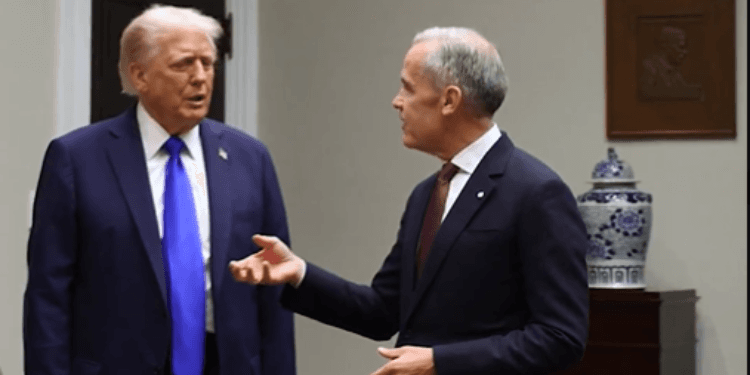
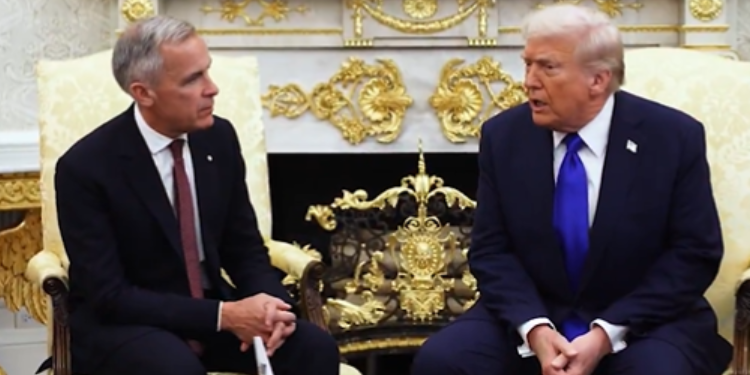
Canadian Prime Minister Mark Carney has firmly rejected claims that the United States is demanding an “entry fee” before beginning negotiations on the review of the United States-Mexico-Canada Agreement (USMCA).
Carney on Thursday, April 23, pushed back on speculation that has fueled tensions with U.S. President Donald Trump.
“I don’t know where the talk of an ‘entry fee’ is from. It’s not language I’ve ever used, and it’s not language I’ve ever heard from the president,” Carney said, dismissing suggestions that Washington is setting preconditions for talks.
The remarks come at a time the three USMCA partners—Canada, the United States, and Mexico—are facing a July 1 deadline to complete a mandatory joint review of the agreement.
The pact, which replaced NAFTA in 2020, includes a built-in mechanism requiring periodic reassessment and unanimous agreement to extend it beyond 2036.
PM Carney speaks amid USMCA tensions
However, progress toward that review has been uneven. While U.S. officials have already initiated formal engagement with Mexico—including scheduling negotiating rounds in Mexico City—no equivalent timeline has been announced for Canada, raising concerns in Ottawa about being sidelined.
Carney signalled that Canada would not rush into talks under pressure or accept piecemeal demands from Washington.
“We’re not sitting here taking notes and taking instruction from the United States,” he said. “We’re ready to go into detailed negotiations, but we’re also prepared to wait if necessary.”
At the centre of the friction are tariffs imposed by the Trump administration on key Canadian imports, which have triggered retaliatory measures and hardened Canada’s stance ahead of negotiations.
Canadian officials have made clear that any review of the agreement must address these broader trade disputes rather than isolate individual concessions.
Trade Minister Dominic LeBlanc has warned against entering negotiations simply to secure a symbolic start.
“We’re not going to make a series of concessions just to get to a table,” he said, signalling Ottawa’s preference for a comprehensive approach.
Carney also pushed back against what he described as a “misimpression” of Canada’s economic dependence on the United States, emphasizing that the relationship is mutually beneficial.
“Yes, it is our biggest trading partner by far. We are also their second biggest trading partner,” he said, describing the relationship as “symbiotic.”
He noted that roughly 85% of trade between the two countries remains tariff-free under the current framework, underscoring the depth of integration across industries.
Why it matters
Still, the broader outlook for the USMCA review remains uncertain. Analysts and the Bank of Canada assessments have outlined several possible outcomes—from a straightforward extension of the agreement to a major renegotiation that could introduce stricter rules of origin, higher trade costs, or new sector-specific tariffs.
In a worst-case scenario, failure to reach consensus could trigger annual review cycles until 2036 or even lead to the agreement’s eventual collapse, significantly increasing trade barriers across North America.
Such uncertainty carries economic risks, particularly for Canada, whose exports are heavily tied to U.S. markets. A less favorable agreement could weaken export competitiveness, reduce investment, and slow economic growth, while also pushing up consumer prices through supply chain disruptions and counter-tariffs.
Prime Minister Carney has increasingly emphasized the need for Canada to diversify its trade relationships and reduce reliance on the United States, even as negotiations continue.
Despite the tensions, he maintained that discussions remain constructive, framing the process as a standard negotiation rather than a one-sided demand.
“There’s an exchange on understanding the issues and on opportunities for cooperation,” Carney said. “This is a negotiation.”
The path forward for the USMCA review remains unclear, with no formal timeline yet set for U.S.-Canada talks and the July 1 deadline approaching, businesses and policymakers on both sides of the border are bracing for a potentially prolonged and contentious process.


Comments
No comments yet. Be the first to share your thoughts.