
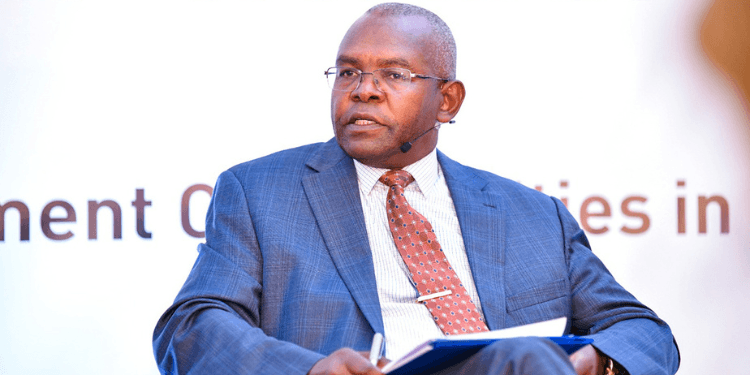
The Central Bank of Kenya has explained how banks will set loan interest rates under the revised Risk-Based Credit Pricing (RBCP) model, with borrowers’ credit risk expected to play a key role in what they pay.
Under the framework, all variable-rate shilling-denominated loans will use a common reference rate, and banks can choose either the Central Bank Rate (CBR) or the Kenya Shilling Overnight Index Average (KESONIA).
However, the reference rate will only form part of the final interest rate charged to a borrower.
Speaking during the Monetary Policy Committee (MPC) briefing on Thursday, October B, CBK Governor Kamau Thugge said banks will add credit-related operating expenses, a return on shareholders and a component reflecting the borrower’s credit risk premium.
Therefore, borrowers considered to be higher risk could face higher interest rates, while those considered lower risk could pay less.
“If you are perceived to be more risky, your interest rate will be higher. If you are perceived to be less risky, then your interest rate will be lower,” Thugge explained.
CBK Governor Reveals How Banks Will Decide What Interest Rate You Pay on Loans
The revised Risk-Based Credit Pricing model has been fully operational since March 2026.
The model includes several components banks must consider when setting the cost of variable-rate loans.
These include a common reference rate, credit-related operating expenses, return on shareholders, the borrower’s credit risk premium and other relevant costs.
KESONIA, compounded in arrears, can be used as the common reference rate.
Banks will also factor in direct and indirect lending costs when determining the final rate charged to customers.
The return to shareholders represents the expected return to shareholders from the lending business.
The borrowers’ risk premium, meanwhile, represents the compensation banks expect from borrowers depending on their individual risk profiles.
This means two customers borrowing from the same bank could receive different interest rates if the bank assesses their credit risk differently.
Banks can also include other lending-related costs, in line with the spirit of the Kenya Banking Sector Charter.
CBR remains an alternative reference rate that banks can use when pricing variable-rate loans.
The total cost of credit under the model is made up of the reference rate, the premium known as “K” and applicable fees and charges.
The new model applies to variable-rate loans, except foreign currency-denominated loans and fixed-rate loans.
KESONIA and CBR Converge
CBK said the new framework has also brought KESONIA and the CBR into closer convergence.
The framework began being implemented in August 2023, initially with an interest rate corridor of 250 basis points. The corridor has since been narrowed to 50 basis points.
According to the CBK, the convergence means there is now very little difference between using KESONIA or the CBR as the reference rate for variable-rate loans.
“Whether you choose the CBR or whether you choose KESONIA, it really doesn’t make that much of a difference since this framework has ensured that there is complete convergence between the CBR and the KESONIA,” the CBK said.
The interest rate-setting framework fully took effect in March 2026.
Loan Rates Fall After CBK Easing
The disclosure comes after a significant easing of monetary policy by the Central Bank.
Thugge said it lowered the Central Bank Rate by 425 basis points, and the reduction was subsequently reflected across several parts of the financial system.
Treasury bill interest rates declined from almost 17% to about 9%.
Average commercial bank lending rates also fell from 17.2% to about 14.4% in September 2026.
The CBK Governor said lending rates remained broadly stable in the three months leading up to September, at 14.4%, 14.3% and 14.4%.
Credit Growth Picks Up
The easing of monetary policy and decline in commercial bank lending rates have also coincided with stronger growth in credit to the private sector.
Credit to the private sector grew by 10.6% in September 2026, compared with negative 2.9% in January 2025.
Kamua Thugge said broad money supply, measured by M3, also rose from-1.4% in early 2025 to 11.3% in September 2026.
The developments point to an improvement in the transmission of monetary policy, with changes in the policy rate increasingly reflected in market interest rates.
The Governor said short-term interest rates were broadly stable and aligned with the policy rate, while commercial banks’ average lending rates remained stable in August and September 2026.
Follow our and X Account for real-time news updates.



Comments
No comments yet. Be the first to share your thoughts.