
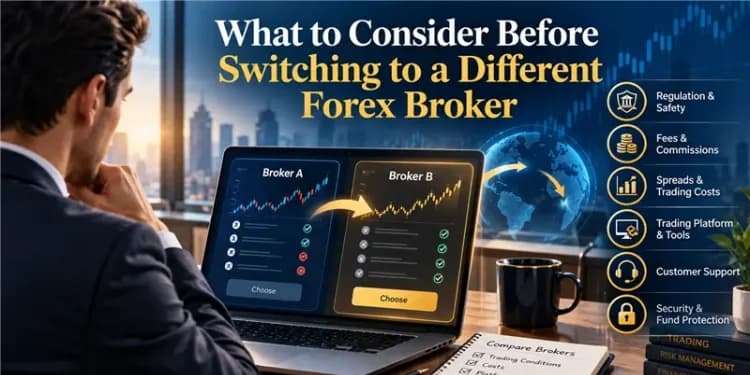
Switching from one broker to another can feel like a chore, but it becomes a vital part of trading hygiene.
In the same way that you maintain your computer, or even your own health, you need to ensure your broker is still the right partner for how your strategy continues to evolve.
Don’t think of switching to a different forex broker as an emotional reaction to a few bad trades and avoidable slippage; think of it as a stratasegic decision that your current platform no longer meets your needs.
We’ve created a 7-point checklist in this article for you to keep handy when auditing your current broker versus your potential next one.
How to use this checklist
This checklist is designed to be used as a professional due diligence report on the shortlisted brokers.
We aim to remove emotion and sentiment from the equation, leading you to a switching decision that no longer feels risky, but a necessary next step in your trading career.
The pre-switch audit: your 7-point checklist
These seven pillars are the difference between trading with a broker that facilitates your chosen strategy and one that becomes a liability, working against you.
Before migrating brokers, benchmark your potential new provider against industry standards.
Reading a detailed Alpari review or similar broker evaluation pages allows you to compare leverage, execution conditions, and platform options before opening a live account with a new broker.
Once you are satisfied that a new broker may be better for your strategy, you should use this checklist to cover all the bases before switching.
- Verify regulatory compliance first, always
Your only non-negotiable factor must be compliance with a regulator. Don’t just look on the website for a logo; verify the licence number (usually found in the footer) with the regulator itself.
A compliant forex provider is held to much higher standards than a non-compliant provider, with much more customer protection built into its operations.
Some providers appear professional on the surface but operate under lax oversight, which is why investigating their disciplinary history and physical location through the regulator is a necessary final safety layer.
- Calculate your true trading costs
Next, make a note of every cost involved in trading: beyond the spread costs, include any hidden fees such as withdrawal commissions, inactivity fees, and even overnight swap rates.
Calculate if these eat into your net profit over 3 months of operating your strategy. Only with this information can you make an informed decision between brokers.
For more experienced traders, remember costs can be tiered by volume, so if you’re a high-frequency trader, ask the new broker for the specific commission schedule that applies to your expected monthly activity.
- Stress-test the trading platform
Before moving your capital from one broker to another, open a demo account. Put the new broker through its paces, exactly how you would want to trade.
You’re trying to test the latency, as well as opening and closing trades during high-volatility periods following macroeconomic news events. If the platform hangs or the indicators lag, it’s not a good fit.
-
Assess asset and instrument availability
Another reason to open a demo account is to confirm that every asset or instrument you have mastered is available with your new broker.
This is especially important if you specialize in exotic pairs or specific CFDs. Confirm the new broker’s liquidity for these assets is equal to or better than what you currently have.
- Review deposit and withdrawal policies
One of the most common frustrations when switching broker is not knowing the deposit and withdrawal policies. When transitioning between brokers, pay close attention to payment processing SLAs, account-closing fees, and funding restrictions.
We recommend reviewing our guide on forex broker withdrawal times, fees, and red flags to spot hidden exit charges or delays before you move your capital. If the potential new broker has a 5-day withdrawal delay, walk away.
- Evaluate the quality of customer support
Don’t wait for a crisis before finding out how good the customer service is with a new broker. Send an email and use their live chat before you get stuck in.
Are their responses entirely script-led reading, or do they actually understand trading and your queries directly? This is the best way to understand how you’ll be treated when things actually go wrong.
- Check alignment with your trading style
Does the trading execution model of your new broker fit your strategy? Whether they offer DD, STP or ECN, make sure that you aren’t upgrading or downgrading the trading model without realizing it, as experienced traders may not want a Market Maker, and beginners certainly won’t want the full transparency of an ECN out of the box.
You must ensure the broker supports your technical approach rather than forcing you to adapt your strategy to the limitations of its liquidity model.
As Vladyslav Kushneryk, CBDO at TopBrokers, explains, choosing a broker should be treated as a strategic decision rather than a reaction to short-term trading results.
“A broker should support the way you trade, not force you to redesign your strategy around its limitations. Regulation, execution quality, real trading costs, and withdrawal conditions matter far more in the long run than an attractive promotional offer or a slightly lower advertised spread,” he says.
This is why traders should evaluate a potential broker as part of their overall risk-management framework rather than simply comparing headline conditions.
Common mistakes when changing brokers
At the end of the day, the grass isn’t always greener on the other side. This is also true when comparing your current forex broker with a new one.
Some people think, “I should move because this other broker has a 0.2 pip spread improvement on my most traded pairs,” but in reality, they end up losing more to execution issues, or by struggling to use a new platform they haven’t learned yet, than they actually gained.
You shouldn’t ever close your old account on the same day you open the new one. Keep both active for a transition period.
We recommend 30 days is a good window for you to ensure the new broker functions as expected under live market conditions without losing access to a platform and a broker you already know well.
Making the final call
Ultimately, it is a business decision. Do not let emotions cloud your judgment. If a broker fails on any of the seven benchmarks above, moving or keeping your capital there will become a severe strategic error.
You don’t owe the forex dealer anything, especially loyalty. Sticking with a broker doesn’t improve your trading performance. So if they aren’t serving your goals, move your capital. That’s where your loyalty should lie.
Using our 7-step checklist, along with the individual broker review pages on our website, you should be able to make an informed decision about what best suits your trading strategy and improves your chances of success with your next batch of trades. Put your money first, not your broker.



Comments
No comments yet. Be the first to share your thoughts.