
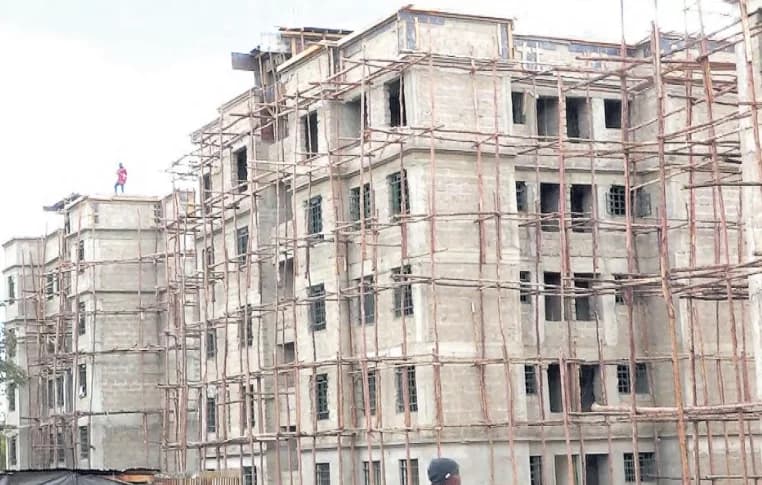
With comparable plots in the area now costing over Sh5 million, land prices have more than tripled. But for Ouma, acquiring the land was only the beginning

Morris Ouma bought a piece of land in Ruaka, Kiambu County, in 2010 for Sh1.5 million. His hope was to build a family home and secure his financial future.
More than a decade later, his journey from owning a plot to putting up a house has become an illustration of how expensive homeownership has become.
“It has been a long journey but I'm almost there,” he told the Star, “I thank God I first invested in land then started construction slowly.”
Price of land in the area has more than tripled with comparable plots now costing over Sh5 million.
Ouma's story mirrors the reality for countless Kenyans who must save for years to buy land before spending an even longer time building a house.
The alternative path is hardly easier: buying a completed house requires steep upfront capital, while a mortgage commits a household to rigid repayments for 15, 20, or even 25 years.
“The biggest challenge is that you are expected to save for a house while paying rent and meeting all your other expenses. Even with a regular salary, it is difficult to accumulate enough money for a deposit,” Nairobi resident Phyllis Nyanchira said.
“Property prices keep changing, and by the time you save enough, the house you wanted may already be beyond your reach. Homeownership is increasingly becoming reserved for rich people."
Those who turn to off-plan developments face the risk of the promised home not being delivered.
“I trusted the developer because the project was presented as a secure investment with a completion date. I paid my instalments expecting to move into my house, but the deadline passed without delivery. My money is now tied up in a project that has not fulfilled its promise,” says Fred Onyango.
Onyango said his situation is worse because he cannot easily start another homeownership journey as his savings are trapped.
These experiences expose a housing market where affordability, financial risk and questions about value for money are increasingly undermining the aspiration to own property.
Data from property consultancy HassConsult show land prices have steadily increased over the last decade across the Nairobi metropolis.
As of March 2026, land in satellite towns averaged Sh33 million per acre, up from Sh16 million a decade earlier. At that average, a quarter-acre plot costs about Sh8.25 million before legal fees, transfer costs and construction.
In the prime suburbs, the cost averages Sh231.9 million per acre.
The high costs have left most households with limited options. Either they buy an apartment, keep renting or seek smaller plots on the periphery of the city.
But cheaper land on the outskirts often hide additional expenses, including access roads, water, electricity and security.
A plot that appears affordable can become expensive once the cost of making it habitable is included. For households unable to afford completed houses or qualify for mortgages, incremental construction offers an alternative.
Buyers acquire land, put up a foundation, construct walls, install a roof and complete the finishing as savings grow.
Although this avoids taking on a large loan at once, it can take years before a family settles in the home.
Data at the Kenya National Bureau of Statistics shows average annual construction-input inflation eased to 0.53 per cent in 2025, from 2.83 per cent in 2024.
However, the construction-input price index increased from 119.41 in the fourth quarter of 2024 to 120.15 in the corresponding quarter of 2025.
“The easing in inflation does not mean construction has become cheap. The final cost still depends on the size and design of a house, the quality of materials, contractor charges, professional services and the efficiency with which a project is managed,” real estate developer John Kamau said.
Building in phases also exposes households to price changes and disruptions from job losses, school fees and medical emergencies, which can push construction further down the list of priorities.
Knight Frank's first-half 2026 market update reported that prime residential selling prices in Kenya rose by 6.2 per cent, while monthly prime residential rents increased by 0.73 per cent compared to the previous year.
However, the broader residential market presents a mixed picture. HassConsult's analysis for the year to March 2026 found that apartment prices declined in 10 of the 18 suburbs and satellite towns surveyed. Westlands recorded a 7.9 per cent fall, while Upper Hill registered a 6.8 per cent decline.
Standalone house prices, meanwhile, increased in 11 of the 14 areas surveyed.
The figures challenge the assumption that property prices will always rise and that buying any house in Nairobi, or any other urban area, is automatically a sound investment.
Construction quality, water supply, parking, security, access to public transport and management of shared facilities all influence a property's long-term value.
Experts say buyers must also factor in service charges and maintenance costs, which can make apartment ownership more expensive than initially anticipated.
Mortgages offer buyers an opportunity to acquire completed homes without raising the entire purchase price upfront. But the long-term financial commitment can expose households to pressure.
Central Bank of Kenya data shows outstanding mortgage loans rose from Sh279.3 billion in December 2024 to Sh307.2 billion in December 2025, representing a 10 per cent increase.
Mortgage accounts rose from 30,016 to 30,762 over the same period, while the average mortgage loan size increased from Sh9 million to Sh10 million.
Mortgage interest rate declined from 15.2 per cent to 13.5 per cent, but the value of non-performing loans increased from Sh46 billion to Sh50.2 billion.
Non-performing mortgages accounted for 16.3 per cent of gross mortgage loans in December 2025, compared to 16.5 per cent a year earlier.
CBK's latest Bank Supervision Annual Report also shows 75.6 per cent of mortgage loans were on variable interest rates in 2025, down from 85.9 per cent in 2024.
“The outstanding value of non-performing mortgage loans however increased from Sh46.0 billion in December 2024, to Sh50.2 billion in December 2025.”
“About 75.6 per cent of mortgage loans were on variable interest rates in 2025, as compared to 85.9 per cent in 2024. This was due to increase in mortgage loans under fixed interest rates from 14.1 per cent in December 2024 to 24.3 per cent in December 2025,” CBK says.
According to the regulator, low household income levels and high property values are the primary impediments to mortgage growth.
The figures mean mortgage lending is expanding, but the cost of buying property remains beyond the reach of many households.
A bank's willingness to approve a loan does not necessarily mean a borrower can comfortably sustain repayments.
Job losses, business difficulties or unexpected emergencies can push borrowers into arrears and ultimately put their homes at risk.
According to Michael Kamau, a realtor in Mombasa, renting should not automatically be dismissed as throwing money away.
“Renting provides accommodation without requiring a large deposit or exposing a household to property-price and mortgage risks. Buying can build long-term equity, but only where the purchase price and financing arrangements are sustainable,” he said.
Stella Gati, a financial sector consultant in Nairobi, says the pressure of servicing a mortgage has become a source of anxiety.
“I pay Sh110,000 every month but I am increasingly concerned about my ability to service the loan. One financial emergency or loss of income could put everything we have worked for at risk."
The risks are not confined to mortgage borrowers or people constructing their own homes.
Off-plan developments attract buyers with the promise of securing property before completion and spreading payments over the construction period. However, this places considerable trust in developers' ability to deliver.
Projects can be delayed by financing difficulties, construction problems, land ownership disputes or failure to secure approvals. In the worst cases, buyers are left without completed homes and face difficulties recovering their money.
Land transactions carry similar risks. Fraudulent documents, disputed ownership and double allocations can turn property purchases into years of litigation.
The KNBS housing survey identifies the sanctity of land titles and corruption among challenges affecting implementation of building-sector regulations.
Other obstacles include delays in land transactions, cumbersome approvals, litigation, financing costs and inadequate infrastructure.
Peter Omari, who is tied to a land case in Kiambu, says the experience has exposed the vulnerability of property buyers.
“I thought I had secured my family's future when I purchased the land. The seller presented documents that appeared genuine, and I believed the transaction was legitimate. I later discovered there were questions surrounding the ownership,” he said.
“You can save for years, buy land and even receive documents, only to discover that you may not have secure ownership. It is a frightening experience."
Prospective buyers therefore need independent legal checks on ownership, searches at the relevant land registry, confirmation of development approvals and clarity on how their payments will be protected if a project stalls.
"By doing so, a purchaser will be considered a bona fide purchaser for value," said Eugene Akumu, an Advocate of the High Court of Kenya.
He said the court does not just look at whether a purchaser conducted due diligence, but also the depth of that due diligence. "So, as much as legal purity of the title origin is key, demonstrating that proper due diligence was conducted increases a purchaser's claim to a title in the event of a dispute."
Beyond the cost of acquiring property in cities, Kenyans are also debating over millions of shillings invested in houses in ancestral villages by people who spend most of their working lives in towns.
For many families, building a permanent home in the village represents achievement, belonging, family security and a place to retire.
Some spend years diverting income and savings into large houses they occupy only during holidays, family ceremonies or a few weeks annually.
Meanwhile, they continue paying rent in cities while meeting the maintenance costs of properties that generate no income.
Some experts say such dead capital can be invested in a rental property closer to the owner's workplace, a business, retirement savings or another income-generating asset.
The contradiction is particularly striking for households struggling to afford decent urban accommodation. A family may own a palatial house in the village but have no property in the town where its members earn their incomes, leaving capital tied up in one location while they continue spending on housing elsewhere.
The 2023-24 Kenya Housing Survey by KNBS illustrates the rural-urban divide. Nationally, 61.3 per cent of households owned their homes, while 33.4 per cent rented or leased.
Rural homeownership stood at 85.5 per cent, compared with just 22.8 per cent in urban areas. Conversely, 72.3 per cent of urban households rented or leased their homes, against 8.9 per cent in rural areas.
The figures point to a housing market where ownership is concentrated in rural areas, while urban workers are largely tenants.
Some experts however say it is unfair to describe every rural house as dead capital. Such homes provide retirement security, accommodate relatives, preserve family ties and can reduce future housing expenses. Some also appreciate in value or may eventually be converted into rental properties.
The real question is whether the investment matches the household's needs and financial capacity.
For someone planning to retire in the village, a family home may be a rational long-term investment.
But for a young worker with limited savings, spending millions on a property that remains empty most of the year could come at the expense of more urgent financial priorities.
"I have invested millions in building a permanent house in the village but I continue paying rent in the city while also spending money maintaining the village property. Sometimes I ask myself whether the money would have generated better returns if I had invested it in a rental property,” says Evans Mochere who hails from Kisii.
Is affordable housing delivering?
The government's Affordable Housing Programme is intended to address the shortage by increasing formal supply and creating pathways to home ownership for low and middle-income households.
The programme is supported by the Affordable Housing Levy. A Parliamentary Budget Office report in September 2026 indicated that cumulative collections had reached Sh205.7 billion.
Expenditure from the National Housing Development Fund stood at Sh202.8 billion, comprising Sh198 billion in development expenditure and Sh4.8 billion in recurrent spending.
The report also projected a financing gap of Sh118.3 billion and identified 176 stalled projects across programme categories.
Government figures indicate that 13,012 housing units had been completed as of September 2026, with 7,050 occupied. A further 60,000 units were projected for completion by June 2027.
Housing and Urban Development PS Charles Hinga said the Affordable Housing Board had been directed to deliver projects on time, with about 300,000 houses under construction across the country.
“The board is under clear directive to deliver 45,000 units between now and December and a further 15,000 units early next year,” Hinga said.
The programme offers proposed entry terms including a five per cent deposit and rent-to-own arrangements, under which buyers make payments towards eventual ownership.
But the central test is whether ordinary workers can afford the deposit, monthly instalments, service charges and transport costs associated with living in the developments.
A house may be classified as affordable but remain beyond the reach of workers with modest or irregular incomes.
There are also concerns after Auditor-General Nancy Gathungu found that 269 out of 394 ongoing housing units and infrastructure projects lack complete or verifiable land ownership documents.
The private sector says affordable housing delivery remains constrained by land prices, financing, infrastructure and regulatory uncertainty.
Kenya Property Developers Association chairman Zoravar Singh has called for more predictable policies, faster approvals, stronger infrastructure planning and innovative financing.
“As we look towards the next two decades, Kenya needs greater policy predictability, more efficient approval processes, stronger infrastructure planning and innovative financing solutions,” he said.
Such predicatability is key to attracting investment, delivering quality developments and building sustainable communities for future generations.
The World Bank has similarly argued that expanding housing finance requires reforms alongside new financing instruments, including stronger mortgage frameworks and a conducive environment for mobilising long-term domestic capital.
It also highlighted the role of cooperatives and Saccos in widening access to housing finance.
“Innovative financing instruments must be accompanied by policy reform to be effective. Such reforms include the standardisation of mortgage contracts, the establishment of appropriate mortgage foreclosure regulations and a clear legal and regulatory framework for mortgage-backed securities and covered bonds,” the World Bank said.
For now, Kenya's homeownership challenge extends beyond the shortage of houses.
The cost of land, construction, financing, legal uncertainty and inadequate infrastructure all determine whether households can acquire and sustain property.
The KNBS identifies building restrictions, litigation, equipment and machinery availability, delays in land transactions, cumbersome approvals, construction material costs and financing costs as major challenges.
Others are access to credit, inadequate infrastructure, shortage of suitable land and the cost of land as major obstacles to housing development.



Comments
No comments yet. Be the first to share your thoughts.