
Idle public land targeted in Kenya’s potato import substitution drive

Kagwe urged investors to take advantage of the government’s Land Commercialisation Initiative, which leases idle public land to private investors on a long-term basis for agricultural production.
Kenya is seeking to ramp up private investment in commercial farming, irrigation and potato processing to bridge a supply gap that leaves the country dependent on imports for 60 per cent of its market demand.
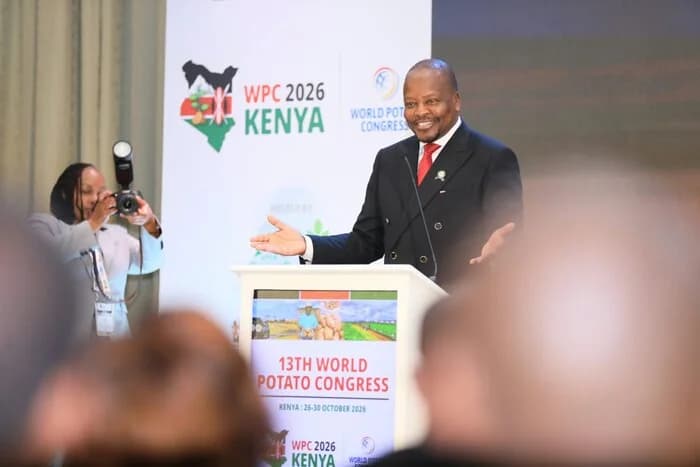
Agriculture Cabinet Secretary Mutahi Kagwe said the government is opening opportunities for investors to expand local production and replace imported potato products.
He spoke during the first-ever World Potato Congress in Sub-Saharan Africa, hosted by Kenya.
The five-day congress, running from October 26 to 30, has attracted 1,000 delegates from 67 countries, exceeding the initial target of 600 participants from 60 countries.
Kagwe urged investors to take advantage of the government’s Land Commercialisation Initiative, which leases idle public land to private investors on a long-term basis for agricultural production.
The initiative is expected to unlock land for commercial farming while encouraging investment in irrigation, technology and value addition to strengthen Kenya’s potato value chain.
Latest Stories
“This is an opportunity to substitute imports,” CS Kagwe said.
The government is also seeking to build stronger links between farmers and processors, hotels, restaurants and fast-food businesses to expand the market for locally produced potatoes and processed products.
The strategy aims to retain more earnings within the domestic economy, create jobs and strengthen Kenya’s capacity to export quality potato products.
Additionally, Kagwe said improving farmers’ incomes and productivity must remain central to efforts to expand the sector.
“A food secure, healthier, prosperous farmer is also, in my considered view, a prerequisite for a safer, stable and productive society.”
The investment drive comes as potato production faces mounting pressure from unpredictable weather and crop diseases.
According to the Kenya National Bureau of Statistics’ National Agriculture Production Report 2025, the country produced approximately 2.2 million tonnes of potatoes in 2024, valued at Sh72.5 billion.
This was down from about 2.3 million tonnes in 2023, following weather disruptions that contributed to fungal diseases, including potato blight.
To address the production challenges, the government is prioritising access to quality seed, disease management, climate-smart farming and reduced post-harvest losses.
Research by the Kenya Agricultural and Livestock Research Organisation (KALRO) and the International Potato Centre is also targeting late blight through a biotech potato developed using the popular Shangi variety.
Kagwe said the variety, developed by introducing three resistance genes into Shangi, had demonstrated complete resistance to late blight in field trials, potentially reducing the need for fungicide spraying.
Another variety, Clone IG-70, developed through KALRO’s Potato Research Centre in Tigoni, is progressing towards final verification, with drought and blight tolerance among its attributes.
The government is also pursuing a broader irrigation programme involving 50 mega dams, 200 medium-sized dams and 1,000 water pans and reservoirs to reduce dependence on rainfall.
The congress provides Kenya with a platform to attract partnerships in research, seed production, mechanisation, storage and processing, as it seeks to turn the potato sector’s supply deficit into an opportunity for farmers and investors.


Comments
No comments yet. Be the first to share your thoughts.