
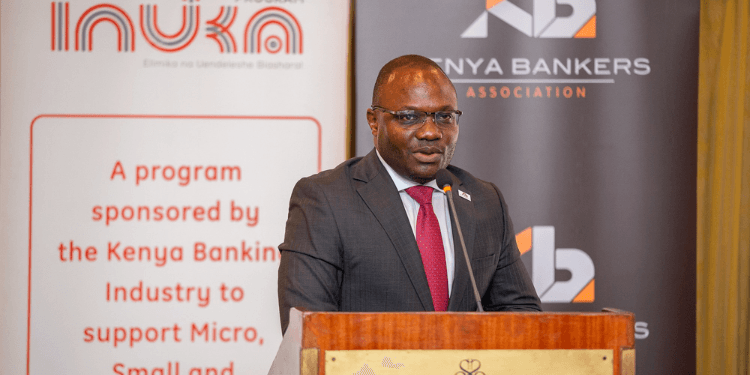
The Kenya Bankers Association (KBA) has urged the Central Bank of Kenya (CBK) to retain the Central Bank Rate (CBR) at 8.75 percent when the Monetary Policy Committee (MPC) meets on Tuesday, August 11.
In its latest research note, KBA Centre for Research on Financial Markets and Policy said the current policy rate remains appropriate, pointing to stable inflation, steady economic growth, a recovery in private sector lending and continued stability of the Kenya shilling.
“With inflation currently anchored within the target range and minimal threats to its escalation in the near term, as well as sustained exchange rate stability, we view that maintaining the current stance of monetary policy in keeping the CBR unchanged at 8.75% would be appropriate to support private sector credit growth and strengthen economic activity,” KBA noted.
At its June Monetary Policy meeting, the CBK retained its benchmark lending rate at 8.75 percent for the second consecutive meeting, saying inflation remained within the target range and did not warrant tighter monetary policy.
The MPC is expected to announce its decision after the meeting.
Why Kenya Bankers Want CBK to Maintain 8.75% CBR Rate
Inflation Within Target
The Centre said inflation has remained within the CBK‘s target range of 2.5 percent to 7.5 percent, giving policymakers room to keep the benchmark lending rate unchanged.
It noted that inflationary pressures have remained contained despite external uncertainties, helping maintain price stability.
The researchers said leaving the policy rate unchanged would support the gains already made through previous monetary policy decisions.
Kenya’s inflation climbed to 6.5 percent in July 2026, according to the latest Kenya National Bureau of Statistics (KNBS) Consumer Price Index (CPI) and Inflation Report.
The report released on Friday, July 31, shows that the overall Consumer Price Index (CPI) increased from 154.91 in June 2026 to 155.20 in July 2026, translating to a monthly inflation rate of 0.2 percent.
On a year-on-year basis, inflation stood at 6.5 percent in July 2026, meaning the general price level was 6.5 percent higher compared to July 2025.
KNBS data shows that the increase was largely driven by higher prices in key household expenditure categories, with transport, food and non-alcoholic beverages, and housing, water, electricity, gas and other fuels recording some of the biggest increases.
Private Sector Credit Recovering
The report showed that lending to the private sector has continued to improve following earlier reductions in the Central Bank Rate.
It noted that keeping the rate at 8.75 percent would allow the recovery in credit growth to continue while avoiding unnecessary changes in borrowing conditions for businesses and households.
According to the Centre, maintaining the current rate would also support economic activity without creating additional inflationary pressure.
Stable Shilling Supports Decision
The researchers also cited the stability of the Kenya shilling as another reason to maintain the current policy stance.
They said strong foreign exchange reserves have helped cushion the local currency against external shocks, reducing pressure for further policy adjustments.
Despite recommending that the policy rate remain unchanged, the Centre warned that the CBK should continue monitoring developments in the global economy.
It identified geopolitical tensions, weaker global demand and widening fiscal deficits among the risks that could affect Kenya’s economic outlook.
MPC Decision Due Next Week
The Monetary Policy Committee will meet on August 11, 2026, to review recent developments in the economy and determine whether to maintain, increase or reduce the Central Bank Rate.
The committee’s decision will influence commercial lending rates, borrowing costs for businesses and households, and the country’s broader monetary policy direction.
What Is the Central Bank Rate?
The Central Bank Rate is the interest rate the Central Bank of Kenya charges commercial banks when lending to them. It serves as the benchmark for the country’s monetary policy and influences the cost of borrowing across the economy.
The rate is reviewed and announced by the Monetary Policy Committee at least once every two months. Any increase or reduction in the CBR signals the direction of the Central Bank’s monetary policy and guides its market operations.
The CBR also determines the rates the Central Bank uses when injecting or withdrawing money from the banking system.
When providing liquidity to banks through reverse repurchase agreements (Reverse Repos), the CBR is the minimum rate it will accept.
However, when mopping up excess liquidity through vertical repurchase agreements (Vertical Repos), it is the highest rate the CBK will pay.
Changes in the CBR often influence commercial banks’ lending rates, affecting the cost of loans for businesses and households as well as overall economic activity.
Follow our WhatsApp Channel and X Account for real-time news updates.



Comments
No comments yet. Be the first to share your thoughts.