
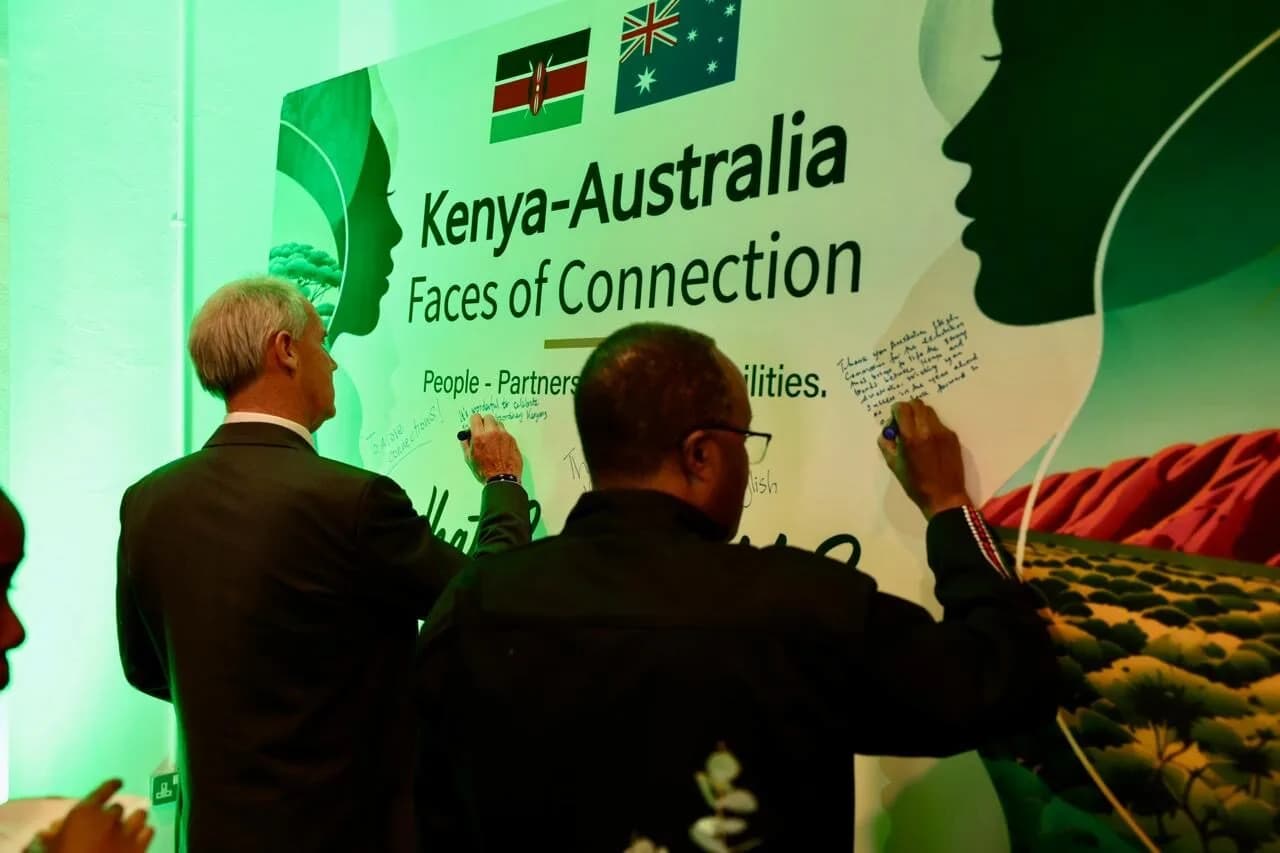
NAIROBI, Kenya, Oct 31 – Kenya has called on its citizens living abroad to direct more of their remittances towards investments back home as the country seeks to strengthen economic and people-to-people ties with Australia.
Speaking during the opening of the Kenya-Australia: Faces of Connection photo exhibition at Nairobi, Ambassador Isaiya Kabira, Kenya’s Secretary for Diaspora Investments, Skills and Entrepreneurship at the State Department for Diaspora Affairs, highlighted the role of diaspora earnings in supporting the country’s economy and encouraged Kenyans overseas to contribute more to national development through investment.
Ambassador Kabira said: “And we all know what remittances are doing for our country, today the earnings that we get from Kenyans in the diaspora are now in the tune of about 7 billion dollars.”
Kabira said about 80 per cent of remittances were being used for consumption, while only 20 per cent went towards investments. He urged Kenyans living overseas, including those in Australia, to consider investing more of their earnings in Kenya while continuing to support their families and building their lives abroad.
His remarks come against the backdrop of growing diaspora remittances, which remain an important source of foreign exchange for Kenya. According to the Central Bank of Kenya (CBK), remittances received through formal channels reached approximately $5.04 billion in 2025, compared to $4.95 billion in 2024.
The 2025 Remittances Household Survey, conducted by the Kenya National Bureau of Statistics (KNBS), CBK and Financial Sector Deepening Kenya, recorded Sh931.8 billion in remittances received by Kenyan households between June 2024 and May 2025. Unlike the CBK’s regular figures, the survey also covered informal transfers and non-cash remittances, providing a broader measure of the money and goods received from abroad.
The survey identified Australia among the major sources of remittances to Kenyan households, ranking behind the United States and Germany.
Kabira, who previously served as Kenya’s High Commissioner to Australia, said relations between the two countries had expanded through trade, tourism, agriculture, health, mining and security. He noted that the exhibition reflected how exchanges between Kenyans and Australians had contributed to cooperation in these sectors.
He also acknowledged the contribution of Kenyans working in Australia’s health and disability support sectors, particularly through the National Disability Insurance Scheme (NDIS), saying their participation demonstrated the opportunities available to Kenyan professionals abroad.
Kabira further renewed calls for the establishment of direct flights between Kenya and Australia, saying a Nairobi-Perth route could reduce travel time and improve connectivity between the two countries.
He said the proposal had been presented to Kenya Airways over the years, expressing hope that it would receive further consideration as trade, tourism and movement of people between the two countries continued to develop.
Australian Chargé d’Affaires to Kenya Andrew Barnes said the exhibition was intended to highlight the personal connections that have contributed to relations between Kenya and Australia beyond formal diplomatic engagements.
“International relations can be surprisingly personal. Governments provide the framework, but relationships between countries grow through the people that bring them to life: through the friendships they form, the ideas they exchange and the opportunities they create,” Barnes said.
He said the exhibition, held under the theme People. Partnerships. Possibilities., brings together photographs and personal accounts of Kenyans and Australians whose experiences have contributed to education, business, culture, tourism and other areas of cooperation.
Among those featured is Kenyan medical practitioner Dr Florentius Koech, who undertook specialist neurosurgery training in Melbourne before returning to Kenya and establishing a specialist brain and spine hospital in Eldoret.
The exhibition also features Kenyan-born musician Elsy Wameyo, who grew up in Adelaide, Australia, and has built a music career influenced by her experiences in both countries.
Barnes said such experiences demonstrated how education, professional opportunities and personal relationships could contribute to cooperation between the two countries.
The exhibition comes as Kenya and Australia continue to explore opportunities for deeper cooperation in trade, investment and other sectors following the 60th anniversary of their diplomatic relations in 2025.
During the anniversary engagements in October 2025, Foreign Affairs Principal Secretary Korir Sing’Oei identified tourism, mining, innovation and sports among the areas in which Kenya was seeking increased Australian investment and cooperation. The two countries also expressed interest in strengthening maritime security cooperation.
Kabira also pointed to sporting exchanges as another example of the relationship between the two countries, citing Kenyan athlete Eliud Kipchoge’s victory at the Melbourne Marathon earlier this month.
Kipchoge won the October 11 race in two hours, nine minutes and ten seconds, setting a new event record.
The exhibition, organised by the Australian High Commission, features Kenyans who have studied or worked in Australia, those who have established careers there, and Australians whose professional and community activities have contributed to initiatives in Kenya.
The organisers say the exhibition is intended to encourage further exchanges and collaboration by showing how individual experiences have contributed to the relationship between the two countries.
Members of the public can visit the Kenya-Australia: Faces of Connection exhibition free of charge at Shah Houses in Ngara, Nairobi, from October 30 to November 1, 2026.


Comments
No comments yet. Be the first to share your thoughts.