
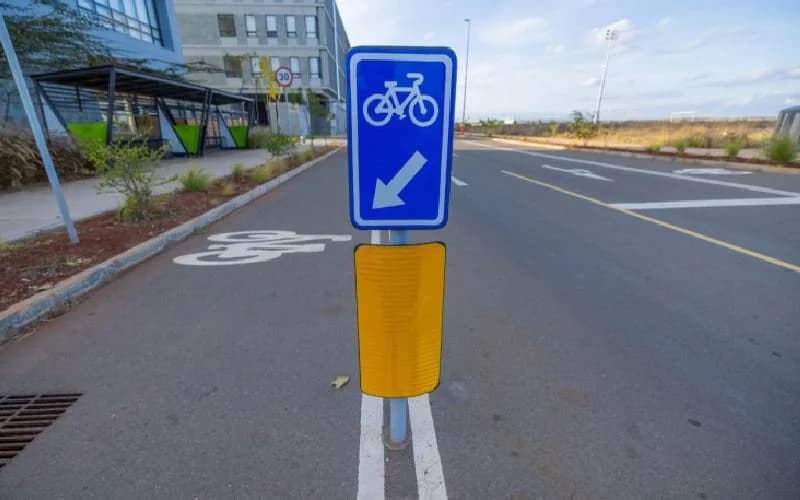
Konza Technopolis is taking shape as a city designed not only for businesses and technology but also for people seeking safer, easier and more sustainable ways to move around.
The 5,000-acre development is placing cycling, walking and electric transport at the centre of its urban planning, with dedicated cycle lanes, pedestrian walkways and a corridor for electric buses forming part of its transport network.
The aim is to make it easier for residents and workers to move around without relying entirely on private cars.
With more than 40 kilometres of internal roads, the city is designed to accommodate bicycles, electric bikes, electric vehicles and buses. Its master plan also seeks to ensure that everyday services and amenities are within a 15-minute walk, encouraging people to walk or cycle rather than drive short distances.
John Paul Okwiri, chief executive officer of the Technopolis Development Authority, said alternative transport had been considered from the early stages of planning.
“We are also looking at using electric vehicles, electric bikes. That is what has been encouraged from the planning of the city,” he said.
Okwiri said the roads include walking paths, cycling lanes and a mass transit corridor where electric buses will transport residents within the city.
The emphasis on cycling and walking comes as Kenya moves to improve road safety for people who do not use motorised transport.
The National Assembly has passed the Kenya Roads (Amendment) Bill, 2024, sponsored by Naisula Lesuuda as National Assembly Bill No. 31 of 2024. The proposed amendments to the Kenya Roads Act seek to make walking and cycling facilities a more integral part of road planning and construction.
Under the amendments, road agencies, including the Kenya National Highways Authority (KeNHA), Kenya Rural Roads Authority (KeRRA) and Kenya Urban Roads Authority (KURA), are expected to incorporate facilities such as pavements, pedestrian crossings and cycling lanes into roads under their management.
The Bill also seeks to provide clearer definitions of cycling lanes, pedestrian walkways and non-motorised vehicles.
The move recognises the millions of Kenyans who walk or cycle daily to reach workplaces, markets and other destinations. Providing dedicated spaces for these road users is expected to reduce their exposure to motorised traffic and improve safety.
At Konza, the transport network forms part of a broader plan to connect residential areas with commercial centres, educational institutions, technology facilities and industrial zones.
Brian Chage Mwaura, a quantity surveyor at the Technopolis Development Authority, said the road network had been designed around the different activities planned for the city.
“Our road network spans over 40 kilometres. That's including our main boulevard, automatic boulevard, which is now segmented into various sections where we'll have our commercial section at the front part of the development,” he said.
But the city's sustainability ambitions extend beyond how people travel.
Developers are required to ensure that buildings cover no more than 60 per cent of their allocated plots, leaving the remaining space for trees, landscaping and other green areas. Public parks and recreational spaces are also included in the master plan.
These measures are intended to create a city where development, environmental protection and the daily needs of residents are balanced.
As Konza expands its green transport network, it is also positioning itself as a hub for businesses that can operate around the clock.
The development has laid the groundwork for a 24-hour economy, with the government now seeking to attract private investors to establish businesses, factories and other facilities.
Okwiri said continuous operations would be important in supporting investors and ensuring that construction and business activities continue as the city grows.
“We are building Africa’s Silicon Savannah, so it means that we have to operate 24-7 in order to facilitate our investors, in order to ensure that the development of the technopolis continues until when we’ll be able to reach full build-out,” he said.
The development already has key infrastructure, including internal roads, electricity distribution facilities, solid-waste management systems and wastewater reclamation facilities.
The government has also designated specific uses for different parcels of land, providing a framework for investors to establish operations without having to start from scratch on basic infrastructure.
One of the major selling points is electricity supply.
Vincent Oyola, an engineer supporting the city's daily operations, said Konza had established a power distribution system that connects individual plots to the electricity network.
The facility includes a 66 kV sub-distribution station fitted with gas-insulated switchgear technology and transformers that reduce voltage for distribution across the city.
This means investors can connect their developments to an existing electricity network once they acquire land.
“So once an investor buys a parcel, it is plug-and-play,” Oyola said.
He added that Phase One had sufficient electricity capacity to meet its expected demand, with 56 distribution cabins serving the development.
“For Phase One, we have enough power to supply our load demand for the entire Phase One of Konza Technopolis,” he said.
Beyond physical infrastructure, Konza is building an ecosystem that brings together research, education, technology and business.
The National Data Centre, which has received Tier III certification from Uptime Institute, is operational and supports the government's digital transformation agenda.
The Kenya Advanced Institute of Science and Technology has also been completed and operationalised as a graduate-level research institution focusing on science, technology, engineering and mathematics.
The Open University of Kenya and Riara University are among the institutions operating from the Technopolis.
Their presence is expected to strengthen links between universities, government and industry, creating opportunities for research, innovation and the commercialisation of new ideas.
Manufacturing is also expected to play a major role in creating jobs and supporting the city's economic growth.
Investor Lucky DJX is establishing an export processing zone with factories initially targeting textiles and electronics. Planned production activities will also include solar products and accessories.
According to Okwiri, the investor intends to recruit up to 10,000 people.
The figure represents projected employment rather than jobs already created, but it points to the scale of the manufacturing ambitions attached to the development.
As businesses and institutions move into Konza, housing is another priority.
Okwiri said the city had a commitment for 10,000 housing units, with the first 1,000 expected to be ready by November 2026.
The housing programme is expected to support the growing population of workers, researchers, students and other residents who will live and work in the Technopolis.
The development's provision of parks, green spaces, walking paths and cycling lanes is also intended to ensure that the city remains accessible as its population increases.
For Okwiri, Konza's progress reflects a shift from the early stages of construction, when much of the work focused on preparing the land and installing underground infrastructure, towards building the facilities and businesses that will bring the city to life.
“You know, before you go up, you must go down when you are developing. So you go down first, you establish the foundation, and then now you start going up,” he said.
The next phase will therefore depend heavily on the ability to attract private investors and turn the infrastructure already in place into functioning businesses, employment opportunities and new industries.


Comments
No comments yet. Be the first to share your thoughts.